

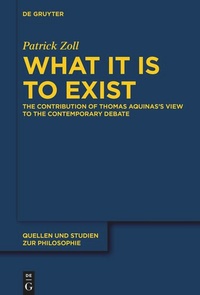
What It Is to Exist
Description

One important task of metaphysics is to answer the question of what it is for an object to exist. The first part of this book offers a systematic reconstruction and critique of contemporary views on existence. The upshot of this part is that the contemporary debate has reached an impasse because none of the considered views is able to formulate a satisfactory answer to this fundamental metaphysical question.
The second part reconstructs Thomas Aquinas's view on existence ( esse ) and argues that it contributes a new perspective which allows us to see why the contemporary debate has reached this impasse. It has come to this point because it has taken a premise for granted which Aquinas's view rejects, namely, that the existence of an object consists in something's having a property. A decisive contribution of Aquinas's theory of esse is that it makes use of the ideas of metaphysical participation and composition. In this way, it can be explained how an object can have esse without being the case that esse is a property of it.
This book brings together a reconstruction from the history of philosophy with a systematic study on existence and is therefore relevant for scholars interested in contemporary or medieval theories of existence.
Reviews / Votes
"What is being? This question is among the oldest and most perplexing metaphysical issues. Contemporary discussions of it are burgeoning, but there is a wide difference in attitudes towards it between philosophers in the analytic and the continental traditions. Through a careful analysis of the thought of Thomas Aquinas, this outstanding book clarifies and resolves some of the current controversies. Using the important new light his work sheds on Aquinas's foundational metaphysics, Patrick Zoll advances significantly the contemporary discussion of being. In consequence, he also succeeds in building an impressive bridge between analytic and continental approaches to this metaphysical question."
Eleonore Stump
, Robert J. Henle Professor of Philosophy, Saint Louis University
"The philosophical question of existence, or of what it is for things to exist, is nearly as old as the discipline of philosophy itself. However, the topic is addressed in new and intellectually rigorous ways in recent analytic philosophy. This excellent book argues convincingly that in this contemporary context, Aquinas' treatment of existence is of surprising relevance, decisive importance, and conceptual acuity. Aquinas rightly sees that existence cannot be either a nature (since existence is common to all natures) or a mere property. What it is, then, for things to exist? In a way that is at once clear and accessible as well as thorough and reasonable, Patrick Zoll explores this question in such a way as to cast great light on a contemporary debate, based on wisdom of the past, and a remarkable renewal of understanding of Aquinas for today."
Fr. Thomas Joseph White
, OP, Rector of the Pontifical University of St. Thomas (Angelicum), Rome
"Zoll provides a valuable, independent, and innovative research contribution to metaphysics. He asks the question - "what is it for that which exists to exist, i.e., what does the existence of an object consist in?" He canvasses five contemporary views and compares them to a Thomistic view, finding, in the end, that the ontological scorecard favors Thomism. Analytic metaphysicians and students of scholastic philosophy both have a great deal to learn from this important book."
Timothy J. Pawl
, Professor of Philosophy, University of St. Thomas
"Für analytisch geprägte Thomistinnen und Thomisten ist sie Pflichtlektüre. Es bleibt zu hoffen, dass sie auch unter
nicht-thomistischen Philosophinnen und Philosophen in der analytischen Diskussion rezipiert wird. Die Chancen
dafür sind gut, denn dem Verf. kommt das große Verdienst zu, dass er thomistische Sichtweisen in einer nicht-dogmatischen dogmatischen,
für die analytische Gegenwartsphilosophie nachvollziehbaren Weise erklärt und effektiv verteidigt." Åke Wahlberg in: Zeitschrift für Theologie und Philosophie, 2024, H. 2
More details
Other editions
Additional editions
Person
Patrick Zoll , Munich School of Philosophy, Munich.
Content
Part I: The Contemporary Debate About the Nature Question
1 The Non-Reductive-Object View
1.1 The Core Idea of the View
Let us begin with the non-reductive-objective view, which gives the most straightforward and simple answer to the nature question: the existence of an object consists in that object's having the property of existing. This view has a long tradition within Western philosophy and can be traced back to Anselm of Canterbury's famous ontological proof for the existence of God. More recently, versions of this view have been defended by authors such as Francisco Berto, Colin McGinn, or Barry Miller.1 What distinguishes this view from that of van Inwagen (dealt with in Chapter 2) is that it employs a non-reductive explanatory strategy. For an object to exist is to have the property of existing. Existence cannot be identified with and reduced to any other property an object has, e.?g., the property of being identical with itself, as van Inwagen claims.2
This view involves three claims: First, existence is a property of an object that exists. Second, existence is a property sui generis of an object that exists, i.?e., existence cannot be identified with and reduced to any other property of an object that exists. Finally, having the property of existence accounts for the existence of an object that exists. It is the conjunction of these three claims that I consider to be the core idea of the non-reductive-object approach.
Now, it is important to recall the limited scope of my book, the topic of which is the nature question, i.?e., the question of how different views explain what it is for an entity that exists to exist. I am not asking about different responses to the question, 'What does the non-existence of a non-existing object consist in?'. Among those who maintain that the existence of an object X consists in X's having the property of existing, there are different answers to questions such as, 'Are there objects which do not exist?' or 'If there are objects that do not exist, how can one make sense of their non-existence?'. Nevertheless, whatever their various answers, they share the common idea that for an object to exist is to have a property, namely, the property of existing. And it is this common idea which I will criticize in the following.
1.2 Three Problems
1.2.1 A Vicious Circularity
The first problem with the non-reductive-object view, i.?e., the view that the existence of an object X consists in X's having the property of existing, is that its answer to the nature question is circular. An object can have or possess the property of existing only if it exists. The assertion that for an object to exist is to have the property of existing does not explain, but rather presupposes, the existence of that object.
What is supposed to be explained is what it is for an object X that exists to exist. According to the non-reductive-object view, the statement that X has the property of existing should do the explanatory work. Now, the problem is that this idea is dependent on the existence of X. X can have the property of existing only if X exists. Something that does not exist cannot have or possess the property of existing. Having the property of existing presupposes a pre-existing subject of that property.
The problem becomes clear if we ask in more general terms what it is for an object to have a property. Frequently, an object's having a property is expressed in terms of instantiation.3 Properties are instantiated by objects while objects are never instantiated but only instantiate properties.4 Thus, for an object to have a property is to instantiate that property. In other words, the explanation of an object's having a property is that the property is instantiated by the object. If this general account of property possession is applied to the case of an object's having or possessing the property of existing, it follows that an object has the property of existing in virtue of instantiating the property of existence. Thus, the explanation of an object X's having the property of existing is that existence is instantiated by X.
Now we see the circularity: Existence can be instantiated by X only if X exists. Consequently, X's having the property of existing cannot explain the existence of X because X's having the property of existing presupposes the existence of X by which the property of existence is instantiated.5 It would be absurd to claim that existence can be instantiated by an object which does not have existence.6 But if the instantiation of the property of existence requires an object which has existence by which existence is instantiated, it follows that the view that the existence of an object X consists in X's having the property of existing is viciously circular. The view does not explain, but rather presupposes, what it is supposed to explain.
1.2.2 Existence Is Neither an Essential Nor an Accidental Property of an Object That Has It
The second problem with the view that the existence of an object X consists in X's having the property of existing concerns the nature of a property: If existence were a property of an object that exists, that existence would be either an essential or an accidental property of that object. But existence is neither an essential nor an accidental property of that object.
A more detailed formulation of the objection runs like this:7
-
The existence of an object X consists in X's having the property of existing.
-
Premise (1) implies that to exist is a property that determines its object.
-
If a property determines its object, it is either an essential property or it is an accidental property of that object.
-
Existence is not an accidental property of the object it determines.
-
Existence is not an essential property of the object it determines.
Therefore, existence is not a property that determines its object.
Let us go through the different steps of the argument to evaluate its soundness. That (2) is an implication of (1) should be obvious. The whole point of the non-reductive-object view is that an object's having the property of existing makes a difference to X. Having the property of existing is supposed to explain in virtue of what an object X exists. But X's having the property of existing can explain the existence of X only if existence as a property determines the object that has that property-namely, with respect to the object's existence. In other words, the property of existing determines its object as an existing object. Consequently, (2) is an implication of (1).
What about premise (3), which expresses a plausible view widely accepted by contemporary philosophers?8 As such, a challenge to its truth is not likely to succeed. This leaves us with premises (4) and (5). While contemporary philosophers largely agree that the distinction between essential and accidental properties of an object is both exclusive and exhaustive (3), they dispute how best to characterize that distinction.
To evaluate the truth of premises (4) and (5), I do not need to take a stand on which way is the best way to characterize the distinction. Rather, I will take one standard way of characterizing the distinction and show that, based on this account, existence is neither an essential nor an accidental property of an object that exists. I will assume at the outset that using an alternate way of characterizing the distinction between essential and accidental properties will yield the same result.9
With the help of modal terms, contemporary philosophers have standardized ways of characterizing the distinction between essential and accidental properties, as illustrated by the following:10
Basic modal characterization (BMC):
P is an essential property of an object o just in case it is necessary that o has P, whereas P is an accidental property of an object o just in case o has P but it is possible that o lacks P.
Possible world characterization (PWC):
P is an essential property of an object o just in case o has P in all possible worlds, whereas P is an accidental property of an object o just in case o has P but there is a possible world in which o lacks P.
...