

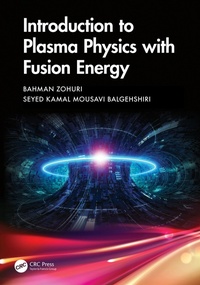
Introduction to Plasma Physics with Fusion Energy
1st Edition
Published on 31. March 2026
416 pages
978-1-040-58882-6 (ISBN)
Description

Scientists have been trying to replicate the same fusion reactions that drive stars on Earth since the beginning of the nuclear era. To create plasmas where light nuclei may overcome electrostatic repulsion and unleash enormous amounts of energy, hydrogen isotopes must be heated to hundreds of millions of degrees to achieve controlled nuclear fusion. There are now two primary approaches: Inertial Confinement Fusion (ICF), which uses intense lasers or particle beams to compress tiny fuel pellets to extremely high densities, and Magnetic Confinement Fusion (MCF), which was pioneered by devices like tokamaks and stellarators, which use strong magnetic fields to confine plasma. When combined, these strategies reflect humanity's most audacious quest for clean, practically endless energy.
This book provides a thorough analysis of both ICF and MCF systems, combining their experimental successes, theoretical underpinnings, and technology difficulties into one volume. It gives readers an unbiased, multidisciplinary perspective on the fusion industry by relating lab research to astrophysical processes and future power generation. This study emphasizes the complementarities, common challenges, and larger scientific and socioeconomic context that propels fusion research ahead, in contrast to previous texts that treat each approach independently.
Key features of this book include:
Clear explanations of the physics of plasma confinement, heating, and ignition in both MCF and ICF.
Coverage of landmark facilities worldwide, from ITER and stellarators to the National Ignition Facility (NIF).
Comparative analysis of confinement strategies, ignition schemes, and prospects for commercial viability.
Connections between fusion experiments, astrophysical phenomena, and national security applications.
A forward-looking assessment of research frontiers, emerging hybrid concepts, and pathways toward fusion power plants.
This book is a complete introduction and reference on controlled fusion, written for physics, engineering, and energy science professionals, researchers, and graduate students. In addition to offering readers both technical depth and useful insight into the endeavour to harness the power of the stars, it distinguishes itself by linking the two main fusion perspectives.
This book provides a thorough analysis of both ICF and MCF systems, combining their experimental successes, theoretical underpinnings, and technology difficulties into one volume. It gives readers an unbiased, multidisciplinary perspective on the fusion industry by relating lab research to astrophysical processes and future power generation. This study emphasizes the complementarities, common challenges, and larger scientific and socioeconomic context that propels fusion research ahead, in contrast to previous texts that treat each approach independently.
Key features of this book include:
Clear explanations of the physics of plasma confinement, heating, and ignition in both MCF and ICF.
Coverage of landmark facilities worldwide, from ITER and stellarators to the National Ignition Facility (NIF).
Comparative analysis of confinement strategies, ignition schemes, and prospects for commercial viability.
Connections between fusion experiments, astrophysical phenomena, and national security applications.
A forward-looking assessment of research frontiers, emerging hybrid concepts, and pathways toward fusion power plants.
This book is a complete introduction and reference on controlled fusion, written for physics, engineering, and energy science professionals, researchers, and graduate students. In addition to offering readers both technical depth and useful insight into the endeavour to harness the power of the stars, it distinguishes itself by linking the two main fusion perspectives.
More details
Edition
1. Auflage
Language
English
Place of publication
London
United Kingdom
Publishing group
Taylor & Francis Ltd
Target group
College/higher education
Illustrations
4 Tables, black and white; 24 Line drawings, color; 87 Line drawings, black and white; 131 Halftones, color; 18 Halftones, black and white; 155 Illustrations, color; 105 Illustrations, black and white
File size
39,95 MB
ISBN-13
978-1-040-58882-6 (9781040588826)
Copyright in bibliographic data and cover images is held by Nielsen Book Services Limited or by the publishers or by their respective licensors: all rights reserved.
Schweitzer Classification
Other editions
Additional editions
Bahman Zohuri | Seyed Kamal Mousavi Balgehshiri
Introduction to Plasma Physics with Fusion Energy
Book
approx. 03/2026
1st Edition
CRC Press
€285.50
Not yet published
Persons
Bahman Zohuri currently works for Galaxy Advanced Engineering, Inc., a consulting firm that he started in 1991 when he left both the semiconductor and defense industries after many years work- ing as a chief scientist. After graduating from the University of Illinois, USA, in the field of physics and applied mathematics, he went to the University of New Mexico, USA, where he studied nuclear engineering and mechanical engineering. He joined Westinghouse Electric Corporation, where he performed thermal hydraulic analysis and studied natural circulation in an inherent shutdown, heat removal system (ISHRS) in the core of a liquid metal fast breeder reactor (LMFBR) as a secondary fully inherent shutdown system for secondary loop heat exchange. All these designs were used in nuclear safety and reliability engineering for a self-actuated shutdown system. He designed a mercury heat pipe and electromagnetic pumps for large pool concepts of an LMFBR for heat rejection purposes for this reactor around 1978, when he received a patent for it. He was subsequently transferred to the defense division of Westinghouse, where he oversaw dynamic analysis and methods of launching and controlling MX missiles from canisters. The results were applied to MX launch seal performance and muzzle blast phenomena analysis (i.e., missile vibration and hydrodynamic shock formation). He was also involved in analytical calculations and computations in the study of non-linear ion waves in rarefying plasma. The results were applied to the propagation of so-called soliton waves and the resulting charge collector traces in the rarefaction characterization of the corona of laser-irradiated target pellets. As part of his graduate research work at Argonne National Laboratory, he performed computations and programming of multi-exchange integrals in surface physics and solid state physics. He earned various patents in areas such as diffusion processes and diffusion furnace design while working as a senior process engineer at various semiconductor companies, such as Intel Corp., Varian Medical Systems, and National Semiconductor Corporation. He later joined Lockheed Martin Missile and Aerospace Corporation as Senior Chief Scientist and oversaw the research and development (R&D) and the study of the vulnerability, survivability, and both radiation and laser hardening of different components of the Strategic Defense Initiative, known as Star Wars.
This included payloads (i.e., IR sensor) for the Defense Support Program, the Boost Surveillance and Tracking System, and Space Surveillance and Tracking Satellite against laser and nuclear threats. While at Lockheed Martin, he also performed analyses of laser beam characteristics and nuclear radiation interactions with materials, transient radiation effects in electronics, electromagnetic pulses, system-generated electromagnetic pulses, single-event upset, blast, thermomechanical, hardness assurance, maintenance, and device technology.
He spent several years as a consultant at Galaxy Advanced Engineering serving Sandia National Laboratories, where he supported the development of operational hazard assessments for the Air Force Safety Center in collaboration with other researchers and third parties. Ultimately, the results were included in Air Force Instructions issued specifically for directed energy weapons operational safety. He completed the first version of a comprehensive library of detailed laser tools for airborne lasers, advanced tactical lasers, tactical high-energy lasers, and mobile/tactical high-energy lasers, for example.
He also oversaw SDI computer programs, in connection with Battle Management C3I and artificial intelligence, and autonomous systems. He is the author of several publications and holds several patents, such as for a laser-activated radioactive decay and results of a through-bulkhead initiator. He has published the following works: Heat Pipe Design and Technology: A Practical Approach; Dimensional Analysis and Self-Similarity Methods for Engineering and Scientists; High Energy Laser (HEL): Tomorrow's Weapon in Directed Energy Weapons Volume I; and recently a book on the subject of Directed Energy Weapons and Physics of High Energy Laser. He has published other books, including Thermodynamics in Nuclear Power Plant Systems and Thermal-Hydraulic Analysis of Nuclear Reactors.
Seyed Kamal Mousavi Balgehshiri is a PhD researcher focused on the design and development of a Test Blanket Module (TBM) for burning Minor Actinides (MA) and nuclear waste while producing Tritium in the RFP-TOKAMAK at the University of Genova. He also conducts strategic studies on nuclear energy programs, reviewing global progress in advanced nuclear reactor development, energy planning, and modelling. With different countries pursuing diverse strategies to ensure energy security, meet climate goals, and transition to net-zero emissions, he notes that today's short-term decisions will have long-term effects. Despite the changing landscape, energy security and effective strategy adoption for diversifying the energy portfolio remain key priorities for policymakers.
One of his main interests is strategic energy planning, particularly SWOT (Strengths, Weaknesses, Opportunities, and Threats) analysis in nuclear energy macroplanning. He believes that accurate situational analysis is critical for companies and organizations to develop strategies that achieve their goals.
He holds a BSc in chemical engineering from the University of Tabriz, Iran, where he focused on chemical analysis in laboratory settings. He later earned an MSc nuclear engineering, specializing in the nuclear fuel cycle and materials at Amirkabir University of Technology. During his MSc studies, he began researching advanced nuclear fuels, nuclear fuel cycles, and reactors.
He is also interested in research on nuclear fission reactors for space applications, particularly for powering equipment (kilowatt-class) in space. He recognizes the importance of nuclear energy for both spacecraft propulsion and providing power for equipment needed in space exploration, especially for missions beyond the solar system.
Another key area of his research focuses on the strategies of advanced nuclear countries in diversifying and securing nuclear fuel supplies based on the "reactor-fuel cycle" network. He emphasizes that choosing the best long-term strategy for a reliable nuclear fuel supply is essential for the development of nuclear energy. Additionally, his work includes Technology Readiness Assessment (TRA) for advanced nuclear fuels and Advanced Small Modular Reactors (ASMR). He highlights the importance of evaluating the Technology Readiness Level (TRL) and identifying Critical Technology Elements (CTEs) when introducing new technologies to determine a maturity plan.
This included payloads (i.e., IR sensor) for the Defense Support Program, the Boost Surveillance and Tracking System, and Space Surveillance and Tracking Satellite against laser and nuclear threats. While at Lockheed Martin, he also performed analyses of laser beam characteristics and nuclear radiation interactions with materials, transient radiation effects in electronics, electromagnetic pulses, system-generated electromagnetic pulses, single-event upset, blast, thermomechanical, hardness assurance, maintenance, and device technology.
He spent several years as a consultant at Galaxy Advanced Engineering serving Sandia National Laboratories, where he supported the development of operational hazard assessments for the Air Force Safety Center in collaboration with other researchers and third parties. Ultimately, the results were included in Air Force Instructions issued specifically for directed energy weapons operational safety. He completed the first version of a comprehensive library of detailed laser tools for airborne lasers, advanced tactical lasers, tactical high-energy lasers, and mobile/tactical high-energy lasers, for example.
He also oversaw SDI computer programs, in connection with Battle Management C3I and artificial intelligence, and autonomous systems. He is the author of several publications and holds several patents, such as for a laser-activated radioactive decay and results of a through-bulkhead initiator. He has published the following works: Heat Pipe Design and Technology: A Practical Approach; Dimensional Analysis and Self-Similarity Methods for Engineering and Scientists; High Energy Laser (HEL): Tomorrow's Weapon in Directed Energy Weapons Volume I; and recently a book on the subject of Directed Energy Weapons and Physics of High Energy Laser. He has published other books, including Thermodynamics in Nuclear Power Plant Systems and Thermal-Hydraulic Analysis of Nuclear Reactors.
Seyed Kamal Mousavi Balgehshiri is a PhD researcher focused on the design and development of a Test Blanket Module (TBM) for burning Minor Actinides (MA) and nuclear waste while producing Tritium in the RFP-TOKAMAK at the University of Genova. He also conducts strategic studies on nuclear energy programs, reviewing global progress in advanced nuclear reactor development, energy planning, and modelling. With different countries pursuing diverse strategies to ensure energy security, meet climate goals, and transition to net-zero emissions, he notes that today's short-term decisions will have long-term effects. Despite the changing landscape, energy security and effective strategy adoption for diversifying the energy portfolio remain key priorities for policymakers.
One of his main interests is strategic energy planning, particularly SWOT (Strengths, Weaknesses, Opportunities, and Threats) analysis in nuclear energy macroplanning. He believes that accurate situational analysis is critical for companies and organizations to develop strategies that achieve their goals.
He holds a BSc in chemical engineering from the University of Tabriz, Iran, where he focused on chemical analysis in laboratory settings. He later earned an MSc nuclear engineering, specializing in the nuclear fuel cycle and materials at Amirkabir University of Technology. During his MSc studies, he began researching advanced nuclear fuels, nuclear fuel cycles, and reactors.
He is also interested in research on nuclear fission reactors for space applications, particularly for powering equipment (kilowatt-class) in space. He recognizes the importance of nuclear energy for both spacecraft propulsion and providing power for equipment needed in space exploration, especially for missions beyond the solar system.
Another key area of his research focuses on the strategies of advanced nuclear countries in diversifying and securing nuclear fuel supplies based on the "reactor-fuel cycle" network. He emphasizes that choosing the best long-term strategy for a reliable nuclear fuel supply is essential for the development of nuclear energy. Additionally, his work includes Technology Readiness Assessment (TRA) for advanced nuclear fuels and Advanced Small Modular Reactors (ASMR). He highlights the importance of evaluating the Technology Readiness Level (TRL) and identifying Critical Technology Elements (CTEs) when introducing new technologies to determine a maturity plan.
Content
1. Foundation of Vector Analysis 2. Foundation of Electrostatics and Electromagnetic Theory 3. Principal of Plasm Physics 4. Controlled Thermonuclear Fusion Driving Confinement Systems 5. The Problem and Challenges of Controlled Fusion 6. Toroidal Magnetic Confinement 7. The Tokamak System 8. Magnetic Mirror System 9. Stellarator Magnetic Confinement Systems 10. Inertial confinement 11. Alternate Confinement Concepts 12. Nuclear Fusion Reactors Fuel Cycles 13. Fusion Confinement Related Safeties - Burning Plasma 14. Nuclear Fusion Energy Economics
