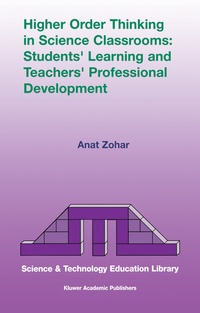
Higher Order Thinking in Science Classrooms: Students' Learning and Teachers' Professional Development
Description

How can educators bridge the gap between "big" ideas about teaching students to think and educational practice? This book addresses this question by a unique combination of theory, field experience and elaborate educational research. Its basic idea is to look at science instruction with regard to two sets of explicit goals: one set refers to teaching science concepts and the second set refers to teaching higher order thinking.
This book tells about how thinking can be taught not only in the rare and unique conditions that are so typical of affluent experimental educational projects but also in the less privileged but much more common conditions of educational practice that most schools have to endure. It provides empirical evidence showing that students from all academic levels actually improve their thinking and their scientific knowledge following the thinking curricula, and discusses specific means for teaching higher order thinking to students with low academic achievements. The second part of the book addresses issues that pertain to teachers' professional development and to their knowledge and beliefs regarding the teaching of higher order thinking.
This book is intended for a very large audience: researchers (including graduate students), curricular designers, practicing and pre-service teachers, college students, teacher educators and those interested in educational reform. Although the book is primarily about the development of thinking in science classrooms, most of it chapters may be of interest to educators from all disciplines.
More details
Other editions
Additional editions