

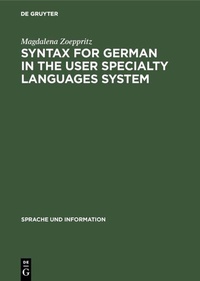
Syntax for German in the User Specialty Languages System
1st Edition
Published on 26. September 2013
X, 373 pages
978-3-11-155556-0 (ISBN)
Description

Keine ausführliche Beschreibung für "Syntax for German in the User Specialty Languages System" verfügbar.
More details
Other editions
Additional editions

Magdalena Zoeppritz
Syntax for German in the User Specialty Languages System
Book
01/1984
De Gruyter
€199.95
Article exhausted; check different version
Magdalena Zoeppritz
Syntax for German in the User Specialty Languages System
Book
01/1984
1st Edition
De Gruyter
€139.95
Shipment within 7-9 days
Content
- Intro
- 1 Introduction
- 2 In defense of syntax
- 3 The User Specialty Languages System
- 3.1 Properties of the system
- 3.2 Data structure and vocabulary definition
- 3.3 Analysis and Interpretation
- 3.4 Disambiguation in the interpretation process
- 3.5 Description of the answer or translation
- 3.6 Subject dependent and subject independent words
- 4 Preface to the grammar
- 4.1 History of the syntax and contributors to it
- 4.2 Coverage
- 4.3 Methodological considerations: Determining needed coverage
- 4.4 The parser: User Language Generator
- 4.5 Target structures
- 4.6 Strategy of the analysis
- 5 Concepts and notation
- 5.1 Notation
- 5.2 Concepts
- 5.3 Processor Extensions: IPE and FPE
- 5.4 Order of rule application
- 6 Symbols, categories and features defined for German
- 6.1 Primitives
- 6.2 Constructs
- 6.3 Features and their values
- 7 The grammar: Preliminary
- 8 System commands and strings
- 8.1 Nullstrings and STOP
- 8.2 System commands
- 8.3 Ordered rules, variable token
- 8.4 System nouns
- 9 Morphology
- 9.1 Affixes
- 9.2 Inflection of nouns and names
- 9.3 Inflection of nouns with adjective inflection
- 9.4 Inflection of adjectives
- 9.5 Inflection of verbs
- 9.6 Nouns with adjectives
- 9.7 Nouns with numeric quantifiers
- 9.8 Overview of features of NOMEN
- 10 Noun phrases (NP)
- 10.1 Interrogative pronouns
- 10.2 Nouns and names without article
- 10.3 Articles
- 10.4 Nouns with article
- 11 Sentence rules
- 11.1 Negation
- 11.2 Verb complex and sentence kernel rules: Overview
- 11.3 Verb complex and sentence kernel rules: Rules
- 11.4 Auxiliary verbs
- 11.5 Verbs with separable prefixes
- 12 Syntax for names
- 13 Genitive attributes
- 13.1 Genitive attributes following their head nouns
- 13.2 Genitive attributes preceding their head nouns
- 14 Appositions
- 15 Adjectives and comparatives
- 15.1 Comparative operators
- 15.2 Comparative phrases
- 15.3 Noun followed by comparative
- 15.4 Verb complex from VC:TYP=NN and adjective
- 15.5 Adjectives with complements
- 15.6 Quantifier modifiers and comparatives
- 16 Prepositional phrase syntax
- 16.1 Prepositions
- 16.2 Prepositional phrases
- 16.3 Nouns with prepositional complements
- 16.4 Verbs with prepositional complements
- 17 Measure expressions
- 18 Syntax of locative?
- 18.1 Locative adverbs
- 18.2 Locative adverbials
- 18.3 Nouns with locative complements
- 18.4 Verbs with locative complements
- 19 Syntax of temporals
- 19.1 Dates
- 19.2 Temporal adverbs and names
- 19.3 Temporal adverbials
- 19.4 Nouns with temporal complements
- 19.5 erbs with temporal complements
- 19.6 Points left open
- 20 Relative clause syntax
- 20.1 Relative pronouns
- 20.2 Sentences with main verb final word order
- 20.3 Participial phrases
- 20.4 Nouns modified by relative clauses
- 20.5 Extraposition
- 21 Arithmetic
- Arithmetic operators
- Numbers from noun phrases
- Arithmetic expressions
- Nounphrases from numbers
- Variable definition
- Set operations
- Arguments for set operations
- Functions
- Simple numerals
- Compound numerals
- 22 Less common verb types
- 22.1 Verbs with genitive objects
- 22.2 Verbs with two accusatives
- 23 Coordination
- 23.1 Excursion: Interpretation of coordinated structures
- 23.2 Syntax of coordinated structures
- 23.3 Parallelism and balance from a structural point of view
- 23.4 Cordinating conjunctions
- 23.5 Coordination of adjectives
- 23.6 Coordination of nouns, numbers, and names
- 23.7 Coordination of noun phrases
- 23.8 Coordination of prepositional phrases and adverbials
- 23.9 Coordination of verbs and sentences
- 24 Subordination of clauses
- 25 Pronouns
- 25.1 Verbs with pronominal complements
- 26 Declarative sentences
- 27 Sentences with missing complements
- 27.1 Pattern of rules for sentences with missing complements
- 27.2 Remaining rules and examples:
- 28 Sentences in passive voice
- 28.1 Pattern of rules for passive voice
- 28.2 Rules and examples
- 29 Conclusion
- 30 References
- 31 Subject index
- 32 Index of names
