

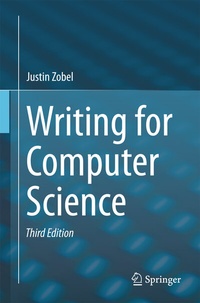
Writing for Computer Science
Description

All researchers need to write or speak about their work, and to have research that is worth presenting. Based on the author's decades of experience as a researcher and advisor, this third edition provides detailed guidance on writing and presentations and a comprehensive introduction to research methods, the how-to of being a successful scientist.
Topics include:
· Development of ideas into research questions;
· How to find, read, evaluate and referee other research;
· Design and evaluation of experiments and appropriate use of statistics;
· Ethics, the principles of science and examples of science gone wrong.
Much of the book is a step-by-step guide to effective communication, with advice on:
· Writing style and editing;
· Figures, graphs and tables;
· Mathematics and algorithms;
· Literature reviews and referees' reports;
· Structuring of arguments and results into papers and theses;
· Writing of other professional documents;
· Presentation of talks and posters.
Written in an accessible style and including handy checklists and exercises, Writing for Computer Science is not only an introduction to the doing and describing of research, but is a valuable reference for working scientists in the computing and mathematical sciences.
Reviews / Votes
"This is a comprehensive guide on research methods and how to produce a scientific publication detailing one's research in computer science . . a must-read for those doing research in CS and related fields. It will greatly benefit anyone who is involved in any kind of scientific research, as the examples are only from the CS field. Students, researchers, scientists, and other academicians involved in scientific research will improve both their research methods and writing by reading this book." (Alexis Leon, Computing Reviews, July, 2015)
More details
Other editions
Additional editions
Person
Justin Zobel is Head of the University of Melbourne's Department of Computing & Information Systems. He received his PhD from the University of Melbourne and for many years was based at RMIT University, where he led the Search Engine group. As a researcher, Professor Zobel is best known for his role in the development of algorithms for efficient web search. His current research areas include search, measurement and evaluation, bioinformatics, fundamental algorithms and data structures and compression. He is an author of around 200 papers, has written three texts on postgraduate study and research methods and is an associate editor of ACM Transactions on Information Systems, Information Processing & Management, and Information Retrieval.
Content
Preface.- Introduction.- Getting Started.- Reading and Reviewing.- Hypotheses, Questions and Evidence.- Writing a Paper.- Good Style.- Style Specifics.- Punctuation.- Mathematics.- Algorithms.- Graphs, Figures and Tables.- Other Professional Writing.- Editing.- Experimentation.- Statistical Principles.- Presentations.- Ethics.- Afterword.- Exercises.- Index.
