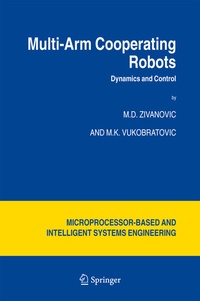
Multi-Arm Cooperating Robots
Description

Several consistent solutions for cooperative system control have recently been identified by the authors of the current monograph. This was achieved by solving three separate tasks that are essential for solving the problem of cooperative manipulation as a whole. The first task is related to the understanding of the physical nature of cooperative manipulation and finding a way for a sufficiently exact characterization of cooperative system statics, kinematics and dynamics. After successfully completing this task, in the frame of the second task, the problem of coordinated motion of the cooperative system is solved. Finally, as a solution to the third task, the control laws of cooperative manipulation are synthesized.
The starting point in dealing with the above three tasks of cooperative manipulation was the assumption that the problem of force uncertainty in cooperative manipulation can be resolved by introducing elastic properties into the cooperative system, at least in the part where force uncertainty appears. In static and dynamic analysis of the elastic structure of cooperative systems the finite element method is applied. In contrast to the procedure used in the major part of the available literature where deformation work is expressed by deviations from the unloaded state of fixed elastic structure, in this monograph the deformation work is expressed by internal forces as a function of the absolute coordinates of contacts of mobile elastic structure. Coordinated motion and control in cooperative manipulation are solved as the problem of coordinated motion and control of a mobile elastic structure, taking into account the specific features of cooperative manipulation. Coordinated motion and control laws in cooperative manipulation are synthesized on the basis of a non-linear model where the problem of uncertainty is solved, which is not the case in the available literature. Simple examples demonstrate the consistent procedure of mathematical modeling and synthesis of nominal coordinated motion, as well as control of the cooperative system.
This book will be useful to a wide audience of engineers, ranging from undergraduate and graduate students, new and advanced academic researchers, to practitioners (mechanical and electrical engineers, computer and system scientists). It is intended for readers whose work involves manufacturing, industrial, robotics, automation, computer and control engineering, and who wish to find out about this important new technology and its potential advantages for control engineering applications.
More details
Other editions
Additional editions