

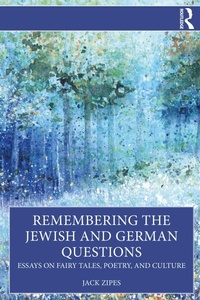
Remembering the Jewish and German Questions
Essays on Fairy Tales, Poetry, and Culture
1st Edition
Published on 24. March 2025
146 pages
978-1-040-29566-3 (ISBN)
Description

Remembering the Jewish and German Questions: Essays on Fairy Tales, Poetry, and Culture is a selection of Jack Zipes's insightful essays and presentations on fairy tales, Jewish studies, philosophy, drama, and the German public sphere.
The collection begins by considering how fairy tales have been shaped by societies, and how they have influenced society in turn. Zipes considers the history of the Grimms' fairy tales and their popularity and spread - comparing them to an epidemic. The second chapter champions the work and significance of the great philosopher Ernst Bloch, with substantial engagement with the essay collection Not Yet: Reconsidering Ernst Bloch (Daniel and Moylan 1997). Chapter 3 probes into the way society makes sense of the world through fairy tales and fantasy. In Chapter 4, Zipes explores the shift and reemergence of Jewish culture in Germany in the 1990s. He turns to the work of Gilles Deleuze and Felix Guattari to offer insight into the usefulness of a "minor literature" for grasping the impact of Jewish culture as a minor culture in Germany. The next chapter provides a fascinating case study of Hungarian writer and theater director George Tabori's relationship to the Jewish Question through examination of his plays from 1968 to 1996. Chapter 6 looks to the fall of the Berlin Wall and the unification of Germany in 1990, and questions around Jewish and German relationships in the public sphere. The final chapter offers detailed examination of Theodor Adorno's essay "Cultural Criticism and Society" (1951) and remembers forgotten poets who wrote remarkable poems in defiance of the barbarism of World War 2.
This interdisciplinary, transnational, and crosscultural collection gathers essays and presentations from Jack Zipes's captivating oeuvre published or presented across two decades. It provides a celebration of the work of this esteemed and field-defining literary scholar. It is an illuminating book intended for readers interested in fairy tale studies, poetry, drama, and Jewish studies.
The collection begins by considering how fairy tales have been shaped by societies, and how they have influenced society in turn. Zipes considers the history of the Grimms' fairy tales and their popularity and spread - comparing them to an epidemic. The second chapter champions the work and significance of the great philosopher Ernst Bloch, with substantial engagement with the essay collection Not Yet: Reconsidering Ernst Bloch (Daniel and Moylan 1997). Chapter 3 probes into the way society makes sense of the world through fairy tales and fantasy. In Chapter 4, Zipes explores the shift and reemergence of Jewish culture in Germany in the 1990s. He turns to the work of Gilles Deleuze and Felix Guattari to offer insight into the usefulness of a "minor literature" for grasping the impact of Jewish culture as a minor culture in Germany. The next chapter provides a fascinating case study of Hungarian writer and theater director George Tabori's relationship to the Jewish Question through examination of his plays from 1968 to 1996. Chapter 6 looks to the fall of the Berlin Wall and the unification of Germany in 1990, and questions around Jewish and German relationships in the public sphere. The final chapter offers detailed examination of Theodor Adorno's essay "Cultural Criticism and Society" (1951) and remembers forgotten poets who wrote remarkable poems in defiance of the barbarism of World War 2.
This interdisciplinary, transnational, and crosscultural collection gathers essays and presentations from Jack Zipes's captivating oeuvre published or presented across two decades. It provides a celebration of the work of this esteemed and field-defining literary scholar. It is an illuminating book intended for readers interested in fairy tale studies, poetry, drama, and Jewish studies.
More details
Edition
1. Auflage
Language
English
Place of publication
London
United Kingdom
Publishing group
Taylor & Francis Ltd
Target group
Professional and scholarly
College/higher education
ISBN-13
978-1-040-29566-3 (9781040295663)
Copyright in bibliographic data and cover images is held by Nielsen Book Services Limited or by the publishers or by their respective licensors: all rights reserved.
Schweitzer Classification
Other editions
Additional editions
Book
03/2025
1st Edition
Routledge
€63.00
Shipment within 10-20 days
Book
03/2025
1st Edition
Routledge
€207.00
Shipment within 10-20 days

Book
03/2025
Routledge
Unfortunately, price unknown
Available (delivery time upon request)
Person
Jack Zipes is Professor Emeritus of German and Comparative Literature at the University of Minnesota, USA. He is a founding father of the academic discipline of Fairy Tale. His books include Grimm Legacies: The Magic Power of Fairy Tales (2014) and The Sorcerer's Apprentice: An Anthology of Magical Tales (2017).
Content
Acknowledgements
Introduction
Chapter 1. Towards an Epidemiology of the Grimms' Fairy Tales
Chapter 2. Traces of Hope: The Nonsynchronicity of Ernst Bloch
Chapter 3. Why Fantasy Matters Too Much: The Delusion and Hope of the Fantastic
Chapter 4. The Contemporary German Fascination for Things Jewish: Toward a Jewish Minor Culture
Chapter 5. George Tabori and the Jewish Question
Chapter 6. Inclusion as Exclusion: Framing Jewish and German Questions in the Public Sphere
Chapter 7. On the Necessity of Writing Poetry and Stories after Auschwitz: A Reassessment of Adorno's Cultural Critique
Bibliography
Index
Introduction
Chapter 1. Towards an Epidemiology of the Grimms' Fairy Tales
Chapter 2. Traces of Hope: The Nonsynchronicity of Ernst Bloch
Chapter 3. Why Fantasy Matters Too Much: The Delusion and Hope of the Fantastic
Chapter 4. The Contemporary German Fascination for Things Jewish: Toward a Jewish Minor Culture
Chapter 5. George Tabori and the Jewish Question
Chapter 6. Inclusion as Exclusion: Framing Jewish and German Questions in the Public Sphere
Chapter 7. On the Necessity of Writing Poetry and Stories after Auschwitz: A Reassessment of Adorno's Cultural Critique
Bibliography
Index
