

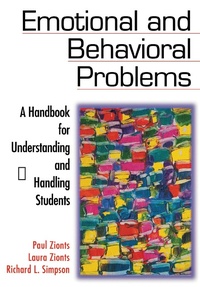
Emotional and Behavioral Problems
A Handbook for Understanding and Handling Students
Published on 10. May 2016
256 pages
978-1-63450-789-9 (ISBN)
Description

A guide to teaching students with emotional and behavioral problems.
More details
Other editions
Additional editions
Paul Zionts | Laura Zionts
Emotional and Behavioral Problems
A Handbook for Understanding and Handling Students
Book
05/2016
Skyhorse Publishing
€19.00
Shipment within 3-4 weeks
Persons
Paul Zionts is a professor of special education and Chairperson of the Department of Educational Foundations and Special Services at Kent State University. He has been a teacher in a reform school and an inner-city high school, a program director, consultant, and teacher trainer. He has lectured and provided training in local, state, and national events and has conducted hundreds of workshops that have included teachers, counselors, psycho logists, social workers, administrators, parents, secretaries, and bus drivers. He has authored Teaching Disturbed and Disturbing Students (2nd edition) and Inclusion Strategies for Students with Learning and Behavior Problems, and he has coauthored with Richard Simpson both Autism (2nd edition) and Understanding Children and Youth with Emotional and Behavioral Problems.Laura Zionts, PhD, is an assistant professor at Texas A&M University in the Department of Educational Psychology's Special Education, At-Risk and Bilingual Education program. She has worked with students who have emotional and behavioral disorders as a classroom teacher and a transition specialist. She has enjoyed teaching in both early elementary and secondary classrooms in mostly urban settings. Her primary area of research is the disproportionate representation of minority youth in programs for children and youth with behavioral disorders.Richard L. Simpson was Professor Emeritus at the University of Kansas.He was a member of the Department of Special Education faculty for over 40 years. While at the University of Kansas he directed numerous University of Kansas and University of Kansas Medical Center demonstration programs for students with autism spectrum disorders and other disabilities and coordinated a variety of federal grant programs related to students with autism spectrum disorders and other disabilities.He also worked as a special education teacher, school psychologist and coordinator of a community mental health outreach program.Rich authored numerous books, articles, and texts on a variety of topics connected to students with disabilities.Richwas the former senior editor of the professional journalFocus on Autism and Other Developmental Disabilities. His awards include the Council for Exceptional Children Research Award, Midwest Symposium for Leadership in Behavior Disorders Leadership Award, Autism Society of Kansas Leadership Award, and numerous University of Kansas awards and distinguished roles, including the Gene A. Budig Endowed Teaching Professorship of Special Education.
Content
- Intro
- Title Page
- Copyright
- Contents
- Preface
- Acknowledgments
- About the Authors
- Part One: Understanding Emotional and Behavioral Disorders
- 1. Introduction to Emotional Disturbance and Behavioral Disorders
- By Any Other Name: Emotional and Behavioral Disorders
- Possible Causes of Emotional Disturbance and Behavioral Disorders
- Incidence
- Serious Emotional Disturbance or Behavioral Disorders or EBD: What's the Difference?
- What Are Informal Labels?
- How Professionals View Labels
- Identification of EBD
- Behaviors That Fit Into Educational Stages
- Characteristics of Emotionally Disturbed or Behaviorally Disordered Children and Youth
- Summary
- 2. Major Types of Emotional and Behavioral Disorders
- Externalizing Behaviors
- Attention Deficit Hyperactivity Disorder (ADHD)
- Aggressive and Violent Behaviors
- Oppositional Defiant Disorder (ODD)
- Juvenile Delinquency
- Internalizing Behaviors
- Depression
- Anxiety Disorders
- Substance Abuse
- Withdrawn Behaviors
- Function Disorders
- Anorexia Nervosa
- Bulimia Nervosa
- Enuresis
- Encopresis
- Other Physical Manifestations of EBD
- Childhood Schizophrenia
- Summary
- 3. Causes of Emotional and Behavioral Disorders
- Understanding Factors Related to the Development of EBD
- Understanding Potential Causes of EBD
- Biological Causes of EBD
- Environmental Causes
- Family Stressors
- Variance Within Environmental Situations
- The Community
- Summary
- 4. Evaluating and Assessing Students Who Have Emotional and Behavioral Disorders
- The Purpose of Evaluation
- An Overview of EBD Evaluation
- Specific Aspects of the Evaluation Process as They Relate to EBD
- Screening and Child Find
- Referral for Special Education Evaluation
- Decisions About Eligibility
- Evaluation Techniques Used to Determine Eligibility
- Intellectual-Cognitive Ability
- Environmental-Ecological Assessment
- Medical and Physical Developmental History
- Emotional and Behavioral Functioning
- Decisions About Eligibility
- Summary
- 5. Violence and Aggression in Schools
- Violence and Aggression in the Schools
- The Roots of Violent and Aggressive Behaviors in Children and Adolescents
- Violence, Aggression, and EBD
- Responses to School Violence and Aggression
- A National Perspective
- A Local Perspective
- Reducing and Preventing Violence and Aggression in the Schools
- Early Intervention
- Student Connectedness
- Summary
- 6. Adolescents Who Have Emotional and Behavioral Disorders and the Juvenile Justice System
- Background Information on EBD and the Juvenile Justice System
- Perplexing Issues of Ethnicity, Mental Health, and Juvenile Justice in the United States
- Addressing Issues of Ethnicity and Bias in Juvenile Justice Agencies
- Addressing the Mental Health Needs of All Youth in the Juvenile Justice System
- Special Education and the Juvenile Justice System
- Funding of Educational Programs in Correctional Institutions
- Youth Who Have EBD, FERPA Rights, and the Juvenile Justice System
- Principles of IDEA in Correctional Facilities
- Juvenile Justice and Youth Who Have EBD: Intervention and Reintegration Strategies
- Effective Intervention Services and Strategies
- Effective Reintegration Services and Strategies
- Summary
- Part Two: Helping Students Who Have Emotional and Behavioral Disorders
- 7. Treatment of Emotional and Behavioral Disorders
- Behavior Modification
- Behavior Modification With Children and Adolescents
- Identifying, Defining, and Measuring a Behavior for Change
- Identifying Events That May Promote or Maintain a Problem Behavior
- Intervention Procedures and How They Are Used With Children and Adolescents
- Examples of Two Behavior Modification Programs
- Example 1. Positive Reinforcement
- Example 2. Punishment Program: Response Cost
- Schoolwide Discipline: Positive Behavioral Supports
- Counseling-Psychotherapy
- Counseling-Psychotherapy and Psychoanalysis
- The History and Theory of Psychoanalysis
- Counseling-Psychotherapy in Schools
- Cognitive Behavior Therapy
- School Implications for the Treatment of Behavior and Emotions
- Positive Behavioral Supports
- Keeping a Watchful Eye
- Summary
- 8. School-Based Placements
- After Identification
- Determining Appropriate Educational Goals
- The Least Restrictive Environment
- The Continuum of Services: Placement Options
- The General Education Classroom
- Part-Time Placement in the Special Education Classroom
- Full-Time Special Classroom
- Public or Private Special Day School
- Homebound Instruction
- Detention or Correction Facilities
- Mental Health Clinics
- An Important Caveat About Placements
- Possible Parental Reactions to Placement Options
- Changing Placements Because of Behavior
- A Few Words About Inclusion
- Summary
- 9. Supporting Students With Emotional and Behavioral Disorders Outside the Public School Setting
- Medications for Emotional and Behavioral Disorders: Psychopharmacology
- Guidelines for Medication Use With Children and Youth Who Have EBD
- Types of Medications Used, Side Effects, and Benefits
- Adolescent Medication Treatment Issues
- The Role of Psychiatric and Juvenile Justice Professionals on the IEP Team
- The Psychiatric Consultant
- Collaborative Efforts Between Mental Health Agencies and the Educational System
- Systems of Care
- Insurance, Managed Care, Medicare, and Systems of Care
- Cultural Competence and Systems of Care
- Systems of Care: Implementation Guidelines
- Summary
- 10. The Role of Families in Supporting Children With Emotional and Behavioral Concerns
- Parents as Referral Agents
- Contact With Medical Personnel
- Contact With Teachers
- Teachers as Referral Agents
- Parents as Advocates for Their Children With Emotional and Behavioral Concerns
- The Importance of Being a Support Agent
- Implementing Changes at Home
- Suggestions to Provide to Parents That Are Designed to Improve the Parent-Child Relationship
- Suggestions to Provide to Parents for Improving Communication Skills
- An Example of Supportive Communication From Parent to Child
- Exercises for Improving Communication
- Ideas to Improve Discipline Strategies at Home
- The Importance of Rules
- Methods of Addressing Individual Behavioral Problems
- Finding Ways to Relieve Stress
- Tips for Professionals Working With Parents of Children Who Have EBD
- Summary
- 11. What Lies Ahead: Postschool Transition
- Critical Concepts About EBD
- EBD Is a Disability
- Least Restrictive Environment Versus Inclusion
- Behavior Is a Shared Responsibility
- Postschool Success
- Transition Planning
- Transition: Law or Concept?
- Curriculum Considerations for School
- Individualized Transition Plans
- Planning Programs Around People, Not Schools
- Self-Advocacy, Self-Responsibility, Self-Direction, and Self-Awareness: The Essential Transition Elements
- Transition-Related Programming Specific to Youth Who Have EBD
- Mental Health for All
- Summary
- Resources for Professionals and Parents
- Resources in Print
- Internet Resources
- Clearinghouses
- Organizations
- Index
