

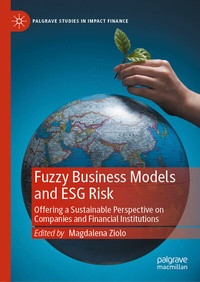
Fuzzy Business Models and ESG Risk
Description

This book discusses fuzzy business models and focuses on using fuzzy logic in business processes from the perspective of financial institutions when integrating ESG factors and risk. Developing and examining sustainable business models requires an appropriate methodology that would consider the specificity of business models because the measurement of this phenomenon is often based on values from specific ranges and requires a fuzzy approach. According to the law, regulations, and recommendations, financial institutions and businesses must incorporate Environmental Social Governance factors and ESG risk in their decision-making process. Sustainable financial institutions include ESG risk in their risk management system, strategies, and policies. As a result, they hope to mitigate ESG risk and create sustainable value in their business models with an impact on sustainable value creation. This book discusses this phenomenon in detail.
One of the first on the market toaddress the issue of fuzzy business models, the book also deals comprehensively with the fuzzy logic in modeling business processes, decision-making processes, and business models using examples from financial institutions, and will be of interest to researchers, professors, and students of sustainable finance, banking, and sustainable development alongside corporate sustainability.
More details
Other editions
Additional editions
Person
Magdalena Ziolo is Full Professor at University of Szczecin, Poland. Her research and teaching scope focus on finance, banking and sustainability. She has extensive experience gained in financial institutions. She has received scholarships from the Dekaban-Liddle Foundation (University of Glasgow, Scotland) and Impakt Asia Erasmus + (Ulan Bator, Mongolia). She is a Member of Polish Accreditation Commission, Member of the Financial Sciences Committee of PAS (the Polish Academy of Sciences), Member of the Advisory Scientific Committee of the Financial Ombudsman, Expert of the National Centre for Research and Development, Expert of the National Science Centre and the National Agency for Academic Exchange, Expert of the Accreditation Agency of Curacao. She was a member of State Quality Council, Kosovo Accreditation Agency and visiting professor of University of Prishtina (Kosovo). She is Principal Investigator in the research projects funded by National Science Center,Poland in the field sustainable finance. She is the author and editor of numerous books, mostly about financing sustainable development.
Content
Chapter 1: Introduction Magdalena Ziolo.- Chapter 2: Theoretical framework of sustainable business models Anna Spoz.- Chapter 3: Fuzzy logic concept Iwona Bak, Maciej Oesterreich .- Chapter 4: Fuzzy logic in finance Anna Spoz, Magdalena Ziolo.- Chapter 5: Fuzzy logic in business Beata Zofia Filipiak .- Chapter 6: Cooperation between financial institutions and companies - fuzzy business models Beata Zofia Filipiak, Magdalena Ziolo.- Chapter 7: Conclusion and recommendations Magdalena Ziolo.
