

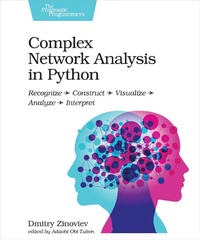
Complex Network Analysis in Python
Description

Construct, analyze, and visualize networks with networkx, a Python language module. Network analysis is a powerful tool you can apply to a multitude of datasets and situations. Discover how to work with all kinds of networks, including social, product, temporal, spatial, and semantic networks. Convert almost any real-world data into a complex network--such as recommendations on co-using cosmetic products, muddy hedge fund connections, and online friendships. Analyze and visualize the network, and make business decisions based on your analysis. If you're a curious Python programmer, a data scientist, or a CNA specialist interested in mechanizing mundane tasks, you'll increase your productivity exponentially.
Complex network analysis used to be done by hand or with non-programmable network analysis tools, but not anymore! You can now automate and program these tasks in Python. Complex networks are collections of connected items, words, concepts, or people. By exploring their structure and individual elements, we can learn about their meaning, evolution, and resilience.
Starting with simple networks, convert real-life and synthetic network graphs into networkx data structures. Look at more sophisticated networks and learn more powerful machinery to handle centrality calculation, blockmodeling, and clique and community detection. Get familiar with presentation-quality network visualization tools, both programmable and interactive--such as Gephi, a CNA explorer. Adapt the patterns from the case studies to your problems. Explore big networks with NetworKit, a high-performance networkx substitute. Each part in the book gives you an overview of a class of networks, includes a practical study of networkx functions and techniques, and concludes with case studies from various fields, including social networking, anthropology, marketing, and sports analytics.
Combine your CNA and Python programming skills to become a better network analyst, a more accomplished data scientist, and a more versatile programmer.
What You Need:
>=0.18), NumPy (>=1.10), matplotlib (>=1.5), networkx (>=1.11), python-louvain (>=0.5), NetworKit (>=3.6), and generalizesimilarity. We recommend using the Anaconda distribution that comes with all these modules, except for python-louvain, NetworKit, and generalizedsimilarity, and works on all major modern operating systems.
More details
Other editions
Additional editions
Person
Dmitry Zinoviev has graduate degrees in physics and computer science with a PhD from Stony Brook University. His research interests include computer simulation and modeling, network science, network analysis, and digital humanities. He has been teaching at Suffolk University in Boston, MA since 2001. He is the author of Data Science Essentials in Python.
