

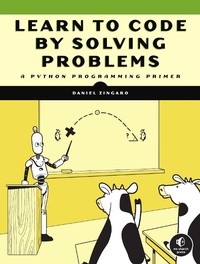
Learn to Code by Solving Problems
A Python Programming Primer
Published on 29. June 2021
336 pages
978-1-7185-0133-1 (ISBN)
Description

Learn to Program by Solving Problems is a practical introduction to programming using Python, one of the world's most popular programming languages. The book emphasizes problem-solving strategies that teach readers not only the mechanics of coding, but how to think like savvy programmers.
• Teaches readers how to use Python to solve short, situational problems (for example, how to predict when a gambler will run out of money while playing slot machines; how to create a program to track cell phone data usage; how to set up a system of identifying the popularity of berths in a parking lot)
• Each chapter requires the reader to learn a new feature or function of Python in order to solve a problem
• Emphasizes basic programming concepts, problem-solving strategies, and critical thinking skills that lay the groundwork for readers to think like good programmers
• Teaches readers how to use Python to solve short, situational problems (for example, how to predict when a gambler will run out of money while playing slot machines; how to create a program to track cell phone data usage; how to set up a system of identifying the popularity of berths in a parking lot)
• Each chapter requires the reader to learn a new feature or function of Python in order to solve a problem
• Emphasizes basic programming concepts, problem-solving strategies, and critical thinking skills that lay the groundwork for readers to think like good programmers
More details
Other editions
Additional editions
Book
06/2021
No Starch Press
€33.00
Available immediately
Person
Dr. Daniel Zingaro is an award-winning Associate Professor of Computer Science in the teaching stream at University of Toronto Mississauga, and is internationally recognized for his expertise in Active Learning. He is also the author of Algorithmic Thinking (No Starch Press, 2021).
Content
Acknowledgements
Introduction
Chapter 1: Getting Started
Chapter 2: Making Decisions
Chapter 3: Repeating Code: Definite Loops
Chapter 4: Repeating Code: Indefinite Loops
Chapter 5: Organizing Values Using Lists
Chapter 6: Designing Programs with Functions
Chapter 7: Reading and Writing Files
Chapter 8: Organizing Values Using Sets and Dictionaries
Chapter 9: Designing Algorithms with Complete Search
Chapter 10: Big O and Program Efficiency
Afterword
Introduction
Chapter 1: Getting Started
Chapter 2: Making Decisions
Chapter 3: Repeating Code: Definite Loops
Chapter 4: Repeating Code: Indefinite Loops
Chapter 5: Organizing Values Using Lists
Chapter 6: Designing Programs with Functions
Chapter 7: Reading and Writing Files
Chapter 8: Organizing Values Using Sets and Dictionaries
Chapter 9: Designing Algorithms with Complete Search
Chapter 10: Big O and Program Efficiency
Afterword
