

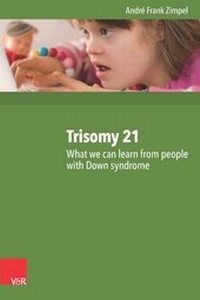
Trisomy 21
What we can learn from people with Down syndrome
1st Edition
Published on 11. July 2016
212 pages
978-3-647-70196-7 (ISBN)
Description

For a long time, it was assumed that a genetic disposition such as trisomy 21 enables predictions to be made about overall personality development. But, who could have ever imagined that people with trisomy 21 (Down syndrome) would also be capable of earning a university degree? We studied 1,294 people with trisomy 21. The results showed that people with trisomy 21 benefit more from abstract learning than their neurotypical counterparts. Two-year-olds with the syndrome first learn to read and only then to speak and will understand algebra better than arithmetic. Ignorance of neurodiversity inevitably leads to learning difficulties when these people are forced to learn at the same pace as others. This applies to autism and trisomy 21 to the same extent. That is why this book advocates the recognition of trisomy 21 as a variant in the spectrum of human neurodiversity.
More details
Edition
Aufl.
Language
English
Place of publication
Göttingen
Germany
Illustrations
With 87 Figures and 7 Tables. With contributions by Alfred Christoph Röhm, Kim Lena Hurtig-Bohn, Torben Rieckmann und Angela Kalmutzke
File size
4,02 MB
ISBN-13
978-3-647-70196-7 (9783647701967)
Schweitzer Classification
Other editions
Additional editions
Book
07/2016
1st Edition
Vandenhoeck & Ruprecht
€25.00
Shipment within 5-7 days
André Frank Zimpel
Trisomie 21 - Was wir von Menschen mit Down-Syndrom lernen können
2000 Personen und ihre neuropsychologischen Befunde
Book
02/2016
1st Edition
Vandenhoeck & Ruprecht
€25.00
Available immediately
Person
Content
- Cover
- Title Page
- Copyright
- Table of Contents
- Body
- Foreword
- I. Genes and society
- A silent cognitive revolution
- Well meant
- Mentally disabled, even before birth?
- Three times 21
- Has our society decided?
- Down's Heritage
- 47 chromosomes rather than 46
- Mutations
- Eugenics, compulsory sterilization and euthanasia
- Fear of low IQ
- Genetics and epigenetics
- A picture is worth a thousand words
- Summary
- II. The brain and intelligence
- Head size and intelligence tests
- IQ as gatekeeper
- Why being different is normal
- Am I stupid?
- Genes for brain growth or stress in early childhood?
- Brain growth and evolution
- Birdbrained geniuses
- The human brain is a social tool
- The brain as a learning tool
- Accelerating thinking through abstraction
- Mouse memory
- The seat of learning
- Memory is distributed across the brain
- Summary
- III. Neurotransmitters and neuroenhancement
- Enzymes: catalysts in the brain
- Acetylcholine and the fear of Alzheimer's
- Donepezil: doping for the brain
- How the brain neutralizes medication
- Dopamine: addictive stimulation
- Glutamate: more than just a matter of taste
- Memantine: hope for a learning pill
- GABA: inhibit inhibition
- Basmisanil: release the brakes in the brain
- Brain doping: cleverer by prescription?
- Neuroenhancement or essential drug?
- Summary
- IV. Neurodiversity and attention
- Serotonin, an endogenous antidepressant
- Oxytocin: cuddling depression away
- Norepinephrine: rock 'n' roll in the brain
- Humans are different and mice too
- Neurodiversity instead of neurodegeneration
- Removing the fear of aging
- Studying at university with trisomy 21?
- Learning from rabbis and nuns
- Segregation already begins with speech
- Empathy for neurodiversity
- Motor learning and the 21st chromosome
- Acetylcholine in the striate body
- Emotion and the 21st chromosome
- Short-term memory and the 21st chromosome
- Learning in sleep
- At the focal point of the stream of thoughts
- The bifurcation diagram: calculation and hypothesis
- Summary
- V. Attention and memory
- Navon figures
- The overall shape and details
- Dice-pip and interference images
- Abstraction means "draw away from ."
- The scope of attention
- The magical number four
- Measuring the scope of attention
- Memory and matching pairs
- Reveal the numbers in sequence
- Object permanence
- Observe and remember causalities
- Abstract thought in the pushchair
- Mouse and duck theater
- Supersigns and abstraction
- Summary
- VI. Imitation and motor learning | Alfred Christoph Röhm
- Juggling in a small attention window
- Auditory and haptic scope of attention
- Proprioception - endogenous perception
- Scope of attention for proprioception
- Body percussion
- Successful imitation depends on the number of micromotions
- Dialogic learning requires creativity
- Summary
- VII. Speech and thought | Kim Lena Hurtig-Bohn
- The window to a child's head
- The prefrontal cortex and private speech
- The development of private speech in childhood
- Private speech in pedagogy
- The zone of proximal development
- Private speech and trisomy 21
- Private speech in autism spectrum disorders
- Summary
- VIII. Cognitive development and mathematics | Torben Rieckmann
- Trisomy 21 and mathematics?
- Trisomy 21 and dyscalculia
- Clustering and supersigns
- The power of five
- Deliberately use teaching materials
- Appropriate visual aids
- Summary
- IX. Communication and emotion | Angela Kalmutzke
- It's great that you have a child with Down syndrome!
- Respect for the essence of and confidence in learning ability
- On life and death
- Late termination of pregnancy
- Opting for life
- The social matrix
- Behavioral problems today, personality disorders tomorrow?
- Promoting self-worth
- Summary
- Afterword
- Literature
