

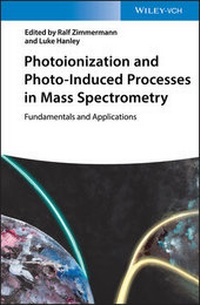
Photoionization and Photo-Induced Processes in Mass Spectrometry
Fundamentals and Applications
1st Edition
Published on 5. October 2020
VIII, 331 pages
978-3-527-68223-2 (ISBN)
Description

Provides comprehensive coverage of laser-induced ionization processes for mass spectrometry analysis
Drawing on the expertise of the leading academic and industrial research groups involved in the development of photoionization methods for mass spectrometry, this reference for analytical scientists covers both the theory and current applications of photo-induced ionization processes. It places widely used techniques such as MALDI side by side with more specialist approaches such as REMPI and RIMS, and discusses leading edge developments in ultrashort laser pulse desorption, to give readers a complete picture of the state of the technology.
Photoionization and Photo-Induced Processes in Mass Spectrometry: Fundamentals and Applications starts with a complete overview of the fundamentals of the technique, covering the basics of the gas phase ionization as well as those of laser desorption and ablation, pulse photoionization, and single particle ionization. Numerous application examples from different analytical fields are described that showcase the power and the wide scope of photo ionization in mass spectrometry.
-The first general reference book on photoionization techniques for mass spectrometry
-Examines technologies and applications of gas phase resonance-enhanced multiphoton ionization mass spectrometry (REMPI-MS) and gas phase resonance ionization mass spectrometry (RIMS)
-Provides complete coverage of popular techniques like MALDI
-Discusses the current and potential applications of each technology, focusing on process and environmental analysis
Photoionization and Photo-Induced Processes in Mass Spectrometry: Fundamentals and Applications is an excellent book for spectroscopists, analytical chemists, photochemists, physical chemists, and laser specialists.
Drawing on the expertise of the leading academic and industrial research groups involved in the development of photoionization methods for mass spectrometry, this reference for analytical scientists covers both the theory and current applications of photo-induced ionization processes. It places widely used techniques such as MALDI side by side with more specialist approaches such as REMPI and RIMS, and discusses leading edge developments in ultrashort laser pulse desorption, to give readers a complete picture of the state of the technology.
Photoionization and Photo-Induced Processes in Mass Spectrometry: Fundamentals and Applications starts with a complete overview of the fundamentals of the technique, covering the basics of the gas phase ionization as well as those of laser desorption and ablation, pulse photoionization, and single particle ionization. Numerous application examples from different analytical fields are described that showcase the power and the wide scope of photo ionization in mass spectrometry.
-The first general reference book on photoionization techniques for mass spectrometry
-Examines technologies and applications of gas phase resonance-enhanced multiphoton ionization mass spectrometry (REMPI-MS) and gas phase resonance ionization mass spectrometry (RIMS)
-Provides complete coverage of popular techniques like MALDI
-Discusses the current and potential applications of each technology, focusing on process and environmental analysis
Photoionization and Photo-Induced Processes in Mass Spectrometry: Fundamentals and Applications is an excellent book for spectroscopists, analytical chemists, photochemists, physical chemists, and laser specialists.
More details
Other editions
Additional editions
Ralf Zimmermann | Luke Hanley
Photoionization and Photo-Induced Processes in Mass Spectrometry
Fundamentals and Applications
Book
12/2020
1st Edition
Wiley-VCH
€165.00
Shipment within 5-7 days
Persons
Ralf Zimmermann, PhD, is full professor for Analytical Chemistry at Rostock University (Germany) and director of the joint mass spectrometry center of Rostock University and the Helmholtz Center Munich. His research interests include mass spectrometry instrumentation, the analysis of complex molecular system and biomedical analysis.
Luke Hanley, PhD, is full professor in the Chemistry department of the University of Illinois at Chicago (USA), and adjunct professor in the Bioengineering department. He received the NSF Young Investigator Award in Chemistry in 1994-1998 and was made a fellow of the American Vacuum Society in 2009.
Luke Hanley, PhD, is full professor in the Chemistry department of the University of Illinois at Chicago (USA), and adjunct professor in the Bioengineering department. He received the NSF Young Investigator Award in Chemistry in 1994-1998 and was made a fellow of the American Vacuum Society in 2009.
Content
Introduction
Fundamentals and Mechanisms of Vacuum Photoionization
Fundamentals and Mechanisms of Resonance-Enhanced Multiphoton Ionization (REMPI) in Vacuum and its Application in Molecular Spectroscopy
Analytical application of Single Photon Ionization Mass Spectrometry (SPI-MS)
Analytical application of Resonance-Enhanced Multi-Photon Ionization mass spectrometry (REMPI-MS)
Probing Chemistry at Vacuum Ultraviolet Synchrotron Light Sources
Resonance ionization mass spectrometry (RIMS): Fundamentals and applications including secondary neutral mass spectrometry
Ultrashort Pulse Photoionization for Femtosecond Laser Mass Spectrometry
Photoionization at elevated or atmospheric pressure: Applications of APPI and LPPI
Fundamentals of Laser Desorption Ionization
Applications of Laser Desorption Ionization and Laser Desorption/Ablation with Postionization
Laser Ionization in Single Particle Mass Spectrometry
Fundamentals and Mechanisms of Vacuum Photoionization
Fundamentals and Mechanisms of Resonance-Enhanced Multiphoton Ionization (REMPI) in Vacuum and its Application in Molecular Spectroscopy
Analytical application of Single Photon Ionization Mass Spectrometry (SPI-MS)
Analytical application of Resonance-Enhanced Multi-Photon Ionization mass spectrometry (REMPI-MS)
Probing Chemistry at Vacuum Ultraviolet Synchrotron Light Sources
Resonance ionization mass spectrometry (RIMS): Fundamentals and applications including secondary neutral mass spectrometry
Ultrashort Pulse Photoionization for Femtosecond Laser Mass Spectrometry
Photoionization at elevated or atmospheric pressure: Applications of APPI and LPPI
Fundamentals of Laser Desorption Ionization
Applications of Laser Desorption Ionization and Laser Desorption/Ablation with Postionization
Laser Ionization in Single Particle Mass Spectrometry
