

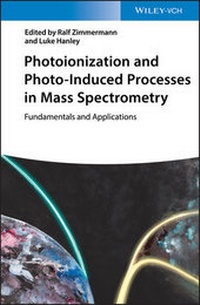
Photoionization and Photo-Induced Processes in Mass Spectrometry
Description

Drawing on the expertise of the leading academic and industrial research groups involved in the development of photoionization methods for mass spectrometry, this reference for analytical scientists covers both the theory and current applications of photo-induced ionization processes. It places widely used techniques such as MALDI side by side with more specialist approaches such as REMPI and RIMS, and discusses leading edge developments in ultrashort laser pulse desorption, to give readers a complete picture of the state of the technology.
Photoionization and Photo-Induced Processes in Mass Spectrometry: Fundamentals and Applications starts with a complete overview of the fundamentals of the technique, covering the basics of the gas phase ionization as well as those of laser desorption and ablation, pulse photoionization, and single particle ionization. Numerous application examples from different analytical fields are described that showcase the power and the wide scope of photo ionization in mass spectrometry.
-The first general reference book on photoionization techniques for mass spectrometry
-Examines technologies and applications of gas phase resonance-enhanced multiphoton ionization mass spectrometry (REMPI-MS) and gas phase resonance ionization mass spectrometry (RIMS)
-Provides complete coverage of popular techniques like MALDI
-Discusses the current and potential applications of each technology, focusing on process and environmental analysis
Photoionization and Photo-Induced Processes in Mass Spectrometry: Fundamentals and Applications is an excellent book for spectroscopists, analytical chemists, photochemists, physical chemists, and laser specialists.
More details
Other editions
Additional editions
Persons
Luke Hanley, PhD, is full professor in the Chemistry department of the University of Illinois at Chicago (USA), and adjunct professor in the Bioengineering department. He received the NSF Young Investigator Award in Chemistry in 1994-1998 and was made a fellow of the American Vacuum Society in 2009.
Content
Fundamentals and Mechanisms of Vacuum Photoionization
Fundamentals and Mechanisms of Resonance-Enhanced Multiphoton Ionization (REMPI) in Vacuum and its Application in Molecular Spectroscopy
Analytical application of Single Photon Ionization Mass Spectrometry (SPI-MS)
Analytical application of Resonance-Enhanced Multi-Photon Ionization mass spectrometry (REMPI-MS)
Probing Chemistry at Vacuum Ultraviolet Synchrotron Light Sources
Resonance ionization mass spectrometry (RIMS): Fundamentals and applications including secondary neutral mass spectrometry
Ultrashort Pulse Photoionization for Femtosecond Laser Mass Spectrometry
Photoionization at elevated or atmospheric pressure: Applications of APPI and LPPI
Fundamentals of Laser Desorption Ionization
Applications of Laser Desorption Ionization and Laser Desorption/Ablation with Postionization
Laser Ionization in Single Particle Mass Spectrometry
Preface
The goal of this book is to explain the fundamentals of photoionization (PI) and the associated applications of PI that are playing an increasingly important role in mass spectrometry (MS). The target audience of this book includes practicing scientists, including PhD and MSc students, whose primary interest is in the application of PI to elemental or molecular analysis by mass spectrometry. An overly simplistic analysis provides several motivations for the use of PI in mass spectrometry:
- 1. Enhance ion yields for specific important compounds of substance classes where other ionization strategies have proven insufficient,
- 2. Selectively ionize individual molecular structures or classes of molecules from mixtures,
- 3. Form ions from neutrals with reduced or controlled degree of fragmentation, and
- 4. Induce desorption or ablation of solids for sampling.
Photoionization comes in different versions and technological realizations, making it somewhat more complicated and thus less popular than standard ionization methods in mass spectrometry such as electrospray ionization and electron ionization. Nevertheless, one goal of this book is to demonstrate how these and other motivations drive the use of PI in MS-based analyses. The editors and authors hope that the readers will use this work as a series of building blocks for future advances in this promising area.
Actually, PI was central to the early development of mass spectrometry and single photon ionization (SPI) remains perhaps the best method for introducing a well-defined amount of internal energy into a molecular ion. Early work in SPI used vacuum ultraviolet (VUV) gas discharge lamps. However, the advent of lasers and the associated nonlinear optical methods made multiphoton ionization (MPI) possible, dramatically expanding PI as a fundamental strategy to probe molecular structure. The continuing improvement of laser technology has also created ongoing opportunities for MS-based applications of PI. For example, MPI via the excimer laser-pumped dye laser was deployed in many early fundamental studies, but was costly, difficult to use, and relatively unreliable. However, the development of smaller and rugged, field-deployable laser sources, such as compact excimer lasers, solid-state lasers as Nd:YAG lasers with integrated harmonic generation, and tunable solid-state lasers such as sealed, Nd:YAG-pumped optical parametric oscillators (OPOs) or Ti:sapphire cavities rendered MPI sufficiently robust for more widespread MS applications.
This interplay between fundamental methods and instrumental considerations has driven the development of analytical applications of PI, so attention is paid here to both considerations. Photodissociation is only discussed here when it occurs in conjunction with PI, such as via the formation of fragment ions from neutral precursors during MPI or SPI. Thus, the burgeoning use of photodissociation of the precursor or molecular ions to form fragment ions for structural elucidation of the former is not discussed here. The fundamentals and mechanisms of low pressure, gas-phase molecular PI for mass spectrometry is covered in Chapters 1, 2, 5, and 7, while molecular atmospheric pressure PI is a topic in Chapter 8. Applications and experimental methods of low-pressure, gas-phase photoionization mass spectrometry (PIMS) are presented in Chapters 3, 4, and 7. Elemental analysis by PI is covered exclusively in Chapter 5. Processes and applications that include a laser desorption (LD) or direct laser desorption/ionization (LDI) of analytes from the condensed phase are covered in Chapters 9 and 10, while Chapter 11 focuses on the direct analysis of individual aerosol particles using LDI, LD, and PI.
In the following, the content of the book is briefly highlighted chapterwise.
The first chapter entitled FUNDAMENTALS and MECHANISMS of VACUUM PHOTOIONIZATION, is serving as an introduction to mechanistic issues common to PI of molecules, atoms, and clusters under vacuum. It provides a fundamental description of light and the interaction of light and matter in the form of photoabsorption on a quantum mechanical level. This includes an excursion in perturbation theory and the dipole approximation and leads to an elucidation of the photon absorption selection rules. Finally, the SPI process, as an absorption in a continuum, nonbound state, is discussed and the most important parameters for SPI, the SPI cross sections and ionization energies, are deducted.
Fundamental aspects of MPI of molecules in the absence of gas-phase collisions are covered in the following chapter, entitled FUNDAMENTALS and MECHANISMS of RESONANCE-ENHANCED MULTIPHOTON IONIZATION (REMPI) in VACUUM and APPLICATION of REMPI for MOLECULAR SPECTROSCOPY (Chapter 2). Here, the theoretical consideration of photoionization processes is extended to MPI processes of molecular species and MPI-based spectroscopy, while multiphoton ionization of atoms is covered in Chapter 6. Different MPI and REMPI processes are presented and a rate equation approach is used to deduct the influence of molecular physical properties on ionization efficiency. Special REMPI schemes are discussed, which can bypass unfavorable photophysical properties. In the following, MPI-induced fragmentation and dissociation processes are discussed. The application of REMPI for molecular spectroscopy with and without supersonic jet cooling is demonstrated in an exemplary manner via a detailed discussion of the REMPI wavelength spectrum of supersonic jet-cooled biphenylene and some other interesting aromatic molecules. REMPI wavelength spectroscopy, in particular with supersonic jet cooling, reveals the selectivity of the REMPI process that connects high-resolution ultraviolet (UV) spectroscopy to mass spectrometry. The selective ionization of isomeric and isobaric compounds, however, can be extended to the differentiation of isotopomers and - by using a special REMPI technique with circular polarized laser light - even of enantiomers. Finally, in this chapter, REMPI-based photoelectron spectroscopic (PS) techniques such as zero kinetic energy photoelectron spectroscopic (ZEKE-PS) are introduced. The explanation of the fundamental aspects of SPI and REMPI leads to the analytical application of these two PI approaches.
In the beginning of Chapter 3, which is entitled "ANALYTICAL APPLICATIONS of SINGLE-PHOTON IONIZATION MASS SPECTROMETRY," a brief introduction into common VUV-light sources, is given. These can be distinguished as incoherent light sources ("lamp"-based technologies) or coherent light sources (lasers). Also, a brief introduction to the generation of synchrotron light in the VUV range is elaborated (for applications of synchrotron-based SPI, see Chapter 5). The general setup of SPI mass spectrometry systems with laser- and lamp-based sources is introduced. Depending on the used VUV wavelengths, SPI can be a very soft ionization method, enabling the detection of the molecular mass fingerprint of complex mixtures. This renders SPI-MS to an ideal approach for direct real time monitoring of complex gas and vapor mixtures. Different applications for online monitoring of combustion and pyrolysis processes are introduced, including online monitoring of gas phases from industrial processes, such as the coffee-roasting and/or the biomass pyrolysis process. Hyphenated instrumental analytical concepts, e.g. gas chromatography (GC) or thermal analysis (TA) coupled to SPI mass spectrometry, are presented and typical results are shown.
Chapter 4, "ANALYTICAL APPLICATION of RESONANCE-ENHANCED MULTIPHOTON IONIZATION MASS SPECTROMETRY (REMPI-MS)," gives, in a similar way as Chapter 3 for SPI, an overview of analytical applications of REMPI mass spectrometry. The preferential detection of aromatic analytes by the REMPI process with common laser is emphasized in Chapter 3. An overview on typical fixed-frequency laser lines (excimer lasers or frequency-multiplied, solid-state lasers) is provided along with typical wavelength ranges of tunable laser systems. In the following, several exemplary analytical concepts and applications using tunable and fixed-frequency lasers are presented. The tunable laser sources can be used to focus on specific analytes, which work particularly well with supersonic jet expansion inlet systems. For many applications, however, fixed-frequency wavelength laser and effusive, heated gas inlets can be applied for a useful and often very sensitive "overview" MS-profiling of many aromatic compounds. Exemplary process monitoring applications comprise detection of combustion by-products in flue gases of incineration plants or flavor and roast degree, indicating compounds in coffee-roasting off-gas. Hyphenated instruments connecting gas chromatography or a thermo-optical carbon analyzer (for aerosol loaded...
