

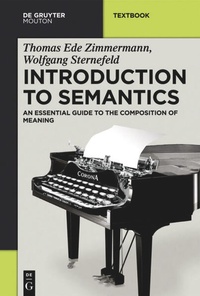
Introduction to Semantics
Description

This textbook helps undergraduate students of language and linguistics taking their first steps in one of the core areas of grammar, introducing them to the basic ideas, insights, and techniques of contemporary semantic theory. Requiring no special background knowledge, the book starts with everyday observations about word meaning and use and then hightlights the role of structure in the analysis of the meanings of phrases and clauses, zooming in on the fascinating and vexing question of how speakers manage to meaningfully communicate with sentences and texts they have never come across before. At the same time, the reader becomes acquainted with the modern, functionalist characterization of linguistic meaning in terms of reference (extension) and information (intension), and learns to apply technical tools from formal logic to analyzing the meaning of complex linguistic expressions as being composed by the meanings of their parts. Each of the nine main chapters contains a variety of exercises for self-study and classroom use, with model solutions in the appendix. Extensive English examples provide ample illustration.
More details
Other editions
Additional editions
Persons
Content
2 - 1 Literal Meaning [Seite 11]
2.1 - 1 Hidden Sense [Seite 11]
2.2 - 2 Irony and Implicature [Seite 14]
2.3 - 3 The Way You Say It [Seite 16]
2.4 - 4 Difficult Sentences [Seite 18]
3 - 2 Lexical Semantics [Seite 22]
3.1 - 1 What's in a Word? [Seite 22]
3.2 - 2 Homonymy and Polysemy [Seite 25]
3.3 - 3 Sense Relations [Seite 28]
3.4 - 4 Semantic Networks [Seite 30]
4 - 3 Structural Ambiguity [Seite 35]
4.1 - 1 Some Elementary Examples [Seite 35]
4.2 - 2 Scope and Syntactic Domains [Seite 44]
4.3 - 3 Syntactic Domains and Reconstruction [Seite 48]
4.4 - 4 Logical Form [Seite 56]
4.4.1 - 4.1 The LF Scope Principle [Seite 56]
4.4.2 - 4.2 Quantifier Raising [Seite 58]
4.4.3 - 4.3 Opaque and Transparent Readings [Seite 61]
4.4.4 - 4.4 More Hidden Structure* [Seite 63]
4.4.5 - Summary [Seite 65]
5 - 4 Introducing Extensions [Seite 68]
5.1 - 1 Frege's Principle [Seite 68]
5.2 - 2 A Farewell to Psychologism [Seite 69]
5.3 - 3 Extensions for Words and Phrases [Seite 72]
5.3.1 - 3.1 Referential Expressions [Seite 72]
5.3.2 - 3.2 Common Nouns [Seite 74]
5.3.3 - 3.3 Functional Nouns [Seite 76]
5.3.4 - 3.4 Verbs and Verb Phrases [Seite 80]
5.4 - 4 Truth Values as Extensions of Sentences [Seite 82]
5.5 - 5 Thematic Roles [Seite 85]
6 - 5 Composing Extensions [Seite 93]
6.1 - 1 Truth Tables [Seite 94]
6.2 - 2 Referential Subjects and Objects [Seite 98]
6.3 - 3 Sets and Set-Theoretic Notation [Seite 103]
6.4 - 4 Referential Arguments and Functional Nouns [Seite 108]
6.5 - 5 Analyzing Structural Ambiguities [Seite 114]
6.5.1 - 5.1 Logical Connectives: and and or [Seite 114]
6.5.2 - 5.2 Nominal Modification [Seite 118]
6.5.3 - 5.3 Calculating an Attachment Ambiguity [Seite 121]
6.5.4 - 5.4 Plural NPs* [Seite 123]
7 - 6 Quantifiers [Seite 125]
7.1 - 1 Determiners and Quantifiers [Seite 125]
7.2 - 2 Names as Quantifiers [Seite 132]
7.3 - 3 Type-Driven Interpretation [Seite 135]
7.4 - 4 Quantifying DPs in Object Position* [Seite 139]
7.4.1 - 4.1 Solution 1: Quantifier Raising [Seite 140]
7.4.2 - 4.2 Solution 2: In Situ Interpretation [Seite 143]
7.4.3 - 4.3 Discussion [Seite 145]
7.5 - 5 The Verb to be [Seite 146]
8 - 7 Propositions [Seite 148]
8.1 - 1 Intensional Contexts [Seite 148]
8.2 - 2 Cases and Propositions [Seite 149]
8.3 - 3 Logical Space [Seite 153]
8.4 - 4 Propositional Logic as the Logic of Propositions [Seite 155]
8.4.1 - 4.1 Venn Diagrams and Truth Tables [Seite 155]
8.4.2 - 4.2 Logical Connectives Revisited [Seite 160]
8.4.3 - 4.3 Material Implication and Valid Inferences [Seite 165]
8.5 - 5 Limits and Limitations of Propositional Logic [Seite 171]
8.5.1 - 5.1 Beyond Truth Functionality [Seite 171]
8.5.2 - 5.2 Exclusive or [Seite 175]
8.5.3 - 5.3 Non-Clausal Connectives [Seite 178]
9 - 8 Intensions [Seite 180]
9.1 - 1 From Propositions to Intensions [Seite 180]
9.2 - 2 Composing Intensions [Seite 183]
9.3 - 3 Intensions and Sense Relations [Seite 187]
9.4 - 4 Compositional vs. Lexical Semantics [Seite 191]
9.5 - 5 Hintikka's Attitudes [Seite 198]
9.6 - 6 From Intension to Extension and Back Again [Seite 203]
9.7 - 7 Tense, Time, and Logic* [Seite 209]
10 - 9 Presuppositions [Seite 215]
10.1 - 1 The Definite Article [Seite 215]
10.2 - 2 More on Entailments and Truth Value Gaps [Seite 221]
10.3 - 3 Presupposition and Assertion [Seite 228]
10.4 - 4 Presupposition and Discourse [Seite 230]
10.5 - 5 Accommodation [Seite 235]
10.6 - 6 Presupposition Projection* [Seite 238]
11 - 10 Compositional Variable Binding* [Seite 242]
11.1 - 1 The Problem [Seite 242]
11.2 - 2 Assignments [Seite 243]
11.3 - 3 Interpreting Variable Binding [Seite 249]
11.4 - 4 Compositionality [Seite 250]
11.5 - 5 Predicate Logic [Seite 254]
11.5.1 - 5.1 Basic Definitions [Seite 254]
11.5.2 - 5.2 Some Variants and Alternatives [Seite 257]
11.5.3 - 5.3 Predicate Logic and Compositionality [Seite 258]
11.5.4 - 5.4 Validity, Logical Equivalence, and Entailment [Seite 259]
11.6 - 6 The Lambda Operator [Seite 263]
11.6.1 - 6.1 Predicate Logic with Lambda Terms [Seite 263]
11.6.2 - 6.2 Beyond Predicate Logic [Seite 268]
12 - Solutions to the Exercises [Seite 272]
13 - References [Seite 289]
14 - Index [Seite 297]
