

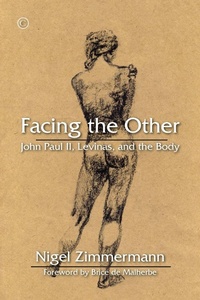
Facing the Other
John Paul II, Levinas, and the Body
Published on 31. March 2016
318 pages
978-0-227-90528-9 (ISBN)
Description

What is the significance of the body? What might phenomenology contribute to a theological account of the body? And what is gained by prolonging the overlooked dialogue between St. John Paul II and Emmanuel Levinas? Nigel Zimmermann answers these questions through the agreements and the tensions between two of the most important thinkers of the twentieth century. John Paul II, the Polish pope, philosopher, and theologian, and Emmanuel Levinas, the French-Jewish philosopher of Lithuanian heritage, were provocative thinkers who courageously faced and challenged the assumptions of their age. Both held the human person in high regard and did their thinking with constant reference to God and to theological language. Zimmermann does not shirk from the challenges of each thinker and does not hide their differences. However, he shows how they bequeath a legacy regarding the body that we would overlook at significant ethical peril. We are called, Zimmermann argues, to face the other. In this moment God refuses a banal marginalisation and our call to responsibility for the other person is issued in their disarming vulnerability. In the body, philosophy, theology, and ethics converge to call us to glory, even in the paradox of lowly suffering.
Reviews / Votes
'Karol Wojtyla and Emmanuel Levinas, obviously two of the great thinkers of the twentieth century, each profoundly original and deeply immersed in his own distinctive tradition, were yet able to meet in fruitful conversation on central questions about human nature and destiny, as Nigel Zimmermann shows in this lucidly and elegantly argued account.'- Fergus Kerr, Honorary Fellow, School of Divinity, University of Edinburgh
''Facing the Other' ... draws out the significance of the difference between a religious tradition whose God is wholly other, and the Christian claim that God became incarnate. Along the way, Zimmermann offers the reader a 'theology of the body for grown-ups' as he explains the centrality of the nuptial mystery and its Trinitarian foundations in the thought of Wojtyla/John Paul II. The work is beautifully crafted.'
- Tracey Rowland, Dean and Permanent Fellow in Political Philosophy and Continental Theology, John Paul II Institute, Melbourne
'Zimmerman's work has several merits.... [I]t is a powerful examination of one of the most important issues in philosophy and theology.... [I]t is also a successful work of Jewish-Christian dialogue. Highly sophisticated, it shows that grand intellectual discussions in an interreligious context can be relevant to day-to-day human affairs, even their bodily feelings and interactions. The work also serves as an exemplary instance of comparative philosophical research. Rather than simply studying a single issue from different perspectives, it tries to get these two intellectuals to clarify each other and to offer solutions where the other had failed.'
- Fatima Tofighi, Reviews in Religion and Theology, Volume 24 Issue 4, October 2017
Nigel does considerably more than lead the reader through a series of difficulties moving from phenomenology to theology and back again, and touches on considerably more than his favored theme of the body. The range of his remarks, some brief and some extended, and the clarity of their formulation, are already enough to recommend this work for close study
Jeffrey Blochl, Boston College, Ma, studies in christian ethics 32(1), pp.142-4
More details
Language
English
Place of publication
Cambridge
United Kingdom
File size
1,91 MB
ISBN-13
978-0-227-90528-9 (9780227905289)
Copyright in bibliographic data and cover images is held by Nielsen Book Services Limited or by the publishers or by their respective licensors: all rights reserved.
Schweitzer Classification
Other editions
Additional editions
Book
03/2016
James Clarke & Co Ltd
€57.20
Shipment within 10-20 days
Person
Nigel Zimmermann lectures in Theology with the Institute for Ethics and Society at the University of Notre Dame Australia. He is author of Levinas and Theology.
Content
Foreword by Brice de Malherbe
Acknowledgments
Introduction
1 John Paul II and Emmanuel Levinas: An Overlooked Dialogue of the Other
2 John Paul II's Theology of the Body
3 Levinas, Alterity, and the Problem of the Body
4 Eros and the Desirous Body
5 On What is Given: A Gift-Logic of the Body
Conclusion: Towards a Theology of Embodied Alterity
Bibliography
Scripture Index
Names Index
Subject Index
Acknowledgments
Introduction
1 John Paul II and Emmanuel Levinas: An Overlooked Dialogue of the Other
2 John Paul II's Theology of the Body
3 Levinas, Alterity, and the Problem of the Body
4 Eros and the Desirous Body
5 On What is Given: A Gift-Logic of the Body
Conclusion: Towards a Theology of Embodied Alterity
Bibliography
Scripture Index
Names Index
Subject Index
