

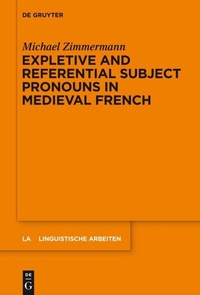
Expletive and Referential Subject Pronouns in Medieval French
Description

Medieval French, usually analyzed as a null subject language, differs considerably from modern Romance null subject languages such as Spanish in the availability of non-expressed subject pronouns; specifically, it shows characteristics reminiscent of non-null, rather than null subject languages, such as the expression of expletive subject pronouns. The central goal of this book is to put forward an account of these differences. On the basis of the analysis of an extensive, newly established data corpus, the development of the expression of both expletive and referential subject pronouns until the 17th c. is determined. Following a thorough discussion of previous approaches, an alternative approach is presented which builds on the analysis of Medieval French as a non-null subject language. The non-expression of subject pronouns, licit in specific contexts in non-null subject languages, is shown to be restricted to configurations generally involving left-peripheral focalization. These configurations - and, concomitantly, non-expressed subject pronouns - are finally argued to be eventually lost for good in the wake of the initial observation by 17th c. writers of pertinent instructions campaigned for in highly influential works of language use.
More details
Other editions
Additional editions
Person
Content
- Intro
- Contents
- 1 Introduction
- 2 The development of subject pronouns in Medieval and Classical French
- 2.0 Overview
- 2.1 Survey of the literature
- 2.1.1 Expletive subject pronouns
- 2.1.1.1 Preliminaries
- 2.1.1.2 Old French
- 2.1.1.3 Middle French
- 2.1.1.4 Classical French
- 2.1.1.5 Conclusion
- 2.1.2 Referential subject pronouns
- 2.1.2.1 Preliminaries
- 2.1.2.2 Old French
- 2.1.2.3 Middle French
- 2.1.2.4 Classical French
- 2.1.2.5 Conclusion
- 2.2 A new data corpus
- 2.2.1 General information
- 2.2.2 Results
- 3 Discussion of previous approaches to subject pronouns in Medieval French
- 3.0 Overview
- 3.1 Approaches to both expletive and referential subject pronouns
- 3.1.1 The 'root V2 approach'
- 3.1.2 The '(root and) embedded V2 approach'
- 3.1.3 The 'clitic (and auxiliary) (root) V2 approach'
- 3.1.4 The 'borrowing approach'
- 3.1.5 The 'disambiguation approach'
- 3.2 Approaches to expletive subject pronouns
- 3.2.1 The 'analogy approach'
- 3.2.2 The 'balance approach'
- 3.2.3 The 'grammaticalization approach'
- 3.2.4 The 'right dislocation approach'
- 3.3 Approaches to referential subject pronouns
- 3.3.1 The 'agent action approach'
- 3.3.2 The 'differential parsing approach'
- 3.3.3 The 'pragmatico-rhetorical approach'
- 3.3.4 The 'inducement approach'
- 3.4 Conclusion
- 4 An alternative approach to subject pronouns in Medieval French
- 4.0 Overview
- 4.1 Old and Middle French as non-null subject languages
- 4.2 Contexts for non-expressed subject pronouns
- 4.3 Conditions on non-expressed subject pronouns
- 4.4 Non-expressed subject pronouns in 'V&1' declaratives
- 4.4.1 Information-structural properties of preverbal constituents
- 4.4.1.1 'V2' declaratives
- 4.4.1.2 'V&2' declaratives
- 4.4.2 Correlation of non-expressed subject pronouns with focalization
- 4.4.3 Fulfillment of the conditions on non-expressed subject pronouns
- 4.5 Non-expressed subject pronouns in 'V1' declaratives
- 4.5.1 Focalization of the finite verb
- 4.5.2 Non-focalization of the finite verb
- 4.5.2.1 Coordination
- 4.5.2.2 Topicalization
- 4.5.2.3 Scene setting topicalization
- 4.5.3 A special case of verbal focalization (?)
- 4.5.4 Evidence for the movement of the finite verb beyond I°
- 4.6 Variation in the non-expression of subject pronouns
- 4.7 Conclusion
- 5 Outlook: The general loss of non-expressed subject pronouns in Classical French
- References
- Index
