

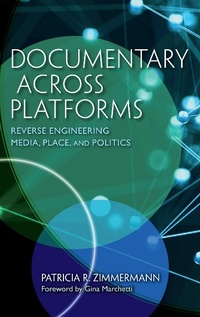
Documentary Across Platforms
Description

In Documentary Across Platforms, noted scholar of film and experimental media Patricia R. Zimmermann offers a glimpse into the ever-evolving constellation of practices known as "documentary" and the way in which they investigate, engage with, and interrogate the world. Collected here for the first time are her celebrated essays and speculations about documentary, experimental, and new media published outside of traditional scholarly venues. These essays envision documentary as a complex ecology composed of different technologies, sets of practices, and specific relationships to communities, engagement, politics, and social struggles. Through the lens of reverse engineering-the concept that ideas just like objects can be disassembled to learn how they work and then rebuilt into something new and better-Zimmermann explores how numerous small-scale documentary works present strategies of intervention into existing power structures. Adaptive to their context, modular, and unfixed, the documentary practices she explores exploit both sophisticated high-end professional and consumer-grade amateur technologies, moving through different political terrains, different platforms, and different exhibition contexts. Together these essays demonstrate documentary's role as a conceptual practice to think through how the world is organized and to imagine ways that it might be reorganized with actions, communities, and ideas.
More details
Other editions
Additional editions
Person
Patricia R. Zimmermann is Professor of Screen Studies at Ithaca College and codirector of the Finger Lakes Environmental Film Festival. She is the author and editor of numerous titles including Reel Families: A Social History of Amateur Film; (with Scott MacDonald) The Flaherty: Decades in the Cause of Independent Film; and (with Helen De Michiel) Open Space New Media Documentary: A Toolkit for Theory and Practice.
Content
Foreword / Gina Marchetti
Introduction: Documentary Across Platforms
Part I: Platforms
1. Reverse Engineering: Taking Things Apart for the New Global Media Ecology
2. Ardent Spaces, Formidable Environments
3. Precious Places, Scribe Video Center, Philadelphia
4. The Hand That Holds Up All This Falling: The Works of Daniel Reeves
5. Cartographies of Impossible and Possible Worlds: The Photography of Michael Kienitz
6. Black Soil: Chernozem and Tusit in Ukraine
Part II: Reversals
7. Matrices of War
8. Blasting War
9. Digital Deployments
10. Public Domains: Engaging Iraq through Experimental Digitalities
11. Cambodian Digital Imaginary Archive: Genocide, Lara Croft, and Crafts
Part III: Histories
12. The Home Movie Archive Live
13. Throbs and Pulsations: Les LeVeque and the Digitizing of Desire
14. Just Say No: Negativland's No Business
15. Remixed and Revisited Black Cinema: Oscar Micheaux's Within Our Gates Live Project
16. Live!: Reconnecting the Histories of Live Multimedia Performance
17. Toward a Theory of Participatory New Media Documentary
Part IV: Speculative Engineering
18. Home Movie Axioms
19. Speculations on Environmental Sensualities and Eco-Documentaries
20. Speculations on Reverse Engineering: Algorithms for Recombinant Documentaries Across Platforms
Acknowledgements
Notes
Index
