

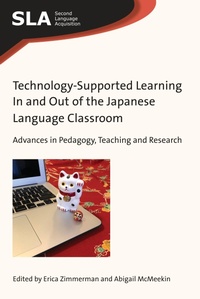
Technology-Supported Learning In and Out of the Japanese Language Classroom
Advances in Pedagogy, Teaching and Research
Published on 10. May 2019
376 pages
978-1-78892-352-1 (ISBN)
Description

This book addresses several pressing concerns of teachers and researchers who are looking for ways to integrate technology use in and out of their classrooms and assess its usefulness in the learning process. It provides an up-to-date examination of technology-supported pedagogy and language acquisition in a variety of Japanese as a foreign or second language contexts. It equips readers with practical pedagogical information, including methods of implementation and learning assessment, and ideas for how technology can be applied to achieve a wide range of learning objectives. The topics examined include cultural learning, identity construction, speaking, reading, writing, pronunciation, collaborative online learning, digital and 3D virtual reality games, online text analysis, and participation in online communities. In addition, different e-learning configurations such as flipped, online, and distance learning classrooms are explored. Studies examine various current technologies (e.g. blogs, synchronous/asynchronous telecollaboration, corpus analysis software, modern pronunciation tools) and will have both direct and indirect consequences for teaching and learning a second/foreign language with technology across all languages.
Reviews / Votes
Zimmerman and McMeekin have given the Japanese as a Foreign Language (JFL) field a huge boost forward with this significant volume on integrating technology with teaching. JFL teachers will surely find new ways to help their students in this impressive collection of innovative projects. * Jonathan deHaan, University of Shizuoka, Japan * Technology has drastically changed the nature of language use, learning and teaching, and yet many educators continue to ponder how best to change familiar instructional methods. This edited volume introduces a range of tools, materials, and activities adopted in and out of the classroom and carefully evaluates their impact on language learning. As such it offers opportunities for researchers and educators of Japanese and other languages to reflect on their current practices and to consider ways forward. * Junko Mori, University of Wisconsin-Madison, USA * In addition to the focus on structural aspects of Japanese learning, this volume is rich in studies taking communicative, integrative, and ecological approaches to CALL. The analysis of learning outcomes, innovative pedagogy, and a range of theoretical underpinnings, along with an outstandingly thorough introduction, make this volume a must-read for CALL researchers and educators far beyond those working in JSL/JFL. * Noriko Ishihara, Hosei University, Japan *More details
Series
Language
English
Place of publication
Bristol
United Kingdom
Target group
College/higher education
ISBN-13
978-1-78892-352-1 (9781788923521)
Copyright in bibliographic data and cover images is held by Nielsen Book Services Limited or by the publishers or by their respective licensors: all rights reserved.
Schweitzer Classification
Other editions
Additional editions
Erica Zimmerman | Abigail McMeekin
Technology-Supported Learning In and Out of the Japanese Language Classroom
Advances in Pedagogy, Teaching and Research
Book
05/2019
Multilingual Matters
€61.90
Shipment within 3-4 weeks
Persons
Erica Zimmerman is an Associate Professor of Japanese in the Languages and Cultures Department at the United States Naval Academy. She has published in the areas of the acquisition of Japanese as a second/foreign language, language pedagogy, computer-assisted language learning, conversation analysis, intercultural communication and identity in talk.
Abigail McMeekin is an Associate Professor of Japanese and Japanese Program Head in the Department of Modern Languages at the University of Lethbridge, Canada. Her published research focuses on Japanese pedagogy and second language acquisition, study abroad, computer-assisted language learning, conversation analysis and intercultural communication.
Abigail McMeekin is an Associate Professor of Japanese and Japanese Program Head in the Department of Modern Languages at the University of Lethbridge, Canada. Her published research focuses on Japanese pedagogy and second language acquisition, study abroad, computer-assisted language learning, conversation analysis and intercultural communication.
Content
Chapter 1. Erica Zimmerman and Abigail McMeekin: Technology Past and Present: The History of CALL and Technology for Learning Japanese
Part 1: Technology for Writing and Reading
Chapter 2. Nina Langton: Screencast Delivery of Feedback on Writing Assignments for Beginning Japanese Language Students: An Alternative to the "Red Pen"
Chapter 3. Abigail McMeekin: The Pedagogical Value of Web-based Readings in the JFL Classroom
Part 2: Collaborative Online Learning
Chapter 4. Yuka Akiyama: Impact of Lexical Categories on Skype-mediated Multimodal Focus on Form and Vocabulary Learning: A Task-based Study
Chapter 5: Yumi Takamiya and Mariya Aida Niendorf: Identity (Re)construction and Improvement in Intercultural Competence through Synchronous and Asynchronous Telecollaboration: Connecting Japanese Language Learners in the United States and Sweden
Part 3: Creation and Analysis of CALL Programs for Learning Japanese
Chapter 6. Toru Yamada, Takako Sakai and Cade Bushnell: Rakugo CALL Program for Japanese Language Learning: Its Development and Possibilities for Implementation
Chapter 7. Saeko Komori, Hiroko Yamamoto, Tae Homma, and Matthew Lanigan: Co-Chu: Japanese Corpus Analysis System and Two Analyses for Language Teaching
Chapter 8. Kazuhiro Yonemoto, Asami Tsuda, and Hisako Hayashi: How a Self-Learning Website can be Utilized for Better Pronunciation Education: Bridging Learning In and Out of the Classroom
Part 4: Learning Through Online Games
Chapter 9. Kasumi Yamazaki: The Effective Use of a 3D Virtual World in a JFL Classroom: Evidence from Discourse Analysis
Chapter 10. Kayo Shintaku: Game-mediated Activities in JFL Classrooms: Considerations and Issues in Learning, Teaching, and Implementation
Part 5: Technology Beyond the Physical Classroom
Chapter 11. Erica Zimmerman: Distance-Learning and Asynchronous Communication While on Study Abroad: Conversation-for-learning and Journal Reflections as a Means to Enhance Language-use
Chapter 12. Jae Dibello Takeuchi: Learners' Participation in Japanese-related Online Communities and the Relationship between Online Activities and Classroom Learning: A Comparative Case Study of Two JFL Learners
Epilogue. Erica Zimmerman and Abigail McMeekin
Part 1: Technology for Writing and Reading
Chapter 2. Nina Langton: Screencast Delivery of Feedback on Writing Assignments for Beginning Japanese Language Students: An Alternative to the "Red Pen"
Chapter 3. Abigail McMeekin: The Pedagogical Value of Web-based Readings in the JFL Classroom
Part 2: Collaborative Online Learning
Chapter 4. Yuka Akiyama: Impact of Lexical Categories on Skype-mediated Multimodal Focus on Form and Vocabulary Learning: A Task-based Study
Chapter 5: Yumi Takamiya and Mariya Aida Niendorf: Identity (Re)construction and Improvement in Intercultural Competence through Synchronous and Asynchronous Telecollaboration: Connecting Japanese Language Learners in the United States and Sweden
Part 3: Creation and Analysis of CALL Programs for Learning Japanese
Chapter 6. Toru Yamada, Takako Sakai and Cade Bushnell: Rakugo CALL Program for Japanese Language Learning: Its Development and Possibilities for Implementation
Chapter 7. Saeko Komori, Hiroko Yamamoto, Tae Homma, and Matthew Lanigan: Co-Chu: Japanese Corpus Analysis System and Two Analyses for Language Teaching
Chapter 8. Kazuhiro Yonemoto, Asami Tsuda, and Hisako Hayashi: How a Self-Learning Website can be Utilized for Better Pronunciation Education: Bridging Learning In and Out of the Classroom
Part 4: Learning Through Online Games
Chapter 9. Kasumi Yamazaki: The Effective Use of a 3D Virtual World in a JFL Classroom: Evidence from Discourse Analysis
Chapter 10. Kayo Shintaku: Game-mediated Activities in JFL Classrooms: Considerations and Issues in Learning, Teaching, and Implementation
Part 5: Technology Beyond the Physical Classroom
Chapter 11. Erica Zimmerman: Distance-Learning and Asynchronous Communication While on Study Abroad: Conversation-for-learning and Journal Reflections as a Means to Enhance Language-use
Chapter 12. Jae Dibello Takeuchi: Learners' Participation in Japanese-related Online Communities and the Relationship between Online Activities and Classroom Learning: A Comparative Case Study of Two JFL Learners
Epilogue. Erica Zimmerman and Abigail McMeekin
