

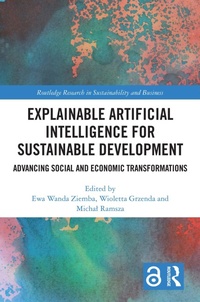
Explainable Artificial Intelligence for Sustainable Development
Advancing Social and Economic Transformations
1st Edition
Published on 30. September 2025
314 pages
978-1-040-44140-4 (ISBN)
Description

This book explores how transparent, interpretable AI technologies can support sustainable progress across industries and societies. It brings together theoretical foundations and practical applications of explainable AI (XAI) aligned with the UN's Sustainable Development Goals (SDGs), offering insights into its potential for responsible innovation.
It provides a comprehensive understanding of how explainable AI enhances trust, ethics, and accountability in AI-driven decisions. Through diverse case studies - from banking, e-commerce, and sustainability reporting, to psychiatry, education, and energy-the book demonstrates XAI's transformative role in driving sustainable business practices and societal well-being. Each chapter merges cutting-edge research with real-world examples, making complex AI systems more accessible and socially relevant. The book bridges gaps between disciplines, offering a holistic and actionable perspective on AI for sustainability.
This book is a vital resource for researchers, professionals, and policymakers seeking to harness AI responsibly. Academics in social sciences, economics, and information systems will find a strong theoretical base, while practitioners in business, government, and NGOs gain practical tools for implementing XAI in real contexts. It is also well-suited for students, educators, and AI enthusiasts aiming to align innovation with sustainable, ethical transformation.
The Open Access version of this book, available at http://www.taylorfrancis.com, has been made available under a Creative Commons [Attribution-Non Commercial-No Derivatives (CC BY-NC-ND)] 4.0 license.
It provides a comprehensive understanding of how explainable AI enhances trust, ethics, and accountability in AI-driven decisions. Through diverse case studies - from banking, e-commerce, and sustainability reporting, to psychiatry, education, and energy-the book demonstrates XAI's transformative role in driving sustainable business practices and societal well-being. Each chapter merges cutting-edge research with real-world examples, making complex AI systems more accessible and socially relevant. The book bridges gaps between disciplines, offering a holistic and actionable perspective on AI for sustainability.
This book is a vital resource for researchers, professionals, and policymakers seeking to harness AI responsibly. Academics in social sciences, economics, and information systems will find a strong theoretical base, while practitioners in business, government, and NGOs gain practical tools for implementing XAI in real contexts. It is also well-suited for students, educators, and AI enthusiasts aiming to align innovation with sustainable, ethical transformation.
The Open Access version of this book, available at http://www.taylorfrancis.com, has been made available under a Creative Commons [Attribution-Non Commercial-No Derivatives (CC BY-NC-ND)] 4.0 license.
More details
Series
Edition
1. Auflage
Language
English
Place of publication
London
United Kingdom
Publishing group
Taylor & Francis Ltd
Target group
College/higher education
Professional and scholarly
Illustrations
37 Tables, black and white; 31 Line drawings, black and white; 42 Halftones, black and white; 73 Illustrations, black and white
File size
15,51 MB
ISBN-13
978-1-040-44140-4 (9781040441404)
Copyright in bibliographic data and cover images is held by Nielsen Book Services Limited or by the publishers or by their respective licensors: all rights reserved.
Schweitzer Classification
Other editions
Additional editions
Ewa Wanda Ziemba | Wioletta Grzenda | Michal Ramsza
Explainable Artificial Intelligence for Sustainable Development
Advancing Social and Economic Transformations
Book
09/2025
1st Edition
Routledge
€208.20
Shipment within 10-20 days
Persons
Ewa Wanda Ziemba is a full professor of management at the University of Economics in Katowice, Poland, and an ordinary member of the European Academy of Sciences and Arts in Salzburg, Austria. Her research focuses on digital transformation for sustainable development, and she is internationally recognized for developing a multi-dimensional framework for a sustainable information society.
She has authored over 300 peer-reviewed publications, including books published by Springer and Taylor & Francis, as well as articles in leading journals such as the Journal of Computer Information Systems, Sustainable Cities and Society, and Information Technology & People. In 2021, she was ranked among the world's top 2% most-cited scientists, according to a global study by Stanford University, Elsevier, and Scopus.
She has led more than 40 research projects and currently coordinates an EU-funded initiative TOP4HoneyChains: Trustable and Sustainable Open Platform for Smart Honey Value, funded by the National Centre for Research and Development in Poland (ICTAGRIFOOD/II/67/ TOP4HoneyChain/2023) as part of the ERA-NET CO-FUND ICT-AGRI-FOOD initiative, implemented under the European Union's Horizon 2020 Programme. She led a project Development of a systemic approach to the sustainable development of the information society - on the example of Poland, founded by the National Science Centre in Poland (OPUS-2011/01/B/HS4/00974).
She also serves as the editor-in-chief and reviewer for several high-impact academic journals. Her academic achievements have been widely recognized, and she has received numerous national and international awards.
Wioletta Grzenda is an associate professor at the Institute of Statistics and Demography, Collegium of Economic Analysis at the SGH Warsaw School of Economics, Poland. She holds a PhD in Mathematics from Maria Curie-Sklodowska University in Lublin, Poland, and a DSc degree in Economics and Finance from SGH Warsaw School of Economics for her works on Bayesian modeling of family and occupational careers. She is the head of the Statistical Methods and Business Analytics Unit.
Her research interests focus on data analytics, with particular attention to statistical methods, including Bayesian techniques, machine learning methods, and the applications of these methods to socio-economic phenomena. She has published research papers in this field in journals of prestigious publishers such as Elsevier, Taylor & Francis, and Sage. Moreover, she is the author of three books and co-author of books on Bayesian statistics, advanced statistical methods, and programming in data analytics. She has authored reviews for journals such as Quality and Quantity, Social Indicators Research, and Statistics in Transition new series. She actively participates in national and international projects, including the ongoing project Towards a Resilient Future of Europe-HORIZON-CL2-2022-TRANSFORMATIONS-01. She was the leader of a project funded by the National Science Center titled The modeling of parallel family and occupational careers with Bayesian methods (OPUS-2015/17/B/HS4/02064).
She is involved in teaching undergraduate and graduate students. She delivers lectures on inter alia data mining and duration analysis. She is a member of the program board of master studies in advanced analytics-big data. She collaborates with SAS Institute Inc. on the SAS Academic Specialization. She developed the postgraduate program Data Science in Business at the SGH Warsaw School of Economics, and she is now the head of these studies. The program has attracted graduates willing to develop their analytical skills. She has supervised over 70 master's students, some of whom continue their scientific activities.
Michal Ramsza is an associate professor at the Institute of Mathematical Economics, Collegium of Economic Analysis at the SGH Warsaw School of Economics, Poland. He holds an MSc in Mathematics from the University of Warsaw, a PhD and a DSc in Mathematical Economics from SGH Warsaw School of Economics for his works on the theory of learning in games. He is the head of the Algorithms and Applications Unit.
His research interests focus on game theory, the theory of learning in games, adaptive complex systems, and machine learning. He published research papers with publishers such as Elsevier, Springer, De Gruyter, and World Scientific and authored a book on modeling economic processes using models of learning in games. He has applied these techniques in many finance, industry, and government commercial projects. He has led many trainings in R programming, e.g., in banks, ministries, and the European Commission. He led a project funded by the National Science Center (OPUS-2016/21/B/HS4/03016). He teaches both undergraduate and graduate students. He delivers lectures and labs on game theory, mathematical economics, and R programming, and he is a member of the program board for master's studies in advanced analytics-big data. He supervised some dozen master's students and several doctoral students.
She has authored over 300 peer-reviewed publications, including books published by Springer and Taylor & Francis, as well as articles in leading journals such as the Journal of Computer Information Systems, Sustainable Cities and Society, and Information Technology & People. In 2021, she was ranked among the world's top 2% most-cited scientists, according to a global study by Stanford University, Elsevier, and Scopus.
She has led more than 40 research projects and currently coordinates an EU-funded initiative TOP4HoneyChains: Trustable and Sustainable Open Platform for Smart Honey Value, funded by the National Centre for Research and Development in Poland (ICTAGRIFOOD/II/67/ TOP4HoneyChain/2023) as part of the ERA-NET CO-FUND ICT-AGRI-FOOD initiative, implemented under the European Union's Horizon 2020 Programme. She led a project Development of a systemic approach to the sustainable development of the information society - on the example of Poland, founded by the National Science Centre in Poland (OPUS-2011/01/B/HS4/00974).
She also serves as the editor-in-chief and reviewer for several high-impact academic journals. Her academic achievements have been widely recognized, and she has received numerous national and international awards.
Wioletta Grzenda is an associate professor at the Institute of Statistics and Demography, Collegium of Economic Analysis at the SGH Warsaw School of Economics, Poland. She holds a PhD in Mathematics from Maria Curie-Sklodowska University in Lublin, Poland, and a DSc degree in Economics and Finance from SGH Warsaw School of Economics for her works on Bayesian modeling of family and occupational careers. She is the head of the Statistical Methods and Business Analytics Unit.
Her research interests focus on data analytics, with particular attention to statistical methods, including Bayesian techniques, machine learning methods, and the applications of these methods to socio-economic phenomena. She has published research papers in this field in journals of prestigious publishers such as Elsevier, Taylor & Francis, and Sage. Moreover, she is the author of three books and co-author of books on Bayesian statistics, advanced statistical methods, and programming in data analytics. She has authored reviews for journals such as Quality and Quantity, Social Indicators Research, and Statistics in Transition new series. She actively participates in national and international projects, including the ongoing project Towards a Resilient Future of Europe-HORIZON-CL2-2022-TRANSFORMATIONS-01. She was the leader of a project funded by the National Science Center titled The modeling of parallel family and occupational careers with Bayesian methods (OPUS-2015/17/B/HS4/02064).
She is involved in teaching undergraduate and graduate students. She delivers lectures on inter alia data mining and duration analysis. She is a member of the program board of master studies in advanced analytics-big data. She collaborates with SAS Institute Inc. on the SAS Academic Specialization. She developed the postgraduate program Data Science in Business at the SGH Warsaw School of Economics, and she is now the head of these studies. The program has attracted graduates willing to develop their analytical skills. She has supervised over 70 master's students, some of whom continue their scientific activities.
Michal Ramsza is an associate professor at the Institute of Mathematical Economics, Collegium of Economic Analysis at the SGH Warsaw School of Economics, Poland. He holds an MSc in Mathematics from the University of Warsaw, a PhD and a DSc in Mathematical Economics from SGH Warsaw School of Economics for his works on the theory of learning in games. He is the head of the Algorithms and Applications Unit.
His research interests focus on game theory, the theory of learning in games, adaptive complex systems, and machine learning. He published research papers with publishers such as Elsevier, Springer, De Gruyter, and World Scientific and authored a book on modeling economic processes using models of learning in games. He has applied these techniques in many finance, industry, and government commercial projects. He has led many trainings in R programming, e.g., in banks, ministries, and the European Commission. He led a project funded by the National Science Center (OPUS-2016/21/B/HS4/03016). He teaches both undergraduate and graduate students. He delivers lectures and labs on game theory, mathematical economics, and R programming, and he is a member of the program board for master's studies in advanced analytics-big data. He supervised some dozen master's students and several doctoral students.
Content
Preface Part 1. Foundations of Explainable Artificial Intelligence for Sustainable Development Chapter 1. The Rise, Core Principles, and Applications of Explainable Artificial Intelligence in Sustainable Development Chapter 2. Interpretable and Explainable Machine Learning: Towards Sustainable Development Goals Part 2. Explainable Artificial Intelligence in Business Decisions for Future Sustainable Solutions Chapter 3. Artificial Intelligence in Achieving Sustainable Development Goals in the Banking Sector Chapter 4. Implementing Responsible AI in Online Marketplaces for Sustainable Development Chapter 5. Explainable AI in the Attestation of Sustainability Reporting Chapter 6. Explainable Machine Learning Methods for Probability of Default in Credit Risk Modelling Chapter 7. Adding Explainability to LSTM Modeling of Business Tendency Survey Results Chapter 8. Cognitive Technologies for Explainable AI in Sustainable Decision Support Part 3. Artificial Intelligence in Societal Transformation for Future Sustainable Solutions Chapter 10. Time and Content Domain Analysis of Managerial Actions Aimed at Introducing Artificial Management Chapter 11. The Determinants of Electricity Prices Through Explainable Machine Learning Chapter 12. Household Indebtedness in the Face of Unscheduled Events: Variable Importance Analysis Chapter 13. Exploring AI Adoption in Visual Arts Education: Insights From the Polish Sector Chapter 14. Explainable AI in Psychiatry: Exploring Obstacles and Biased Credibility - A Review Chapter 15. Robotic Arm Digital Twin for Pathomorphological Diagnosis Process
