

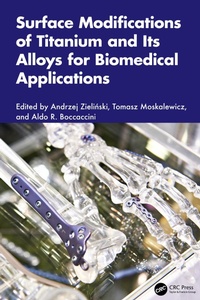
Surface Modifications of Titanium and Its Alloys for Biomedical Applications
1st Edition
Published on 12. February 2026
530 pages
978-1-040-69331-5 (ISBN)
Description

This book focuses on a promising achievement of biomaterials engineering: surface modifications of titanium and its alloys, including change in surface topography, formation of subsurface layers, and deposition of coating.
* Describes titanium and its alloys and applied surface treatment approaches.
* Demonstrates electropolishing and anodization of titanium biomaterials, the formation of composite layers by micro-arc oxidation in electrolytes of different compositions, and laser-made surface modification.
* Details coatings based on nanohydroxyapatite, chitosan, polyetheretherketone, oils, 3 polysaccharides, and carbon nanotubes, with a separate chapter focused on the thermal stability of hydroxyapatite.
* Discusses adhesion and cohesion strengths, important because of the high mechanical stresses imposed on titanium implants.
* Considers the biological behavior of modified surfaces regarding bioactivity, cytotoxicity, and antibacterial efficiency as well as the phenomenon of biofilm formation and possible countermeasures.
Authored by world-renowned researchers, this book provides readers working in biomaterials, biomedical, and chemical engineering as well as medicine with the most important developments and practical applications in titanium surface modifications.
* Describes titanium and its alloys and applied surface treatment approaches.
* Demonstrates electropolishing and anodization of titanium biomaterials, the formation of composite layers by micro-arc oxidation in electrolytes of different compositions, and laser-made surface modification.
* Details coatings based on nanohydroxyapatite, chitosan, polyetheretherketone, oils, 3 polysaccharides, and carbon nanotubes, with a separate chapter focused on the thermal stability of hydroxyapatite.
* Discusses adhesion and cohesion strengths, important because of the high mechanical stresses imposed on titanium implants.
* Considers the biological behavior of modified surfaces regarding bioactivity, cytotoxicity, and antibacterial efficiency as well as the phenomenon of biofilm formation and possible countermeasures.
Authored by world-renowned researchers, this book provides readers working in biomaterials, biomedical, and chemical engineering as well as medicine with the most important developments and practical applications in titanium surface modifications.
More details
Edition
1. Auflage
Language
English
Place of publication
London
United Kingdom
Publishing group
Taylor & Francis Ltd
Target group
College/higher education
Professional and scholarly
Illustrations
18 Tables, black and white; 55 Line drawings, black and white; 18 Halftones, color; 18 Illustrations, color; 55 Illustrations, black and white
File size
26,33 MB
ISBN-13
978-1-040-69331-5 (9781040693315)
Copyright in bibliographic data and cover images is held by Nielsen Book Services Limited or by the publishers or by their respective licensors: all rights reserved.
Schweitzer Classification
Other editions
Additional editions
Andrzej Zielinski | Tomasz Moskalewicz | Aldo R. Boccaccini
Surface Modifications of Titanium and Its Alloys for Biomedical Applications
Book
approx. 02/2026
1st Edition
CRC Press
€289.30
Not yet published
Persons
Andrzej S. Zielinski earned a Ph.D. in Chemical Sciences at the Institute of Physical Chemistry, Polish Academy of Sciences, Warsaw, in 1976. He became Dr hab. (D.Sc.) in Technical Sciences, Materials Science and Engineering (Physical Chemistry of Metals), at the Military Technical Academy, Warsaw, Poland, in 1990. He is Professor Emeritus at Gdansk University of Technology, where he served as Professor for many years.
Tomasz Moskalewicz is Professor of Materials Science, Head of the Interfaculty Laboratory of Transmission Electron Microscopy, and leader of the Design and Development of Coatings for Biomedical Applications group in the Department of Surface Engineering & Materials Characterization, Faculty of Metals Engineering and Industrial Computer Science, AGH University of Krakow, Poland. He received his Ph.D. (2001) and his Habilitation (2012) from AGH University of Science and Technology (Krakow, Poland).
Aldo R. Boccaccini is Professor of Biomaterials and Head of the Institute of Biomaterials at the Department of Materials Science and Engineering, University of Erlangen-Nuremberg, Germany. Until October 2009 he was a Professor of Materials Science and Engineering at Imperial College London, UK, Department of Materials, where he is now a Visiting Professor. Prof. Boccaccini holds an MSc (Nuclear Engineering) from Instituto Balseiro (Argentina), a PhD (Dr-Ing.) from Aachen University of Technology (Germany), and a Habilitation from Ilmenau University of Technology (Germany).
Tomasz Moskalewicz is Professor of Materials Science, Head of the Interfaculty Laboratory of Transmission Electron Microscopy, and leader of the Design and Development of Coatings for Biomedical Applications group in the Department of Surface Engineering & Materials Characterization, Faculty of Metals Engineering and Industrial Computer Science, AGH University of Krakow, Poland. He received his Ph.D. (2001) and his Habilitation (2012) from AGH University of Science and Technology (Krakow, Poland).
Aldo R. Boccaccini is Professor of Biomaterials and Head of the Institute of Biomaterials at the Department of Materials Science and Engineering, University of Erlangen-Nuremberg, Germany. Until October 2009 he was a Professor of Materials Science and Engineering at Imperial College London, UK, Department of Materials, where he is now a Visiting Professor. Prof. Boccaccini holds an MSc (Nuclear Engineering) from Instituto Balseiro (Argentina), a PhD (Dr-Ing.) from Aachen University of Technology (Germany), and a Habilitation from Ilmenau University of Technology (Germany).
Content
Chapter 0 Front Matter
Chapter 1 Titanium and its alloys for bone implants: properties, challenges, and current trends in surface treatment
Chapter 2 Electropolishing and anodization of titanium and its alloys
Chapter 3 Electrochemical oxide layers obtained on titanium alloy Ti-13Nb-13Zr in medical application
Chapter 4 Micro-arc oxidation of titanium and its alloys
Chapter 5 Micro-arc oxidation assisted with other techniques: treatment of titanium and its alloys
Chapter 6 Laser-enhanced surface structurization of titanium and its alloys
Chapter 7 Fabrication and characterization of hydroxyapatite-based coatings on titanium or its alloys
Chapter 8 Thermal stability of titanium/hydroxyapatite systems
Chapter 9 Fabrication and characterization of chitosan-based bioactive coatings on titanium or its alloys
Chapter 10 Chitosan-based bioactive composite coatings on Ti alloys by electrophoretic deposition (EPD)
Chapter 11 Composite polyetheretherketone-based coatings on titanium alloys: electrophoretic deposition, heat treatment, microstructure and properties
Chapter 12 Plant-derived natural compounds as antimicrobial coating materials for titanium biomaterials
Chapter 13 Natural polysaccharide-based coatings with solid antibacterial particles for titanium or its alloys
Chapter 14 Carbon nanotube coating technology for titanium and its alloys
Chapter 15 Surface treatments for implants obtained through additive manufacturing
Chapter 16 Towards high cohesion and adhesion of coatings on titanium and its alloys
Chapter 17 Surface modifications of titanium alloys: how to achieve bioactivity and antibacterial surface not enhancing cytotoxicity?
Chapter 18 The phenomenon of biofilm formation on titanium surfaces, its clinical implications, and the search for new strategies in the development of functionalized surfaces with antibacterial properties
End Matter I List of abbreviations and acronyms
End Matter II List of symbols
Chapter 1 Titanium and its alloys for bone implants: properties, challenges, and current trends in surface treatment
Chapter 2 Electropolishing and anodization of titanium and its alloys
Chapter 3 Electrochemical oxide layers obtained on titanium alloy Ti-13Nb-13Zr in medical application
Chapter 4 Micro-arc oxidation of titanium and its alloys
Chapter 5 Micro-arc oxidation assisted with other techniques: treatment of titanium and its alloys
Chapter 6 Laser-enhanced surface structurization of titanium and its alloys
Chapter 7 Fabrication and characterization of hydroxyapatite-based coatings on titanium or its alloys
Chapter 8 Thermal stability of titanium/hydroxyapatite systems
Chapter 9 Fabrication and characterization of chitosan-based bioactive coatings on titanium or its alloys
Chapter 10 Chitosan-based bioactive composite coatings on Ti alloys by electrophoretic deposition (EPD)
Chapter 11 Composite polyetheretherketone-based coatings on titanium alloys: electrophoretic deposition, heat treatment, microstructure and properties
Chapter 12 Plant-derived natural compounds as antimicrobial coating materials for titanium biomaterials
Chapter 13 Natural polysaccharide-based coatings with solid antibacterial particles for titanium or its alloys
Chapter 14 Carbon nanotube coating technology for titanium and its alloys
Chapter 15 Surface treatments for implants obtained through additive manufacturing
Chapter 16 Towards high cohesion and adhesion of coatings on titanium and its alloys
Chapter 17 Surface modifications of titanium alloys: how to achieve bioactivity and antibacterial surface not enhancing cytotoxicity?
Chapter 18 The phenomenon of biofilm formation on titanium surfaces, its clinical implications, and the search for new strategies in the development of functionalized surfaces with antibacterial properties
End Matter I List of abbreviations and acronyms
End Matter II List of symbols
