

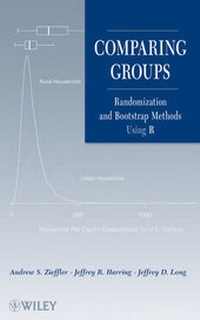
Comparing Groups
Description

Reviews / Votes
"The book can be used from upper-undergraduate and graduatelevel courses on statistical methods, particularly in theeducational and behavioral sciences. The book also serves as avaluable resource for researchers who need a practical guide tomodern data analytic and computational methods." (Zentralblatt Math, 1 August 2013) "The three authors of this book have a deep understandingof research methods and statistics and provide great value in thisbook for students of this subject and readers interested init." (Biz India, 8 May 2012)More details
Other editions
Additional editions
Persons
Content
List of Tables.
Foreword.
Preface.
Acknowledgments.
1. An Introduction to R.
1.1 Getting Started.
1.2 Arithmetic: R as a Calculator.
1.3 Computations in R: Functions.
1.4 Connecting Computations.
1.5 Data Structures: Vectors.
1.6 Getting Help.
1.7 Alternative Ways to Run R.
1.8 Extension: Matrices and Matrix Operations.
1.9 Further Reading.
Problems.
2. Data Representation and Preparation.
2.1 Tabular Data.
2.2 Data Entry.
2.3 Reading Delimited Data into R.
2.4 Data Structure: Data Frames.
2.5 Recording Syntax using Script Files.
2.6 Simple Graphing in R.
2.7 Extension: Logical Expressions and Graphs for Categorical Variables.
2.8 Further Reading.
Problems.
3. Data Exploration: One Variable.
3.1 Reading in the Data.
3.2 Non-Parametric Density Estimation.
3.3 Summarizing the Findings.
3.4 Extension: Variability Bands for Kernel Densities.
3.5 Further Reading.
Problems.
4. Exploration of Multivariate Data: Comparing Two Groups.
4.1 Graphically Summarizing the Marginal Distribution.
4.2 Graphically Summarizing Conditional Distributions.
4.4 Numerical Summaries of Data: Estimates of the Population Parameters.
4.4 Summarizing the Findings.
4.5 Extension: Robust Estimation.
4.6 Further Reading.
Problems.
5. Exploration of Multivariate Data: Comparing Many Groups.
5.1 Graphing Many Conditional Distributions.
5.2 Numerically Summarizing the Data.
5.3 Summarizing the Findings.
5.4 Examining Distributions Conditional on Multiple Variables.
5.5 Extension: Conditioning on Continuous Variables.
5.6 Further Reading.
Problems.
6. Randomization & Permutation Tests.
6.1 Randomized Experimental Research.
6.2 An Introduction to the Randomization Test.
6.3 Randomization Tests with Large Samples: Monte Carlo Simulation.
6.4 Validity of the Inferences and Conclusions Drawn from a Randomization Test.
6.5 Generalization from the Randomization Results.
6.6 Summarizing the Results for Publication.
6.7 Extension: Test of the Variance.
Further Reading.
Problems.
7. Bootstrap Tests.
7.1 Educational Achievement of Latino Immigrants.
7.2 Probability Models: An Interlude.
7.3 Theoretical Probability Models in R.
7.4 Parametric Bootstrap Tests.
7.5 The Parametric Bootstrap.
7.6 Implementing the Parametric Bootstrap in R.
7.7 Summarizing the Results of the Parametric Bootstrap Test.
7.8 Nonparametric Bootstrap Tests.
7.9 Summarizing the Results for the Nonparametric Bootstrap Test.
7.10 Bootstrapping Using a Pivot Statistic.
7.11 Independence Assumption for the Bootstrap Methods.
7.12 Extension: Testing Functions.
7.13 Further Reading.
Problems.
8. Philosophical Considerations.
8.1 The Randomization Test vs. the Bootstrap Test.
8.2 Philosophical Frameworks of Classical Inference.
9. Bootstrap Intervals and Effect Sizes.
9.1 Educational Achievement Among Latino Immigrants: Example Revisited.
9.2 Plausible Models to Reproduce the Observed Result.
9.3 Bootstrapping Using an Alternative Model.
9.4 Interpretation of the Interval Estimate.
9.5 Adjusted Bootstrap Intervals.
9.6 Standardized Effect Size: Quantifying the Group Differences in a Common Metric.
9.7 Summarizing the Results.
9.8 Extension: Bootstrapping the Confidence Envelope for a Q-Q Plot.
9.9 Confidence Envelopes.
9.10 Further Reading.
Problems.
10. Dependent Samples.
10.1 Matching: Reducing the Likelihood of Non-Equivalent Groups.
10.2 Mathematics Achievement Study Design.
10.3 Randomization/Permutation Test for Dependent Samples.
10.4 Effect Size.
10.5 Summarizing the Results of a Dependent Samples Test for Publication.
10.6 To Match or Not to Match: That is the Question.
10.7 Extension: Block Bootstrap.
10.8 Further Reading.
Problems.
11. Planned Contrasts.
11.1 Planned Comparisons.
11.2 Examination of Weight Loss Conditioned on Diet.
11.3 From Research Questions to Hypotheses.
11.4 Statistical Contrasts.
11.5 Computing the Estimated Contrasts Using the Observed Data.
11.6 Testing Contrasts: Randomization Test.
11.7 Strength of Association: A Measure of Effect.
11.8 Contrast Sum of Squares.
11.9 Eta-Squared for Contrasts.
11.10 Bootstrap Interval for Eta-Squared.
11.11 Summarizing the Results of a Planned Contrast Test Analysis.
11.12 Extension: Orthogonal Contrasts.
11.13 Further Reading.
Problems.
12. Unplanned Contrasts.
12.1 Unplanned Comparisons.
12.2 Examination of Weight Loss Conditioned on Diet.
12.3 Omnibus Test.
12.4 Group Comparisons After the Omnibus Test.
12.5 Ensemble-Adjusted p-values.
12.6 Strengths and Limitations of the Four Approaches.
12.7 Summarizing the Results of Unplanned Contrast Tests for Publication.
12.8 Extension: Plots of the Unplanned Contrasts.
12.9 Further Reading.
Problems.
References.
