

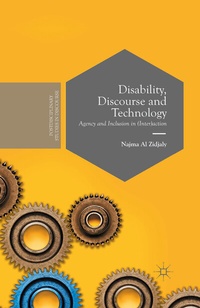
Disability, Discourse and Technology
Description

Reviews / Votes
"Disability, Discourse and Technology is useful for anyone interested in how to apply multimodal research and linguistics; and for activists and policy-makers. The methodology is complex yet clearly explained and helpful for a generalist audience. Also, this book would fascinate anyone interested in Muslim identity politics and non-western perspectives on disability and inclusion." (Sue Cranmer, Disability & Society, November, 2017)"The volume provides a valuable interdisciplinary exploration of the ways in which discourse can be used, specifically by individuals with disabilities, to challenge exclusion and to create inclusion and agency. . a fascinating and useful resource for disability scholars and activists, as well as others interested in understanding and advocating for issues of disability, identity and agency within complex nexus of communication." (MaryClinkenbeard, Discourse & Society, Vol. 28 (6), 2017)
More details
Other editions
Additional editions
Person
Najma Al Zidjaly is Associate Professor of Sociolinguistics in the Department of English Language and Literature at Sultan Qaboos University, Oman. She is the editor of Building Bridges: Integrating Language, Linguistics, Literature and Translation in English Studies (2012), and is on the Editorial Board of Multimodal Communication.
Content
Preface
1. Inclusion in (Inter)action
2. Methodology and Research Background
3. Inclusion through Microsoft PowerPoint
4. Inclusion through Hypothetical Narratives
5. Inclusion through Discourse
6. Inclusion through Yahoo Chatrooms
7. Agency Redefined
