


Cultural Intelligence in Aviation
Bridging Social Attitudes, Culture, and Safety in a Global Environment
Published on 12. March 2026
200 pages
978-1-040-59204-5 (ISBN)
Description

The aviation industry has evolved into a complex global network where diverse cultural backgrounds interact with flight operations, training, and safety management. Cultural Intelligence in Aviation: Bridging Social Attitudes, Culture, and Safety in a Global Environment examines the vital role of cultural intelligence (CQ) in creating safer, more effective aviation operations.
This book addresses the challenges and opportunities that arise when multinational crews, cross-border regulations, and varied workplace cultures come together in aviation environments. Through real-world case studies, empirical research, and theoretical frameworks, this guide explores how cultural intelligence shapes key aviation domains, from flight deck dynamics to accident investigations. It introduces innovative approaches to understanding cultural adaptability, incorporating methodologies from human factors, safety science, and artificial intelligence. Expert contributors bring a wealth of experience from across the industry and from different countries, allowing the reader to have a 360 view of the topic. Readers will gain practical tools and strategies to enhance cross-cultural communication, minimize miscommunication risks, and build a more inclusive aviation culture that prioritizes safety across all operations.
This resource is designed for aviation professionals at every level, including flight crews, safety managers, and training specialists. It will also serve as a valuable reference for academics and researchers in aviation studies, while providing regulatory authorities with evidence-based insights for policy development.
This book addresses the challenges and opportunities that arise when multinational crews, cross-border regulations, and varied workplace cultures come together in aviation environments. Through real-world case studies, empirical research, and theoretical frameworks, this guide explores how cultural intelligence shapes key aviation domains, from flight deck dynamics to accident investigations. It introduces innovative approaches to understanding cultural adaptability, incorporating methodologies from human factors, safety science, and artificial intelligence. Expert contributors bring a wealth of experience from across the industry and from different countries, allowing the reader to have a 360 view of the topic. Readers will gain practical tools and strategies to enhance cross-cultural communication, minimize miscommunication risks, and build a more inclusive aviation culture that prioritizes safety across all operations.
This resource is designed for aviation professionals at every level, including flight crews, safety managers, and training specialists. It will also serve as a valuable reference for academics and researchers in aviation studies, while providing regulatory authorities with evidence-based insights for policy development.
Reviews / Votes
Transforms aviation safety culture by providing the first comprehensive framework that integratesCultural Intelligence (CQ) with operational procedures, addressing a critical gap in current industry literature and practice
Enhances crew performance through 20 international case studies that demonstrate real-world applications of cultural intelligence in flight operations, accident investigations, and training programs
Reveals training methodologies by introducing innovative behavioral matrices that combine human factors, safety science, and artificial intelligence to assess and improve cultural adaptability
Equips aviation professionals with practical tools for cross-cultural communication, risk mitigation, and inclusive leadership, directly applicable across multiple roles from flight deck to management
Highlights the industry's preparedness for future challenges by addressing the intersection of cultural intelligence with emerging technologies, including AI, automation, and advanced air mobility
More details
Language
English
Place of publication
London
United Kingdom
Publishing group
Taylor & Francis Ltd
Target group
Professional and scholarly
Illustrations
1 Line drawings, black and white; 1 Illustrations, black and white
File size
1,63 MB
ISBN-13
978-1-040-59204-5 (9781040592045)
Copyright in bibliographic data and cover images is held by Nielsen Book Services Limited or by the publishers or by their respective licensors: all rights reserved.
Schweitzer Classification
Other editions
Additional editions
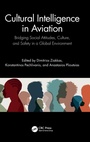
Dimitrios Ziakkas | Konstantinos Pechlivanis | Anastasios Plioutsias
Cultural Intelligence in Aviation
Bridging Social Attitudes, Culture, and Safety in a Global Environment
Book
approx. 03/2026
1st Edition
CRC Press
€124.30
Not yet published
Persons
Dimitrios Ziakkas is an affiliate researcher at the Science, Technology and Innovation in Society (STIS) Laboratory at the National and Kapodistrian University of Athens. He previously served as an Assistant Professor at Purdue University's School of Aviation and Transportation Technology, USA, and is an Airbus captain instructor and examiner with A-320, A-330/350, and A-340 type ratings. With over 34 years in military and civil aviation, he has accumulated 12,000 flight hours across various aircraft. A former Hellenic Air Force officer, he later served with Olympic Air, Qatar Airways, and Legend Airlines. He holds multiple advanced degrees, including a Ph.D. in History and Philosophy of Science and Technology, and focuses his research on aviation technology adoption, flight safety, and Advanced Air Mobility. He is a Fellow of the Royal Aeronautical Society and a member of several prestigious aviation organizations.
Konstantinos Pechlivanis is a Mentor Captain and Airline Captain for WizzAir who is a PhD candidate at the Technical University of Crete, Greece. His academic work focuses on computational science, engineering, and applied mathematics, with a particular interest in modelling complex systems and advancing numerical methods. His recent projects explore cutting-edge techniques in simulation and data-driven modelling.
Anastasios Plioutsias is Assistant Professor of Human Factors at Coventry University, UK. He has over ten years of experience in Human Factors and Accident & Incident Investigations. He was a fighter pilot in Hellenic Air Force (HAF) for 27 years with flight experience in F-16BLK52+ and F-4E Phantoms (2500 flight hours in fighter). He is an experienced accident and incident investigator, and he had assigned to all levels of investigation boards when he was on duty in HAF. He is an experienced accident and incident investigator, and was assigned to all levels of investigation boards during his service with HAF.
Konstantinos Pechlivanis is a Mentor Captain and Airline Captain for WizzAir who is a PhD candidate at the Technical University of Crete, Greece. His academic work focuses on computational science, engineering, and applied mathematics, with a particular interest in modelling complex systems and advancing numerical methods. His recent projects explore cutting-edge techniques in simulation and data-driven modelling.
Anastasios Plioutsias is Assistant Professor of Human Factors at Coventry University, UK. He has over ten years of experience in Human Factors and Accident & Incident Investigations. He was a fighter pilot in Hellenic Air Force (HAF) for 27 years with flight experience in F-16BLK52+ and F-4E Phantoms (2500 flight hours in fighter). He is an experienced accident and incident investigator, and he had assigned to all levels of investigation boards when he was on duty in HAF. He is an experienced accident and incident investigator, and was assigned to all levels of investigation boards during his service with HAF.
Content
Part 1: Foundations and Theoretical Context. 1. Rethinking Human Performance in High-Reliability Transportation Systems. 2. Aviation Safety, Human Factors, and Cultural Underpinnings. 3. Culture, Personality, and Identity in Aviation. Part 2: Cultural Intelligence and Crew Resource Management. 4. Understanding Cultural Intelligence (CQ). 5. Cultural Differences in CRM and Communication. 6. Implementing Cultural Intelligence in Training. Part 3: Accident Analysis Through a Cultural Lens. 7. Methodologies for Cultural Accident Analysis. 8. An evidence-based approach. Part 4: Strategies, Policy, and Future Directions. 9. Designing and Evaluating Cross-Cultural CRM Training Programs. 10. Policy, Organizational Change, and Future Trends.
