

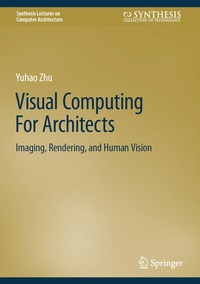
Visual Computing For Architects
Description

This book equips computer architects with a foundational understanding of visual computing, preparing them to design next-generation visual computing systems. It presents a unified perspective, viewing visual computing as a sequence of signal transductions across multiple domains, i.e., optical, analog, digital, and semantic, alongside the processing that occurs within each. Any sufficiently complex visual computing system worth examining will likely encompass both transduction and processing across all these domains. The central message is that, to unlock new application capabilities and achieve unprecedented efficiency, computer architects must look beyond the traditional boundaries of architecture and, from the ground up, exploit the interplay between computing, imaging, displays, and human vision in a holistic system.
More details
Other editions
Additional editions
Person
Yuhao Zhu is an Associate Professor of Computer Science, Brain and Cognitive Sciences, and an affiliated faculty member of Center for Visual Science, all at University of Rochester, where he and his students are mostly drawn to research problems at the intersection of imaging, human vision, and computer architecture.
Content
An Invitation to Visual Computing.- From Light to Visual Perception: An Overview.- Color Vision.- Colorimetry.- The Basics.- Surface Scattering.- Subsurface and Volume Scattering.- Imaging Optics.- Image Sensor Architecture.- Gaze-Contingent Rendering in VR.- In-Sensor Compression.
