

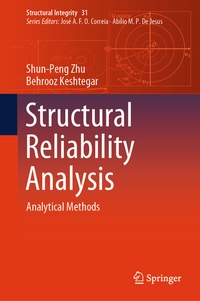
Structural Reliability Analysis
Description

This book delves into structural reliability analysis across seven comprehensive chapters. Beginning with foundational methods and key definitions, it transitions into FORM-based formulations, such as the HL-RF method and its variants, with a focus on convergence control and stability enhancement. The subsequent chapters cover gradient methods and directional conjugate gradient formulations, addressing challenges like instability control and search direction vector adjustments. A novel optimization model for Most Probable Point (MPP) search in the original space for interval-based random variables is introduced, offering a cutting-edge approach to uncertainty optimization. The book concludes with second-order reliability analysis methods and forward-looking discussions on emerging analytical perspectives in the field.
More details
Other editions
Additional editions
Persons
Dr. Shun-Peng Zhu is a professor of Mechanical Engineering at the University of Electronic Science and Technology of China (UESTC). His research focuses on fatigue design, structural reliability analysis, probabilistic physics of failure, multi-physics damage modeling, and life prediction for engineering structures and materials.
Dr. Behrooz Keshtegar is a faculty member in the Department of Civil Engineering at the University of Zabol. His research interests include structural reliability analysis, nonparametric regression, probabilistic analysis, and reliability-based design optimization. He also works on machine learning methods, mathematical modeling, and hybrid surrogate methods. His work emphasizes chaos control approaches, conjugate sensitivity methods, and harmony search techniques for reliability analysis.
Content
Chapter 1. Basic concepts.- Chapter 2. Brief introduction on reliability methods.- Chapter 3. Steepest methods for FORM.- Chapter 4. Convergence control for first order reliability methods.- Chapter 5. Directional steepest descent approaches for FORM.- Chapter 6. Directional conjugate gradient approaches for FORM.- Chapter 7: Improved conjugate FORM.- Chapter 8. Original-space search for FORM.
