

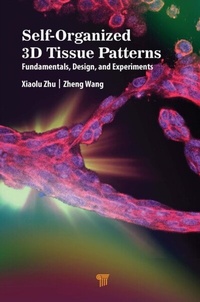
Self-Organized 3D Tissue Patterns
Fundamentals, Design, and Experiments
1st Edition
Published on 25. May 2022
148 pages
978-1-000-40059-5 (ISBN)
Description

Therapies for regenerating damaged tissue and organs have been attracting much attention. In order to efficiently regenerate the functions of living tissue and organs, diverse attempts have been made to utilize scaffolds to "mold" artificial tissue structures. However, the structural complexity of reconstituted tissue is limited by the mechanical precision of scaffolds, which still cause problems arising from their degradation, immunogenic reactions, and so forth. It is also being realized that ultimately the best approach might be to rely on the innate self-organizing properties of cells and the regenerative capability of the organism itself.
This book investigates the 3D-pattern formation and evolution mechanism in multipotent cells embedded in 3D semi-synthetic hydrogels and the control methodology for self-organized patterns. The authors theoretically and experimentally demonstrate several types of topological 3D-pattern formation by cells in a 3D matrix in vitro, which can be modeled and predicted by mathematical models based on the reaction-diffusion dynamics of various chemical, physical, and mechanical cues. The study, focused on the 3D pattern formation of cells, provides (i) a unique perspective for understanding the self-organized 3D tissue structures based on Turing instability, (ii) the scheme for rationally controlling the cellular self-organization via exogenous factors or tailored inner interfaces inside hydrogels, and (iii) the elaborate and sophisticated regulating method for tuning collective cellular behaviors in 3D matrices.
This book investigates the 3D-pattern formation and evolution mechanism in multipotent cells embedded in 3D semi-synthetic hydrogels and the control methodology for self-organized patterns. The authors theoretically and experimentally demonstrate several types of topological 3D-pattern formation by cells in a 3D matrix in vitro, which can be modeled and predicted by mathematical models based on the reaction-diffusion dynamics of various chemical, physical, and mechanical cues. The study, focused on the 3D pattern formation of cells, provides (i) a unique perspective for understanding the self-organized 3D tissue structures based on Turing instability, (ii) the scheme for rationally controlling the cellular self-organization via exogenous factors or tailored inner interfaces inside hydrogels, and (iii) the elaborate and sophisticated regulating method for tuning collective cellular behaviors in 3D matrices.
More details
Edition
1. Auflage
Language
English
Place of publication
Singapore
Singapore
Target group
College/higher education
Professional and scholarly
Illustrations
1 Tables, black and white; 7 Line drawings, color; 9 Line drawings, black and white; 8 Halftones, color; 9 Halftones, black and white; 15 Illustrations, color; 18 Illustrations, black and white
ISBN-13
978-1-000-40059-5 (9781000400595)
Copyright in bibliographic data and cover images is held by Nielsen Book Services Limited or by the publishers or by their respective licensors: all rights reserved.
Schweitzer Classification
Other editions
Additional editions
Book
05/2022
1st Edition
Jenny Stanford Publishing
€147.90
Shipment within 3-4 weeks
Persons
Xiaolu Zhu is Associate Professor at Hohai University, China. He graduated from Southeast University, China, in 2007 and obtained a PhD in 2014. He worked as a research scholar at the University of California, Los Angeles, from 2011 to 2013. His work is currently focused on understanding and controlling self-organized 3D patterns of cells and hydrogel-based biofabrication.
Zheng Wang is currently a master's student at the University of Hong Kong. He obtained his bachelor's degree from Hohai University in 2020. He is working on the development of the applications of hydrogels in the regulation of cellular behaviors and on the quantification of the relationships between cellular behaviors and the physical properties of the extracellular matrix.
Zheng Wang is currently a master's student at the University of Hong Kong. He obtained his bachelor's degree from Hohai University in 2020. He is working on the development of the applications of hydrogels in the regulation of cellular behaviors and on the quantification of the relationships between cellular behaviors and the physical properties of the extracellular matrix.
Content
1. Introduction 2. Fundamentals of Three-Dimensional Cell Culture in Hydrogels 3. Three-Dimensional Patterns of Tissues Emerging in Hydrogels 4. Constructing 3D Tissue Structures via Cellular Self-Assembly at Patterned Interfaces inside Hydrogel 5. Modeling Cellular Self-Assembly at Patterned Interfaces inside Hydrogel via Turing's Reaction-Diffusion Frame 6. Tuning Cellular Behaviors during Self-Organization of Cells in Hydrogel by Changing Inner Nano-Structure of Hydrogel
