

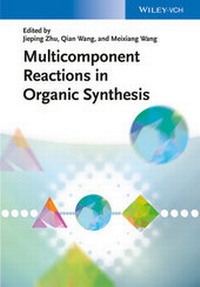
Multicomponent Reactions in Organic Synthesis
Description

Edited by the leading experts and with a list of authors reading like a "who's who" in multicomponent reaction chemistry, this is definitely a must-have for every synthetic organic chemist as well as medicinal chemists working in academia and pharmaceutical companies.
More details
Other editions
Additional editions
Persons
Qian Wang received her BSc and MSc degree from Lanzhou University (P.R. China) under the guidance of Prof. Y. Li. She obtained her PhD degree from Chinese University of Hong Kong under the supervision of Prof. H.N.C. Wong. After several post-doctoral stays in Switzerland and in France, she joined the Institut de Chimie des Substances Naturelles (CNRS, France) as a research engineer. In 2010, she moved to Swiss Federal Institute of Technology Lausanne (EPFL), Switzerland, as a research scientist.
Mei-Xiang Wang received a BSc degree in chemistry from Fudan University, Shanghai. After spending three years at the General Research Institute of Non-ferrous Metals (GRINM, Beijing) as a research associate, he joined the Institute of Chemistry, Chinese Academy of Sciences (ICCAS) at Beijing as a research student. He obtained his master degree and PhD in 1989 and 1992, respectively under the supervision of Prof. Z.-T. Huang. In the next 17 years, he worked at ICCAS ranking from assistant professor, associate professor to professor. During 2000 to 2004, he served as the Director of ICCAS and Center for Molecular Science, Chinese Academy of Sciences. Since May 2009, he has been a professor of chemistry at Tsinghua University in Beijing. He has published over 150 research articles and his research interests include enantioselective biotransformations using whole cell catalysts and selective organic reactions for the synthesis of natural products and bioactive compounds.
Content
GENERAL INTRODUCTION TO MCRs: PAST, PRESENT, AND FUTURE
Introduction
Advances in Chemistry
Total Synthesis
Applications in Pharmaceutical and Agrochemical Industry
Materials
Outlook
DISCOVERY OF MCRs
General Introduction
The Concept
The Reaction Design Concept
Multicomponent Reactions and Biocatalysis
Multicomponent Reactions in Green Pharmaceutical Production
Conclusions
ARYNE-BASED MULTICOMPONENT REACTIONS
Introduction
Multicomponent Reactions of Arynes via Electrophilic Coupling
Transition Metal-Catalyzed Multicomponent Reactions of Arynes
Concluding Remarks
UGI-SMILES AND PASSERINI-SMILES COUPLINGS
Introduction
Scope and Limitations
Ugi-Smiles Postcondensations
Conclusions
1,3-DICARBONYLS IN MULTICOMPONENT REACTIONS
Introduction
Achiral and Racemic MCRs
Enantioselective MCRs
Conclusions and Outlook
FUNCTIONALIZATION OF HETEROCYCLES BY MCRs
Introduction
Mannich-Type Reactions and Related Processes
Beta-Dicarbonyl Chemistry
Hetero-Diels-Alder Cycloadditions and Related Processes
Metal-Mediated Processes
Isocyanide-Based Reactions
Dipole-Mediated Processes
Conclusions
DIAZOACETATE AND RELATED METAL-STABILIZED CARBENE SPECIES IN MCRs
Introduction
MCRs via Carbonyl or Azomethine Ylide-Involved 1,3-Dipolar Cycloadditions
MCRs via Electrophilic Trapping of Protic Onium Ylides
MCRs via Electrophilic Trapping of Zwitterionic Intermediates
MCRs via Metal Carbene Migratory Insertion
Summary and Outlook
METAL-CATALYZED MULTICOMPONENT SYNTHESIS OF HETEROCYCLES
Introduction
Multicomponent Cross-Coupling and Carbonylation Reactions
Metallacycles in Multicomponent Reactions
Multicomponent Reactions via 1,3-Dipolar Cycloaddition
Concluding Remarks
MACROCYCLES FROM MULTICOMPONENT REACTIONS
Introduction
IMCR-Based Macrocyclizations of Single Bifunctional Building Blocks
Multiple MCR-Based Macrocyclizations of Bifunctional Building Blocks
IMCR-Based Macrocyclizations of Trifunctionalized Building Blocks (MiB-3D)
Sequential IMCR-Based Macrocyclizations of Multiple Bifunctional Building Blocks
Final Remarks and Future Perpectives
MULTICOMPONENT REACTIONS UNDER OXIDATIVE CONDITIONS
Introduction
Multicomponent Reactions Involving In-Situ Oxidation of One Substrate
Multicomponent Reactions Involving Oxidation of a Reaction Intermediate
Multicomponent Reactions Involving Oxidants as Lewis Acids
Conclusions
ALLENES IN MULTICOMPONENT SYNTHESIS OF HETEROCYCLES
Introduction
Reactions with 1,2-Propadiene and Unactivated Allenes
Reactions with Acceptor-Substituted Allenes
Reactions with Donor-Substituted Allenes
Conclusions
ALKYNES IN MULTICOMPONENT SYNTHESIS OF HETEROCYCLES
Introduction
Sigma-Nucleophilic Reactivity of Alkynes
Pi-Nucleophilic Reactivity of Alkynes
Alkynes as Electrophilic Partners
Alkynes in Cycloadditions
Alkynes as Reaction Partners in Organometallic MCRs
Conclusions
ANHYDRIDE-BASED MULTICOMPONENT REACTIONS
Introduction
Quinolones and Related Heterocylces from Homophthalic and Isatoic Anhydrides
Alpha, Beta-Unsaturated Cyclic Anhydrides: MCRs Involving Conjugate Addition and Cycloaddition Reactions
MCRs of Cyclic Anhydrides in Annulation Reactions and Related Processes
MRCs of Acyclic Anhydrides
Conclusions
FREE-RADICAL MULTICOMPONENT PROCESSES
Introduction
MCRs Involving Addition Across Olefin C=C Bonds
Free-Radical Carbonylation
Free-Radical Oxygenation
MCRs Involving Addition Across Pi-C=N Bonds
Miscellaneous Free-Radical Multicomponent Reactions
Conclusions
CHIRAL PHOSPHORIC ACID-CATALYZED ASYMMETRIC MULTICOMPONENT REACTIONS
Introduction
Mannich Reaction
Ugi-Type Reaction
Biginelli Reaction
Aza-Diels-Alder Reaction
1,3-Dipolar Cycloaddition
Hantzsch Dihydropyridine Synthesis
The Combination of Metal and Chiral Phosphoric Acid for Multicomponent Reaction
Other Phosphoric Acid-Catalyzed Multicomponent Reactions
Summary
Index
1
General Introduction to MCRs: Past, Present, and Future
Alexander Dömling and AlAnod D. AlQahtani
1.1 Introduction
Multicomponent reactions (MCRs) are generally defined as reactions in which three or more starting materials react to form a product, where basically all or most of the atoms contribute to the newly formed product [1]. Their usefulness can be rationalized by multiple advantages of MCRs over traditional multistep sequential assembly of target compounds. In MCRs, a molecule is assembled in one convergent chemical step in one pot by simply mixing the corresponding starting materials as opposed to traditional ways of synthesizing a target molecule over multiple sequential steps. At the same time, considerably complex molecules can be assembled by MCRs. This has considerable advantages as it saves precious time and drastically reduces effort.
MCRs are mostly experimentally simple to perform, often without the need of dry conditions and inert atmosphere. Molecules are assembled in a convergent way and not in a linear approach using MCRs. Therefore, structure-activity relationships (SARs) can be rapidly generated using MCRs, since all property-determining moieties are introduced in one step instead of sequentially [2]. Last but not least, MCRs provide a huge chemical diversity and currently more than 300 different scaffolds have been described in the chemical literature. For example, more than 40 different ways to access differentially substituted piperazine scaffolds using MCRs have been recently reviewed [3].
Although MCR chemistry is almost as old as organic chemistry and was first described as early as 1851, it should be noted that early chemists did not recognize the enormous engineering potential of MCRs. However, it took another >100 years until Ivar Ugi in a strike of a genius discovered his four-component condensation and also recognized the enormous potential of MCRs in applied chemistry (Figure 1.1) [4].
Figure 1.1 A three-component reaction toward the local anesthetic xylocaine and the first combinatorial library of small molecules proposed by Ivar Ugi in the 1960.
1.2 Advances in Chemistry
Many MCRs have been described in the past one and a half century and recently not many fundamental advances in finding new MCRs have been made [5-7]. A strategy to enhance the size and diversity of current MCR chemical space is the concept of combining a MCR and a subsequent secondary reaction, also known as postcondensation or Ugi-deprotection-cyclization (UDC) [2]. Herein, bifunctional orthogonally protected starting materials are used and ring cyclizations can take place in a secondary step upon deprotection of the secondary functional groups. Many different scaffolds have been recently described using this strategy. One example is shown in Figure 1.2. It is based on a recently discovered variation of the Ugi reaction of a-amino acids, oxo components, and isocyanides, now including primary and secondary amines [8-10].
Figure 1.2 Discovery of the Ugi-5C-4CR variation employing unprotected a-amino acids, oxo components, primary or secondary amines, and isocyanides, and the synthesis of several heterocyclic scaffolds using orthogonally protected bifunctional starting materials. Generalized scaffolds are shown in color, and synthesized examples in black and white.
1.3 Total Syntheses
While the Bucherer-Bergs and the related Strecker synthesis are well-established methods for the one-pot synthesis of natural and unnatural amino acids, the complex antibiotic penicillin was synthesized 50 years ago in a highly convergent approach by Ivar Ugi by using two MCRs, the Asinger reaction and his own reaction (Figure 1.3) [11]. Other recent natural product targets using MCR as a key step in their synthesis are also shown in Figure 1.3. Although early example of the advantageous use of MCR in the conscious total synthesis of complex natural products leads the way, its use has been neglected for decades and only recently realized by a few organic chemists [12-17].
Figure 1.3 (a) The union of the Asinger-4CR and the Ugi-4CR allows for the convergent and fast assembly of 6-aminopenicillanic acid natural product. (b) Recent synthetic targets of MCR natural product chemistry.
1.4 Applications in Pharmaceutical and Agrochemical Industry
Two decades ago, MCR chemistry was almost generally neglected in pharmaceutical and agro industry. The knowledge of these reactions was often low and it was generally believed that MCR scaffolds are associated with useless drug-like properties (absorption, distribution, metabolism, excretion, and toxicity (ADMET)). Now MCR technology is widely recognized for its impact on drug discovery projects and is strongly endorsed by industry as well as academia [18]. An increasing number of clinical and marketed drugs were discovered and assembled by MCR since then (Figure 1.4). Examples include nifedipine (Hantzsch-3CR), praziquantel, or ZetiaT. Two oxytocin receptor antagonists for the treatment of preterm birth and premature ejaculation, epelsiban and atosiban, are currently undergoing human clinical trials. They are both assembled by the classical Ugi MCR [19-21]. Interestingly, they show superior activity for the oxytocin receptor and selectivity toward the related vasopressin receptors than the peptide-based compounds currently used clinically. Perhaps against the intuition of many medicinal chemists, the Ugi diketopiperazines are orally bioavailable, while the currently used peptide derivatives are i.v. only and must be stabilized by the introduction of terminal protecting groups and unnatural amino acids. An example of a MCR-based plant protecting antifungal includes mandipropamide [22]. These examples show that pharmaceutical and agrochemical compounds with preferred ADMET properties and superior activities can be engineered based on MCR chemistry.
Figure 1.4 Examples of marketed drugs or drugs under (pre)clinical development and incorporating MCR chemistry.
The very high compound numbers per scaffold based on MCR may be regarded as friend or foe. On the one hand, it can be fortunate to have a MCR product as a medicinal chemistry starting point, since a fast and efficient SAR elaboration can be accomplished; on the other hand, the known chemical space based on MCRs is incredibly large and can neither be screened nor exhaustively synthesized with reasonable efforts. The currently preferred path to medicinal chemistry starting points in industry, the high-throughput screening (HTS), however, is an expensive process with rather low efficiency yielding hits often only in low double-digit or single-digit percentage. Modern postgenomic targets often yield zero hits. The initial hits are often ineffective to elaborate due to their complex multistep synthesis. Thus, neither the screening even of a very small fraction of the chemical space accessible by the classical Ugi-4CR and other scaffolds, nor the synthesis is possible. Recent advances in computational chemical space enumeration and screening, however, allow for an alternative process to efficiently foster a very large chemical space. The free web-, anchor-, and pharmacophore-based server AnchorQueryT (anchorquery.ccbb.pitt.edu/), for example, allows for the screening of a very large virtual MCR library with over a billion members (Figure 1.5) [23]. AnchorQuery builds on the role deeply buried amino acid side chains or other anchors play in protein-protein interactions. Proposed virtual screening hits can be instantaneously synthesized and tested using convergent MCR chemistry. The software was instrumental to the discovery of multiple potent and selective MCR-based antagonists of the protein-protein interaction between p53 and MDM2 [24-26]. Thus, computational approaches to screen MCR libraries will likely play a more and more important role in the early drug discovery process in the future.
Figure 1.5 MCR-based computational methods can help to effectively query the very large chemical MCR space. Clockwise: generation of a pharmacophore model based on a 3D structure, screening of the pharmacophore model against a very large MCR 3D compound database (AnchorQuery), synthesis, and refinement of hits.
More and more high-resolution structural information on MCR molecules bound to biological receptors is available (Figure 1.6) [18]. With the advent of structure-based design and fragment-based approaches in drug discovery, access to binding information of MCR molecules to their receptors is becoming crucial. Once the binding mode of a MCR molecule is defined, hit-to-lead transitions become more facile and time to market can be shortened and attrition rate in later clinical trials can be potentially reduced.
Figure 1.6 Examples of cocrystal structures of MCR molecules bound to biological receptors. Clockwise left: Povarov-3CR molecule bound to kinesin-5 (PDB ID 3L9H) [27], Ugi-3CR molecule bound to FVIIa (PDB ID 2BZ6) [28], Ugi-4CR molecule bound to MDM2 (PDB ID 4MDN) [26], and Gewald-3CR molecule targeting motor protein KSP (PDB ID 2UYM) [29].
Other worthwhile applications of MCRs in medicinal chemistry are in route scouting for shorter, convergent, and cheaper syntheses. An excellent showcase is the synthesis of the recently approved HCV protease inhibitor...
