

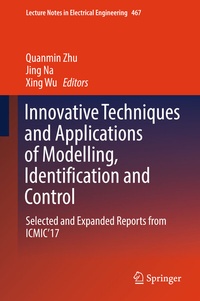
Innovative Techniques and Applications of Modelling, Identification and Control
Description

This book presents the most important findings from the 9th International Conference on Modelling, Identification and Control (ICMIC'17), held in Kunming, China on July 10-12, 2017. It covers most aspects of modelling, identification, instrumentation, signal processing and control, with a particular focus on the applications of research in multi-agent systems, robotic systems, autonomous systems, complex systems, and renewable energy systems.
The book gathers thirty comprehensively reviewed and extended contributions, which help to promote evolutionary computation, artificial intelligence, computation intelligence and soft computing techniques to enhance the safety, flexibility and efficiency of engineering systems. Taken together, they offer an ideal reference guide for researchers and engineers in the fields of electrical/electronic engineering, mechanical engineering and communication engineering.
More details
Other editions
Additional editions
Persons
Prof. Quanming Zhu currently works at the University of the West of England. His research areas include dynamic system modeling, identification, control and simulation, and he has published more than 200 papers on these topics. Prof. Zhu is the editor/founder of the International Journal of Modelling, Identification and Control, the International Conference on Modelling, Identification and Control and the Elsevier Book Series: Emerging Methodologies and Applications in Modelling, Identification and Control. He is also an editor of the International Journal of Computer Applications in Technology.
Prof. Jing Na is currently a Professor at the Kunming University of Science and Technology (KUST), China. He received B.S. and Ph.D. degrees from the School of Automation, Beijing Institute of Technology, China, in 2004 and 2010, respectively. He was a Postdoctoral Fellow (2011 to 2012) at the ITER Organization, France, and a Marie Curie Fellow (2015-2016) at the University of Bristol,UK. His research interests include adaptive control, nonlinear control, optimal control, parameter estimation and applications. He has published more than 100 papers on these topics.Prof. Xing WU is currently a Professor at Kunming University of Science and Technology (KUST), China. He obtained his Ph.D. from Shanghai Jiao Tong University in 2005. He is currently the Director of Machinery Fault Diagnosis at the Chinese Vibration Engineering Society, the Director of the Key Laboratory of Vibration and Noise of Yunnan Province. His recent research interests focus on modern signal processing and their applications on fault feature extracting and fault diagnosis. He has published more than 40 papers since 1997.
