

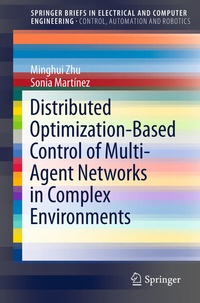
Distributed Optimization-Based Control of Multi-Agent Networks in Complex Environments
Description

This book offers a concise and in-depth exposition of specific algorithmic solutions for distributed optimization based control of multi-agent networks and their performance analysis. It synthesizes and analyzes distributed strategies for three collaborative tasks: distributed cooperative optimization, mobile sensor deployment and multi-vehicle formation control. The book integrates miscellaneous ideas and tools from dynamic systems, control theory, graph theory, optimization, game theory and Markov chains to address the particular challenges introduced by such complexities in the environment as topological dynamics, environmental uncertainties, and potential cyber-attack by human adversaries.
The book is written for first- or second-year graduate students in a variety of engineering disciplines, including control, robotics, decision-making, optimization and algorithms and with backgrounds in aerospace engineering, computer science, electrical engineering, mechanical engineering and operations research. Researchers in these areas may also find the book useful as a reference.
More details
Other editions
Additional editions
Persons
Sonia Martínez is a Professor at the Department of Mechanical and Aerospace Engineering at the University of California, San Diego. Prof. Martínez received her Ph.D. degree in Engineering Mathematics from the Universidad Carlos III de Madrid, Spain, in May 2002. Following a year as a Visiting Assistant Professor of Applied Mathematics at the Technical University of Catalonia, Spain, she obtained a Postdoctoral Fulbright Fellowship and held appointments at the Coordinated Science Laboratory of the University of Illinois, Urbana-Champaign during 2004, and at the Center for Control, Dynamical systems and Computation (CCDC) of the University of California, Santa Barbara during 2005. From January 2006 to June 2010, and then from July 2010 to June 2014, she was an Assistant Professor, and then Associate Professor, with the department of Mechanical and Aerospace Engineering at the University of California, San Diego. Dr Martínez' main reseach interests include the control of network systems, multi-agent systems, nonlinear control theory, androbotics. In particular, she has focused on the modeling and control of robotic sensor networks, the development of distributed coordination and estimation algorithms for groups of autonomous vehicles, and the geometric control of mechanical systems. She was the recipient of a NSF CAREER Award in 2007. For the paper "Motion coordination with Distributed Information," co-authored with Jorge Cortés and Francesco Bullo, she received the 2008 Control SystemsMagazine Outstanding Paper Award.
Content
1. Preliminaries.- 2. Distributed Cooperative Optimization.- 3. Game Theoretic Optimal Sensor Deployment.- 4. Distributed Resilient Formation Control.- Index.- References.
