

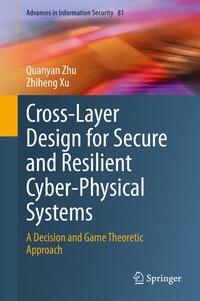
Cross-Layer Design for Secure and Resilient Cyber-Physical Systems
Description

This book introduces a cross-layer design to achieve security and resilience for CPSs (Cyber-Physical Systems). The authors interconnect various technical tools and methods to capture the different properties between cyber and physical layers. Part II of this book bridges the gap between cryptography and control-theoretic tools. It develops a bespoke crypto-control framework to address security and resiliency in control and estimation problems where the outsourcing of computations is possible. Part III of this book bridges the gap between game theory and control theory and develops interdependent impact-aware security defense strategies and cyber-aware resilient control strategies.
With the rapid development of smart cities, there is a growing need to integrate the physical systems, ranging from large-scale infrastructures to small embedded systems, with networked communications. The integration of the physical and cyber systems forms Cyber-Physical Systems (CPSs), enabling the use of digital information and control technologies to improve the monitoring, operation, and planning of the systems. Despite these advantages, they are vulnerable to cyber-physical attacks, which aim to damage the physical layer through the cyber network.
This book also uses case studies from autonomous systems, communication-based train control systems, cyber manufacturing, and robotic systems to illustrate the proposed methodologies. These case studies aim to motivate readers to adopt a cross-layer system perspective toward security and resilience issues of large and complex systems and develop domain-specific solutions to address CPS challenges.
More details
Other editions
Additional editions
Persons
Zhiheng Xu received his Ph.D. degree in Electrical Engineering from New York University in 2018. After his Ph.D. graduation, he went to Nanyang Technological University, Singapore, working as Research Fellow for two years. Currently, he works as a senior robotics software engineer at the Department of Intelligent Machines, Dyson Company. His research interests include cyber-physical security, artificial intelligence, reinforcement learning, intelligent decision making, and game theory
