

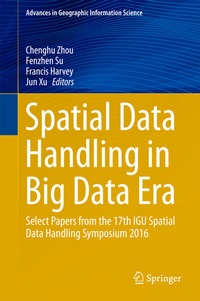
Spatial Data Handling in Big Data Era
Description

This proceedings volume introduces recent work on the storage, retrieval and visualization of spatial Big Data, data-intensive geospatial computing and related data quality issues. Further, it addresses traditional topics such as multi-scale spatial data representations, knowledge discovery, space-time modeling, and geological applications.
Spatial analysis and data mining are increasingly facing the challenges of Big Data as more and more types of crowd sourcing spatial data are used in GIScience, such as movement trajectories, cellular phone calls, and social networks. In order to effectively manage these massive data collections, new methods and algorithms are called for. The book highlights state-of-the-art advances in the handling and application of spatial data, especially spatial Big Data, offering a cutting-edge reference guide for graduate students, researchers and practitioners in the field of GIScience.
More details
Other editions
Additional editions
Persons
CHENGHU ZHOU received his PhD from the Institute of Geographical Science and Natural Resources Research, Chinese Academy of Sciences, with a focus on Cartography and GIS. He is currently an Academician at the Chinese Academy of Science.
FENZHEN SU completed his PhD in GIS and Cartography at the Institute of Geographical Science and Natural Resources Research, Chinese Academy of Sciences, Beijing. He is currently Director of the State Key Lab of Resources and Environmental Information Systems, Institute of Geographical Science and Natural Resources Research, Chinese Academy of Sciences, Beijing, China.
FRANCIS HARVEY completed his PhD at the University of Washington, Seattle, Washington. He has been head of the Department of Cartography and Visual Communication, Leibniz Institute for Regional Geography, since 2015.JUN XU received his PhD in Geographical Information Systems from the Department of Geography, State University of New York at Buffalo. Her research interests are in the fields of geographical ontology, spatial knowledge representation and qualitative reasoning, and spatial data mining. She is now an Associate Professor at the State Key Laboratory of Resources and Environmental Information Systems, Institute of Geographical Science and Natural Resources Research, Chinese Academy of Sciences, Beijing, China.
