

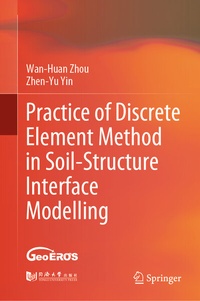
Practice of Discrete Element Method in Soil-Structure Interface Modelling
Description

This book is related to a parametric study of the soil-structural interface shearing behavior based on the numerical simulations of interface shear test with DEM, which is conducted from the role of soil properties, particle properties and structural properties.
To aid readers in easily understanding the generation, implementation of models and controlling modes, for each part, the relevant code is provided in the text, and the whole source code of model is given in Appendix to share with readers for practice. The book is intended for graduate-level teaching and research in soil mechanics and geotechnical engineering, as well as in other related engineering specialties. This book is also of use to industry practitioners due to the inclusion of real-world applications, opening the door to advanced courses on modeling within the industrial engineering and operations research fields.More details
Other editions
Additional editions
Persons
Wan-Huan Zhou
is currently Head and Professor of the Department of Civil and Environmental Engineering at the University of Macau. Prof. Zhou received her B.Eng. degree in 2002 and M.Sc. degree in 2005 from Zhejiang University in China and Ph.D. in Geotechnical Engineering from The Hong Kong Polytechnic University in 2008. After graduation, she worked as a lecturer at The Hong Kong Polytechnic University and later joined the University of Macau in September 2009. She has acted as the Principal Investigator (PI) on 15 research projects, including the 2020 Excellent Young Scientists Fund (HK and Macau) from the National Natural Science Foundation of China. She has published more than 70 SCI indexed articles in topranked geotechnical journals. She also serves as an editorial board member in several top geotechnical engineering journals, such as the Canadian Geotechnical Journal and the International Journal of Geomechanics.
Zhen-Yu Yin
is currently Professor ofGeotechnical Engineering at The Hong Kong Polytechnic University. Prof. Yin received his B.Eng. in Civil Engineering from Zhejiang University in 1997, followed by five years of engineering consultancy at the Zhejiang Jiahua Architecture Design Institute. Then, he obtained his MSc and Ph.D. in Geotechnical Engineering at Ecole Centrale de Nantes (France) in 2003 and 2006, respectively. Prof. Yin has published over 220 articles in peer-reviewed international journals with an H index of 48 according to Web of Science. He is Associate Committee Member of Granular Materials Committee of American Society of Civil Engineers; Associate Editor of "European Journal of Environmental and Civil Engineering" and "Geotechnique Letters"; and Editorial BoardMembers of some top journals in the field of soil mechanics and geotechnical engineering (Canadian Geotechnical Journal, International Journal of Geomechanics ASCE, Soils and Foundations, Acta Geotechnica, Transportation Geotechnics, Computers and Geotechnics, etc.).
