

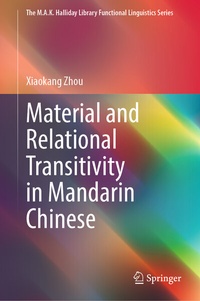
Material and Relational Transitivity in Mandarin Chinese
Description

This book presents a systemic-functional analysis of aspects of transitivity in Mandarin Chinese, focusing on two major types of clause: material clauses and relational clauses. Material clauses represent actions/events in the material world. Relational clauses express relationships between entities in the most general sense; they include as their prototypical members 'being' or 'copula' clauses. It demonstrates a brief account of the theoretical framework of SFG. The book also provides a detailed description of material clauses, to deal in turn with three major types of relational clause: attributive, locational, and possessive. One of the significant findings of the monograph is that relational clauses encompass a much larger portion of the grammar than is usually believed and include various 'processes' such as 'giving', 'renting', 'putting', in addition to 'being' (usually classified as material). Hence, the notion of transitivity has been refined.
More details
Other editions
Additional editions
Person
Xiaokang Zhou served as Head of the Chinese Department and Overseas VCE Chinese CFL Program Mentor at Peninsula Grammar School in Melbourne. In 2019, she was appointed as Visiting Professor by the School of Humanities and International Education at Zhejiang University of Science and Technology. In 2020, she was appointed as Honoured Supervisor for the Master's program in Chinese International Education at Zhejiang University. Her unique "Chinese Teaching Method through Rhymes" has gained widespread influence both internationally and domestically. She has written and composed over 350 teaching rhymes/songs and has compiled and produced five sets of bilingual Chinese-English textbooks for overseas learners. These include "Dr. Zhou's Rhymes for Learning Chinese" (Volumes 1-4) ", "Dr. Zhou's Rhymes for Learning Culture", "Dr. Zhou's Rhymes Fun Stories", "The Adventures of Dingding and Damien", and "Learning Culture through Reciting and Singing Classical Poems" published by Peking University Press in China and in Australia.
Dr. Zhou's works have won the Bronze and Gold Moonbeam Children's Book Awards in the United States. She has also received numerous prestigious awards in Australia and China, including the Multicultural Award for Excellence from the State of Victoria, the Innovation Award for Outstanding Demonstration Classes in International Chinese Teaching from the World Chinese Language Association, and the Excellent Overseas Chinese Teacher Award from the Chinese Overseas Affairs Office. She is a popular speaker at many international conferences and teaching institutions, where she delivers academic presentations, teaching demonstrations, and teacher training sessions.
Content
Introduction: Linguistic Background and Theoretical Framework.- Material Clauses in Mandarin Chinese.- Relational Clauses in Mandarin Chinese: Attributive.- Relational Clauses in Mandarin Chinese: Locational.- Relational Clauses in Mandarin Chinese: Possessive.
