

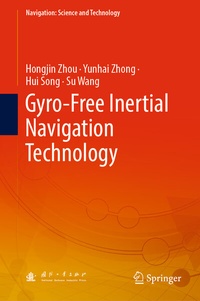
Gyro-Free Inertial Navigation Technology
Description

This book focuses on gyro-free inertial navigation technology, which is used to measure not only linear motion parameters but also angular rates. Since no gyroscopes are used, the key technologies, such as initial alignment, attitude resolution, and error calibration, are very different than those used in traditional methods.
Discussing each key technology in gyro-free inertial navigation system (GFINS) manufacture in a separate chapter, the book features easy-to-understand, detailed illustrations, to allow all those involved in inertial navigation to gain a better grasp of GFINS manufacture, including accelerometer setting principles; initial alignment; quaternion-based, attitude resolution algorithms; and accelerometer de-noise methods.
More details
Other editions
Additional editions

Persons
Hongjin Zhou received his M.S. degree and Ph.D. in Satellite and Inertial Navigation from the Naval University of Engineering, Wuhan, China, in 2004 and 2008, respectively. He has since worked at the Department of Marine Navigation at Dalian Naval Academy. His research mainly focuses on inertial technology, and he has published more than 15 papers in journals and conference proceedings as the first author. He is a fellow of the Chinese Inertial Technology Association.
Yunhai Zhong received his bachelor's and M.S. degrees in Traffic Transportation Engineering from Dalian Naval Academy, Dalian, China, in 1998 and 2001, respectively. He has since worked at the Department of Marine Navigation at Dalian Naval Academy. His research mainly focuses on electronic chart information display and application systems.Hui Song received his bachelor's and M.S. degrees in Traffic Transportation Engineering from Dalian Naval Academy, Dalian, China, in 1992 and 1996, respectively. He has since worked at Dalian Naval Academy. His research mainly focuses on nautical navigation technology.
Su Wang received his bachelor's degree from Marine Navigation Engineering at Naval University of Engineering in Wuhan in 2002 and M.S. degree in Navigation Guide and Control from Ha'erbin Engineering University, Ha'erbin, China, in 2009. He has since worked at the Department of Marine Navigation in Dalian Naval Academy. His research mainly focuses on navigation guide and control.
