

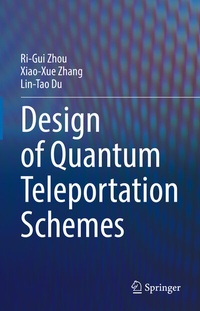
Design of Quantum Teleportation Schemes
Description

This book offers a design-centered approach to quantum teleportation as well as in-depth analysis of various quantum teleportation schemes. Quantum teleportation, a vital component of practical quantum communication technologies, serves as a secure and reliable way to transmit confidential information. Quantum teleportation relies on the unique physical property of quantum superposition, accomplishing the remote transmission of information through unitary transformations and measurements on entangled states, combined with classical communication. Therefore, as one of the safe and reliable means of quantum state transmission between communicating parties, quantum teleportation is bound to play a vital role in future quantum communication. This book begins with the basics of quantum teleportation before going on to consider various refinements such as controlled, bidirectional, cyclic, symmetric, and asymmetric scenarios. It goes further, investigating a multitude of quantum teleportation schemes in bidirectional, controlled bidirectional, cyclic bidirectional, asymmetric cyclic controlled, and noisy environments, and conducts detailed performance analyses of these schemes. This book is an essential resource for students, researchers, and professionals in the field of quantum communications.
More details
Other editions
Additional editions
Persons
Ri-Gui Zhou received a BS degree from Shandong University, China, in 1997, an MS degree from the department of Computer Science and Technology of Nanchang Hangkong University, China, in 2003, and a PhD degree from the department of Computer Science and Technology of Nanjing University of Aeronautics and Astronautics, China, in 2007.
From 2008 to 2010, he was a Postdoctoral Fellow in Tsinghua University, China. From 2010 to 2011, he was a Postdoctoral Fellow in Carleton University, Ottawa, Canada. From 2014 to 2015, he was a Visiting Scholar at North Carolina State University, Raleigh, NC, USA. He is currently a Professor with the College of Information Engineering, Shanghai Maritime University, China. His main research interests include quantum image processing, quantum reversible logic and the quantum genetic algorithm, among others.
Prof. Zhou is a distinguished membership of the China Computer Federation (CCF) and the recipient of the New Century Excellent Talents program, Ministry of Education of China, in 2013.
Xiao-Xue Zhang received a BS degree in computer science and technology from Huaibei Normal University, Anhui, China, in 2019. She is currently pursuing a PhD degree in information management and information system at Shanghai Maritime University, Shanghai, China. Her research interests include quantum communication and quantum computation.
Lin-Tao Du received a BS degree in information and computing science from Shenyang Agricultural University, Liaoning, China, in 2020. She is currently pursuing a PhD degree in information management and information system at Shanghai Maritime University, Shanghai, China. Her research interests include quantum cryptography and secure communication.
Content
Chapter 1. Introduction.- Chapter 2. The Basic Concept of Quantum Information.- Chapter 3. Bidirectional Quantum Teleportation.- Chapter 4. Controlled Bidirectional Quantum Teleportation.- Chapter 5. Cyclic Quantum Teleportation.- Chapter 6. Quantum Teleportation in Noisy Environment.
