

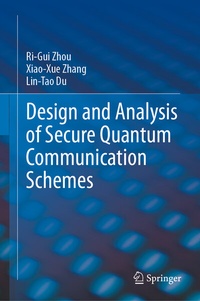
Design and Analysis of Secure Quantum Communication Schemes
Description

This book provides a comprehensive guide to the design and analysis of quantum secure communication schemes. While quantum computers may provide a platform for arithmetic calculations which threaten classical cryptosystems, the development of quantum information has also brought a corresponding solution: quantum cryptography, which is the basis of quantum secure communication. Quantum secure communication (QSC) uses quantum states for key agreement and information transmission, and uses the basic principles of quantum mechanics to discover eavesdropping behavior, and to ensure the security of information. It can overcome the security risks of classical encryption technology and can securely distribute keys in real time via public channels. Beginning in 1984 with the first conception of quantum key distribution (QKD) based on single-photon polarization states, subsequent innovations include quantum identity authentication (QIA), quantum secret sharing (QSS), quantum direct communication (QDC), quantum key agreement (QKA), quantum private query (QPQ), and quantum network coding (QNC). Each of these schemes is explored in detail based on different environments and structures, along with specific security and feasibility analyses. This book is essential reading for academic researchers and graduate students in quantum science and technology, as well as professionals and engineers in quantum industries and cybersecurity.
More details
Other editions
Additional editions
Persons
Ri-Gui Zhou received a BS degree from Shandong University, China, in 1997; an MS degree from the department of Computer Science and Technology of Nanchang Hangkong University, China, in 2003; and a PhD degree from the department of Computer Science and Technology of Nanjing University of Aeronautics and Astronauts, China, in 2007.
From 2008 to 2010, he was a Postdoctoral Fellow in Tsinghua University, China. From 2010 to 2011, he was a Postdoctoral Fellow in Carleton University, Ottawa, Canada. From 2014 to 2015, he was a Visiting Scholar at North Carolina State University, Raleigh, NC, USA. He is currently a Professor with the College of Information Engineering, Shanghai Maritime University, China. His main research interests include quantum image processing, quantum reversible logic and the quantum genetic algorithm, among others.
Prof. Zhou is a senior member of the China Computer Federation (CCF) and the recipient of the New Century Excellent Talents program, Ministry of Education of China, in 2013.
Xiao-Xue Zhang received a BS degree in Computer Science and Technology from Huaibei Normal University, Anhui, China, in 2019. She is currently pursuing a PhD degree in information management and information system at Shanghai Maritime University, Shanghai, China. Her research interests include quantum communication and quantum computation.
Lin-Tao Du received a BS degree in Information and computing science from Shenyang Agricultural University, Liaoning, China, in 2020. She is currently pursuing a PhD degree in information management and information system at Shanghai Maritime University, Shanghai, China. Her research interests include quantum cryptography and secure communication.
Content
Chapter 1: Introduction.- Chapter 2: Fundamentals of Quantum Information Theory.- Chapter 3: Quantum Key Distribution.- Chapter 4: Quantum Secret Sharing.- Chapter 5: Quantum Direct Communication.- Chapter 6: Quantum Key Agreement.- Chapter 7: Quantum Private Query.- Chapter 8: Quantum Network Coding.
