

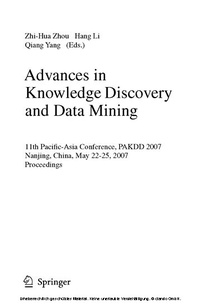
Advances in Knowledge Discovery and Data Mining
Description

This book constitutes the refereed proceedings of the 11th Pacific-Asia Conference on Knowledge Discovery and Data Mining, PAKDD 2007, held in Nanjing, China in May 2007.
The 34 revised full papers and 92 revised short papers presented together with four keynote talks or extended abstracts thereof were carefully reviewed and selected from 730 submissions. The papers are devoted to new ideas, original research results and practical development experiences from all KDD-related areas including data mining, machine learning, databases, statistics, data warehousing, data visualization, automatic scientific discovery, knowledge acquisition and knowledge-based systems.
Written for: Researchers and professionals
Keywords: Web data mining, algorithmic learning, ant colony optimization, association rule mining, biomedical data analysis, classification, clustering, computer security, data analysis, data mining, feature selection, image segmentation, information extraction, knowledge discovery, learning classifier systems, machine learning, privacy, qualitative reasoning, random forest, rough sets, statistical learning, support vector machines, text mining, text summarization, workflow mining
More details
Other editions
Additional editions
Content
Research Frontiers in Advanced Data Mining Technologies and Applications (p. 25)
Data mining, as the confluence of multiple intertwined disciplines, including statistics, machine learning, pattern recognition, database systems, information retrieval, World-Wide Web, and many application domains, has achieved great progress in the past decade [1]. Similar to many research fields, data mining has two general directions: theoretical foundations and advanced technologies and applications.
Here we focus on advanced technologies and applications in data mining and discuss some recent progress in this direction. Notice that some popular research topics, such as privacypreserving data mining, are not covered in the discussion for lack of space/time. Our discussion is organized into nine themes, and we briefly outline the current status and research problems in each theme.
1 Pattern Mining, Pattern Usage, and Pattern Understanding
Frequent pattern mining has been a focused theme in data mining research for over a decade. Abundant literature has been dedicated to this research and tremendous progress has been made, ranging from efficient and scalable algorithms for frequent itemset mining in transaction databases to numerous research frontiers, such as sequential pattern mining, structural pattern mining, correlation mining, associative classification, and frequent-pattern-based clustering, as well as their broad applications.
Recently, studies have proceeded to scalable methods for mining colossal patterns where the size of the patterns could be rather large so that the step-by-step growth using an Apriori-like approach does not work, methods for pattern compression, extraction of high-quality top-k patterns, and understanding patterns by context analysis and generation of semantic annotations.
Moreover, frequent patterns have been used for effective classification by top-k rule generation for long patterns and discriminative frequent pattern analysis. Frequent patterns have also been used for clustering of high-dimensional biological data. Scalable methods for mining long, approximate, compressed, and sophisticated patterns for advanced applications, such as biological sequences and networks, and the exploration of mined patterns for classification, clustering, correlation analysis, and pattern understanding will still be interesting topics in research.
2 Information Network Analysis
Google’s PageRank algorithm has started a revolution on Internet search. However, since information network analysis covers many additional aspects and needs scalable and effective methods, the systematic study of this domain has just started, with many interesting issues to be explored. Information network analysis has broad applications, covering social and biological network analysis, computer network intrusion detection, software program analysis, terrorist network discovery, and Web analysis.
One interesting direction is to treat information network as graphs and further develop graph mining methods. Recent progress on graph mining and its associated structural pattern-based classification and clustering, graph indexing, and similarity search will play an important role in information network analysis.
Moreover, since information networks often form huge, multidimensional heterogeneous graphs, mining noisy, approximate, and heterogeneous subgraphs based on different applications for the construction of application-specific networks with sophisticated structures will help information network analysis substantially.The discovery of the power law distribution of information networks and the rules on density evolution of information networks will help develop effective algorithms for network analysis.
