

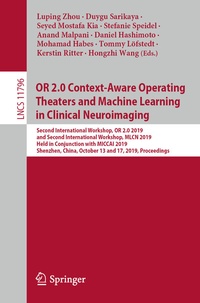
OR 2.0 Context-Aware Operating Theaters and Machine Learning in Clinical Neuroimaging
Description

This book constitutes the refereed proceedings of the Second International Workshop on Context-Aware Surgical Theaters, OR 2.0 2019, and the Second International Workshop on Machine Learning in Clinical Neuroimaging, MLCN 2019, held in conjunction with MICCAI 2019, in Shenzhen, China, in October 2019.
For OR 2.0 all 6 submissions were accepted for publication. They aim to highlight the potential use of machine vision and perception, robotics, surgical simulation and modeling, multi-modal data fusion and visualization, image analysis, advanced imaging, advanced display technologies, human-computer interfaces, sensors, wearable and implantable electronics and robots, visual attention models, cognitive models, decision support networks to enhance surgical procedural assistance, context-awareness and team communication in the operating theater, human-robot collaborative systems, and surgical training and assessment.
MLCN 2019 accepted 6 papers out of 7 submissions for publication. They focus on addressing the problems of applying machine learning to large and multi-site clinical neuroimaging datasets. The workshop aimed to bring together experts in both machine learning and clinical neuroimaging to discuss and hopefully bridge the existing challenges of applied machine learning in clinical neuroscience.
Chapter 5 is available open access under a Creative Commons Attribution 4.0 International License via Springerlink.
More details
Other editions
Additional editions
Content
Proceedings of the Second International Workshop on OR 2.0 Context-Aware Operating Theaters (OR 2.0 2019).- Feature Aggregation Decoder for Segmenting Laparoscopic Scenes.- Preoperative Planning for Guidewires employing Shape-Regularized Segmentation and Optimized Trajectories.- Guided unsupervised desmoking of laparoscopic images using Cycle-Desmoke.- Unsupervised Temporal Video Segmentation as an Auxiliary Task for Predicting the Remaining Surgery Duration.- Live monitoring of hemodynamic changes with multispectral image analysis.- Towards a Cyber-Physical Systems Based Operating Room of the Future.- Proceedings of the Second International Workshop on Machine Learning in Clinical Neuroimaging: Entering the era of big data via transfer learning and data harmonization (MLCN 2019).- Deep Transfer Learning For Whole-Brain FMRI Analyses.- Knowledge distillation for semi-supervised domain adaptation.- Relevance Vector Machines for harmonization of MRI brain volumes using image descriptors.- Data Pooling and Sampling of Heterogeneous Image Data for White Matter Hyperintensity Segmentation.- A Hybrid 3DCNN and 3DC-LSTM based model for 4D Spatio-temporal fMRI data: An ABIDE Autism Classification study.- Automated Quantification of Enlarged Perivascular Spaces in Clinical Brain MRI across Sites.
