

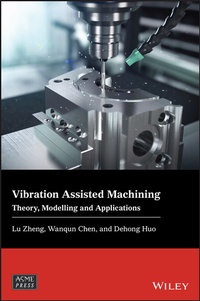
Vibration Assisted Machining
Description

Vibration Assisted Machining: Theory, Modelling and Applications covers all key aspects of vibration assisted machining, including cutting kinematics and dynamics, the effect of workpiece materials and wear of cutting tools. It also addresses practical applications for these techniques. Case studies provide detailed guidance on the design, modeling and testing of VAM systems. Experimental machining methods are also included, alongside considerations of state-of-the-art research developments on cutting force modeling and surface texture generation.
Advances in computational modelling, surface metrology and manufacturing science over the past few decades have led to tremendous benefits for industry. This is the first comprehensive book dedicated to design, modelling, simulation and integration of vibration assisted machining system and processes, enabling wider industrial application of the technology. This book enables engineering students and professionals in manufacturing to understand and implement the latest vibration assisted machining techniques. Highlights include:
* Comprehensive coverage of the theory, kinematics modelling, numerical simulation and applications of vibration assisted machining (VAM)
* Case studies with detailed guidance on design, modelling and testing of VAM systems, as well as experimental machining methods
* Discussion of state-of-the-art research developments on cutting force modelling and surface texture generation
* Coverage of the history of VAM, its current applications and future directions for the technology
Vibration Assisted Machining: Theory, Modelling and Applications provides engineering students, researchers, manufacturing engineers, production supervisors, tooling engineers, planning and application engineers and machine tool designers with the fundamentals of vibration assisted machining, along with methodologies for developing and implementing the technology to solve practical industry problems.
More details
Other editions
Additional editions

Persons
Dr. Lu Zheng received his MSc and PhD in Mechanical Engineering from Newcastle University, UK in 2016 and 2020, respectively. He is currently a Lecturer at China Agricultural University. His research interests include cutting performance and functional surface generation in vibration assisted machining.
Dr. Wanqun Chen received his PhD in mechanical engineering from Harbin Institute of Technology, China in 2014. Currently, he is an Associate Professor at Harbin Institute of Technology. His research interests include ultra-precision machining and vibration assisted machining. He has published more than 80 peer reviewed papers, contributed to three book chapters and holds six patents.
Dr. Dehong Huo is currently a Senior Lecturer in Precision Engineering at the School of Engineering, Newcastle University, UK. Currently, his work in precision manufacturing is focused on precision/micro machining processes for hard-to-machine materials and hybrid manufacturing processes. He is the co-author of four books and more than 100 papers in international journals and conferences. He is the editor and reviewer of many international journals and is an organizer for several international scientific conferences.
Content
Preface xi
1 Introduction to Vibration-Assisted Machining Technology 1
1.1 Overview of Vibration-Assisted Machining Technology 1
1.1.1 Background 1
1.1.2 History and Development of Vibration-Assisted Machining 2
1.2 Vibration-Assisted Machining Process 3
1.2.1 Vibration-Assisted Milling 3
1.2.2 Vibration-Assisted Drilling 3
1.2.3 Vibration-Assisted Turning 5
1.2.4 Vibration-Assisted Grinding 5
1.2.5 Vibration-Assisted Polishing 6
1.2.6 Other Vibration-Assisted Machining Processes 7
1.3 Applications and Benefits of Vibration-Assisted Machining 7
1.3.1 Ductile Mode Cutting of Brittle Materials 7
1.3.2 Cutting Force Reduction 8
1.3.3 Burr Suppression 8
1.3.4 Tool Life Extension 8
1.3.5 Machining Accuracy and Surface Quality Improvement 9
1.3.6 Surface Texture Generation 10
1.4 Future Trend of Vibration-Assisted Machining 10
References 12
2 Review of Vibration Systems 17
2.1 Introduction 17
2.2 Actuators 18
2.2.1 Piezoelectric Actuators 18
2.2.2 Magnetostrictive Actuators 18
2.3 Transmission Mechanisms 18
2.4 Drive and Control 19
2.5 Vibration-Assisted Machining Systems 19
2.5.1 Resonant Vibration Systems 19
2.5.1.1 1D System 20
2.5.1.2 2D and 3D Systems 23
2.5.2 Nonresonant Vibration System 27
2.5.2.1 2D System 29
2.5.2.2 3D Systems 34
2.6 Future Perspectives 35
2.7 Concluding Remarks 36
References 37
3 Vibration System Design and Implementation 45
3.1 Introduction 45
3.2 Resonant Vibration System Design 46
3.2.1 Composition of the Resonance System and Its Working Principle 46
3.2.2 Summary of Design Steps 46
3.2.3 Power Calculation 47
3.2.3.1 Analysis of Working Length Lpu 48
3.2.3.2 Analysis of Cutting Tool Pulse Force Fp 49
3.2.3.3 Calculation of Total Required Power 49
3.2.4 Ultrasonic Transducer Design 49
3.2.4.1 Piezoelectric Ceramic Selection 49
3.2.4.2 Calculation of Back Cover Size 51
3.2.4.3 Variable Cross-Sectional, One-Dimensional Longitudinal Vibration Wave Equation 51
3.2.4.4 Calculation of Size of Longitudinal Vibration Transducer Structure 53
3.2.5 Horn Design 53
3.2.6 Design Optimization 54
3.3 Nonresonant Vibration System Design 55
3.3.1 Modeling of Compliant Mechanism 56
3.3.2 Compliance Modeling of Flexure Hinges Based on the Matrix Method 56
3.3.3 Compliance Modeling of Flexure Mechanism 59
3.3.4 Compliance Modeling of the 2 DOF Vibration Stage 61
3.3.5 Dynamic Analysis of the Vibration Stage 62
3.3.6 Finite Element Analysis of the Mechanism 63
3.3.6.1 Structural Optimization 63
3.3.6.2 Static and Dynamic Performance Analysis 63
3.3.7 Piezoelectric Actuator Selection 65
3.3.8 Control System Design 66
3.3.8.1 Control Program Construction 66
3.3.9 Hardware Selection 66
3.3.10 Layout of the Control System 68
3.4 Concluding Remarks 68
References 69
3.A Appendix 70
4 Kinematics Analysis of Vibration-Assisted Machining 73
4.1 Introduction 73
4.2 Kinematics of Vibration-Assisted Turning 74
4.2.1 TWS in 1D VAM Turning 75
4.2.2 TWS in 2D VAM Turning 78
4.3 Kinematics of Vibration-Assisted Milling 80
4.3.1 Types of TWS in VAMilling 81
4.3.1.1 Type I 81
4.3.1.2 Type II 82
4.3.1.3 Type III 82
4.3.2 Requirements of TWS 83
4.3.2.1 Type I Separation Requirements 83
4.3.2.2 Type II Separation Requirements 85
4.3.2.3 Type III Separation Requirements 87
4.4 Finite Element Simulation of Vibration-Assisted Milling 89
4.5 Conclusion 93
References 93
5 Tool Wear and Burr Formation Analysis in Vibration-Assisted Machining 95
5.1 Introduction 95
5.2 Tool Wear 95
5.2.1 Classification of Tool Wear 95
5.2.2 Wear Mechanism and Influencing Factors 96
5.2.3 Tool Wear Reduction in Vibration-Assisted Machining 98
5.2.3.1 Mechanical Wear Suppression in 1D Vibration-Assisted Machining 98
5.2.3.2 Mechanical Wear Suppression in 2D Vibration-Assisted Machining 101
5.2.3.3 Thermochemical Wear Suppression in Vibration-Assisted Machining 102
5.2.3.4 Tool Wear Suppression in Vibration-Assisted Micromachining 106
5.2.3.5 Effect of Vibration Parameters on Tool Wear 107
5.3 Burr Formation 108
5.4 Burr Formation and Classification 109
5.5 Burr Reduction in Vibration Assisted Machining 109
5.5.1 Burr Reduction in Vibration-Assisted Micromachining 111
5.6 Concluding Remarks 113
5.6.1 Tool Wear 113
5.6.2 Burr Formation 115
References 115
6 Modeling of Cutting Force in Vibration-Assisted Machining 119
6.1 Introduction 119
6.2 Elliptical Vibration Cutting 120
6.2.1 Elliptical Tool Path Dimensions 120
6.2.2 Analysis and Modeling of EVC Process 120
6.2.2.1 Analysis and Modeling of Tool Motion 120
6.2.2.2 Modeling of Chip Geometric Feature 120
6.2.2.3 Modeling of Transient Cutting Force 124
6.2.3 Validation of the Proposed Method 126
6.3 Vibration-Assisted Milling 127
6.3.1 Tool-Workpiece Separation in Vibration Assisted Milling 128
6.3.2 Verification of Tool-Workpiece Separation 131
6.3.3 Cutting Force Modeling of VAMILL 133
6.3.3.1 Instantaneous Uncut Thickness Model 133
6.3.3.2 Cutting Force Modeling of VAMILL 136
6.3.4 Discussion of Simulation Results and Experiments 137
6.4 Concluding Remarks 143
References 143
7 Finite Element Modeling and Analysis of Vibration-Assisted Machining 145
7.1 Introduction 145
7.2 Size Effect Mechanism in Vibration-Assisted Micro-milling 147
7.2.1 FE Model Setup 148
7.2.2 Simulation Study on Size Effect in Vibration-Assisted Machining 151
7.3 Materials Removal Mechanism in Vibration-Assisted Machining 152
7.3.1 Shear Angle 152
7.3.2 Simulation Study on Chip Formation in Vibration-Assisted Machining 154
7.3.3 Characteristics of Simulated Cutting Force and von-Mises Stress in Vibration-Assisted Micro-milling 156
7.4 Burr Control in Vibration-Assisted Milling 158
7.4.1 Kinematics Analysis 159
7.4.2 Finite Element Simulation 160
7.5 Verification of Simulation Models 161
7.5.1 Tool Wear and Chip Formation 162
7.5.2 Burr Formation 163
7.6 Concluding Remarks 164
References 164
8 Surface Topography Simulation Technology for Vibration-Assisted Machining 167
8.1 Introduction 167
8.2 Surface Generation Modeling in Vibration-Assisted Milling 171
8.2.1 Cutter Edge Modeling 172
8.2.2 Kinematics Analysis of Vibration-Assisted Milling 173
8.2.3 Homogeneous Matrix Transformation 174
8.2.3.1 Basic Theory of HMT 174
8.2.3.2 Establishment of HTM in the End Milling Process 174
8.2.3.3 HMT in VAMILL 176
8.2.4 Surface Generation 185
8.2.4.1 Surface Generation Simulation 185
8.3 Vibration-Assisted Milling Experiments 187
8.4 Discussion and Analysis 187
8.4.1 The Influence of the Vibration Parameters on the Surface Wettability 188
8.4.2 Tool Wear Analysis 189
8.5 Concluding Remarks 189
References 189
Index 193
1
Introduction to Vibration-Assisted Machining Technology
1.1 Overview of Vibration-Assisted Machining Technology
1.1.1 Background
Precision components are increasingly in demand in various engineering fields such as microelectromechanical systems (MEMS), electro-optics, aerospace, automotive, biomedical engineering, and internet and communication technology (ICT) hardware. In addition to the aims of achieving tight tolerances and high-quality surface finishes, many applications also require the use of hard and brittle materials such as optical glass and technical ceramics owing to their superior physical, mechanical, optical, and electronic properties. However, because of their high hardness and usually low fracture toughness, the processing and fabrication of these hard-to-machine materials have always been challenging. Furthermore, the delicate heat treatment required and composite materials in aeronautic or aerospace alloys have caused similar difficulties for precision machining.
It has been reported that excessive tool wear and fracture damage are the main failure modes during the processing of such materials, leading to low surface quality and machining accuracy. Efforts to optimize a conventional machining process to achieve better cutting performance with these materials have never been stopped, and these optimizations include the cutting parameters, tool materials and geometry, and cutting cooling systems in the past decades [1-6]. Generally, harder materials or wear-resistant coatings are applied, and tool geometry is optimized to prevent tool cracking and to reduce wear on wearable positions such as the flank face [5, 7-10]. Cryogenic coolants are used in the machining process, and their input pressure has been optimized to achieve better cooling performance [2, 4, 11]. However, although cutting performance can be improved, the results are often still unsatisfactory.
Efforts to enhance machining performance have revealed that machining quality can be improved using the high-frequency vibration of the tool or workpiece. Vibration-assisted machining (VAM) was first introduced in the late 1950s and has been applied in various machining processes, including both traditional machining (turning, drilling, grinding, and more recently milling) and nontraditional machining (laser machining, electro-discharge machining, and electrochemical machining), and it is now widely used in the precision manufacturing of components made of various materials. VAM adds external energy to the conventional machining process and generate high-frequency, low-amplitude vibration in the tool or workpiece, through which a periodic separation between the uncut workpiece and the tool can be achieved. This can decrease the average machining forces and generate thinner chips, which in turn leads to high processing efficiency, longer tool life, better surface quality and form accuracy, and reduced burr generation [12-17]. Moreover, when hard and brittle materials such as titanium alloy, ceramic, and optical glass are involved, the cutting depth in the ductile regime cutting mode can be increased [18]. As a result, the cutting performance can be improved and unnecessary post-processing can be avoided, which allows the production of components with more complex shape features [14]. Nevertheless, there are still many opportunities for technological improvement, and ample scope exists for better scientific understanding and exploration.
VAM may be classified in two ways. The first classification is according to the dimensions in which vibration occurs: 1D, 2D, or 3D VAM. The other classification is based on the vibration frequency range, for example, in ultrasonic VAM and non-ultrasonic VAM. Ultrasonic VAM is the most common type of VAM. It works at a high vibration frequency (usually above 20 kHz), and a resonance vibration device maintains the desired vibration amplitude. Most of its applications are concentrated in the machining of hard and brittle materials because of the fact that high vibration frequency dramatically improves the cutting performance of difficult-to-machine materials. Meanwhile non-ultrasonic VAM uses a mechanical linkage to transmit power to make the device expand and contract, and this can obtain lower but variable vibration frequencies (usually less than 10 kHz). It is easier to achieve closed-loop control because of the low range of operating frequency, which makes it uniquely advantageous in applications such as the generation of textured surface.
1.1.2 History and Development of Vibration-Assisted Machining
The history of vibration technology in VAM can be traced back to the 1940s. During the period of World War II, the high demand for the electrically controlled four-way spool valves mainly used in the control of aircraft and gunnery circuits stimulated the development of servo valve technology [19]. Because of their wide frequency response and high flow capacity, electrohydraulic vibrators were successfully developed and applied in VAM in the 1960s with positive effects in enhanced processing quality and efficiency [20]. With the further development of technology, electromagnetic vibrators featuring higher accuracy and a wide range of frequency and amplitude generation were developed based on electromagnetic technology, and these were successfully applied to various VAM processes [21]. The need for complex hydraulic lines was eliminated, and greater tolerance for the application environment was allowed, which also leads to smaller devices. As a result, a transmission line or connecting body can be attached to the vibrator to achieve a wide range of vibration frequencies and amplitude adjustments [22]. In the 1980s, the maturity of piezoelectric transducer (PZT) piezoelectric ceramic technology had brought a new choice for the vibrator. A piezoelectric ceramic stack could be sandwiched under compressive strain between metal plates, and this has advantages including compactness, high precision and resolution, high frequency response, and large output force [23]. Various shapes of piezoelectric ceramic elements can be used to make different types of vibration actuators, which indicate that the limitations of traditional vibrators were overcome and the application of VAM technology for precision machining was broadened. In addition, it helped in the development of multidimensional VAM equipment. Elliptical VAM has received extensive attention since it was first proposed in the 1990s. Although this process has many advantages compared to its 1D counterpart in terms of reductions in cutting force and prolongation of tool life, it requires higher performance in the vibrator, producing a more accurate tool tip trajectory [24-28]. Piezoelectric actuators with high sensitivity can fulfill the requirements of vibration devices and promote the development of elliptical VAM technology.
1.2 Vibration-Assisted Machining Process
This section briefly introduces commonly used VAM processes, including milling, drilling, turning, grinding, and polishing. Different vibration device layouts are required to implement these vibration-assisted processes and to achieve advantages over the corresponding conventional machining processes.
1.2.1 Vibration-Assisted Milling
Milling is one of the most common machining processes and is capable of fabricating parts with complex 3D geometry. However, uncontrollable vibration problems during the cutting process are quite serious and can affect processing stability, especially in the micro-milling process, leading to excessive tolerance, increased surface roughness, and higher cost. Vibration-assisted milling is a processing method that combines the external excitation of periodic vibrations with the relative motion of the milling tool or workpiece to obtain better cutting performance. In addition to the same advantages as other VAM processes, complex surface microstructures can also be obtained because of the combination of a unique tool path and external vibration. Currently, the application of vibration-assisted milling mainly focuses on the one-dimensional direction. The vibration may be applied in the feed direction, cross-feed direction, or axial direction, and tool rotational vibrations may also be applied [14]. Little research has been carried out on 2D vibration-assisted milling because of the difficulty of developing two-dimensional vibration platforms (motion coupling and control difficulty), and the vibration mode of these 2D vibration devices mainly involves elliptical vibration and longitudinal torsional vibration.
1.2.2 Vibration-Assisted Drilling
Problems such as large axial forces and poor surface quality are found in the process of drilling the hard and brittle materials. Vibration-assisted drilling technology combines the VAM mechanism with the traditional drilling process, and this can achieve more efficient drilling, especially for small bore diameters and deep holes. Compared with conventional drilling, the interaction between the tool and the workpiece is changed, and the drilling tool edge cutting conditions are improved. Vibration-assisted drilling has found applications in the high-efficiency and high-quality machining of various parts with difficult-to-machine holes [29]. Its main merits are as...
