

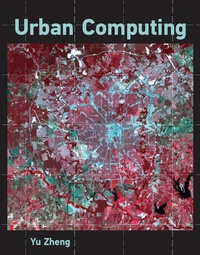
Urban Computing
Description

Urban computing brings powerful computational techniques to bear on such urban challenges as pollution, energy consumption, and traffic congestion. Using today's large-scale computing infrastructure and data gathered from sensing technologies, urban computing combines computer science with urban planning, transportation, environmental science, sociology, and other areas of urban studies, tackling specific problems with concrete methodologies in a data-centric computing framework. This authoritative treatment of urban computing offers an overview of the field, fundamental techniques, advanced models, and novel applications.
Each chapter acts as a tutorial that introduces readers to an important aspect of urban computing, with references to relevant research. The book outlines key concepts, sources of data, and typical applications; describes four paradigms of urban sensing in sensor-centric and human-centric categories; introduces data management for spatial and spatio-temporal data, from basic indexing and retrieval algorithms to cloud computing platforms; and covers beginning and advanced topics in mining knowledge from urban big data, beginning with fundamental data mining algorithms and progressing to advanced machine learning techniques. Urban Computing provides students, researchers, and application developers with an essential handbook to an evolving interdisciplinary field.
More details
Other editions
Additional editions
Person
Content
- Intro
- Series Page
- Title Page
- Copyright Page
- Table of Contents
- Preface
- Acknowledgments
- I: Concepts and Framework
- 1. Overview
- 1.1. Introduction
- 1.2. Definition of Urban Computing
- 1.3. General Framework
- 1.3.1. Brief and Example
- 1.3.2. Functions of Each Layer
- 1.4. Key Urban-Computing Challenges
- 1.4.1. Urban-Sensing Challenges
- 1.4.2. Urban Data Management Challenges
- 1.4.3. Urban Data Analytics Challenges
- 1.4.4. Urban Service Challenges
- 1.5. Urban Data
- 1.5.1. Taxonomy of Urban Data
- 1.5.2. Geographical Data
- 1.5.3. Traffic Data on Road Networks
- 1.5.4. Mobile Phone Data
- 1.5.5. Commuting Data
- 1.5.6. Environmental-Monitoring Data
- 1.5.7. Social Network Data
- 1.5.8. Energy
- 1.5.9. Economy
- 1.5.10. Health Care
- 1.6. Public Datasets
- References
- 2. Urban-Computing Applications
- 2.1. Introduction
- 2.2. Urban Computing for Urban Planning
- 2.2.1. Gleaning Underlying Problems in Transportation Networks
- 2.2.2. Discovering Functional Regions
- 2.2.3. Detecting a City's Boundaries
- 2.2.4. Facility and Resource Deployment
- 2.3. Urban Computing for Transportation Systems
- 2.3.1. Improving Driving Experiences
- 2.3.2. Improving Taxi Services
- 2.3.3. Improving Bus Services
- 2.3.4. Subway Services
- 2.3.5. Bike-Sharing Systems
- 2.4. Urban Computing for the Environment
- 2.4.1. Air Quality
- 2.4.2. Noise Pollution
- 2.4.3. Urban Water
- 2.5. Urban Computing for Urban Energy Consumption
- 2.5.1. Gas Consumption
- 2.5.2. Electricity Consumption
- 2.6. Urban Computing for Social Applications
- 2.6.1. Concepts of Location-Based Social Networks
- 2.6.2. Understanding Users in Location-Based Social Networks
- 2.6.3. Location Recommendations
- 2.7. Urban Computing for the Economy
- 2.7.1. Location Selection for Businesses
- 2.7.2. Optimizing Urban Logistics
- 2.8. Urban Computing for Public Safety and Security
- 2.8.1. Detecting Urban Anomalies
- 2.8.2. Predicting the Flow of Crowds
- 2.9. Summary
- References
- II: Urban Sensing and Data Acquisition
- 3. Urban Sensing
- 3.1. Introduction
- 3.1.1. Four Paradigms of Urban Sensing
- 3.1.2. General Framework of Urban Sensing
- 3.2. Sensor and Facility Deployment
- 3.2.1. Finding Optimal Meeting Points
- 3.2.2. Maximizing Coverage
- 3.2.3. Learning-to-Rank Candidates
- 3.2.4. Minimizing Uncertainty
- 3.3. Human-Centric Urban Sensing
- 3.3.1. Data Evaluation
- 3.3.2. Participant Recruitment and Task Design
- 3.4. Filling Missing Values
- 3.4.1. Problem and Challenges
- 3.4.2. Spatial Models
- 3.4.3. Temporal Models
- 3.4.4. Spatiotemporal Models
- 3.5. Summary
- References
- III: Urban Data Management
- 4. Spatiotemporal Data Management
- 4.1. Introduction
- 4.1.1. Data Structures
- 4.1.2. Queries
- 4.1.3. Indexes
- 4.1.4. Retrieval Algorithms
- 4.2. Data Structures
- 4.2.1. Point-Based Spatial Static Data
- 4.2.2. Point-Based Spatial Time Series Data
- 4.2.3. Point-Based Spatiotemporal Data
- 4.2.4. Network-Based Spatial Static Data
- 4.2.5. Network-Based Spatial Time Series Data
- 4.2.6. Network-Based Spatiotemporal Data
- 4.3. Spatial Data Management
- 4.3.1. Grid-Based Spatial Index
- 4.3.2. Quadtree-Based Spatial Index
- 4.3.3. K-D Tree-Based Spatial Index
- 4.3.4. R-Tree-Based Spatial Index
- 4.4. Spatiotemporal Data Management
- 4.4.1. Managing Spatial Static and Temporal Dynamic Data
- 4.4.2. Moving-Object Databases
- 4.4.3. Trajectory Data Management
- 4.5. Hybrid Indexes for Managing Multiple Datasets
- 4.5.1. Queries and Motivations
- 4.5.2. Spatial Key Words
- 4.5.3. Indexes for Managing Multiple Datasets
- 4.6. Summary
- References
- 5. Introduction to Cloud Computing
- 5.1. Introduction
- 5.2. Storage
- 5.2.1. SQL Databases
- 5.2.2. Azure Storage
- 5.2.3. Redis Cache
- 5.3. Computing
- 5.3.1. Virtual Machine
- 5.3.2. Cloud Services
- 5.3.3. HDInsight
- 5.4. Applications
- 5.4.1. Web Apps
- 5.4.2. Mobile Apps
- 5.4.3. API Apps
- 5.5. Summary
- References
- 6. Managing Spatiotemporal Data in the Cloud
- 6.1. Introduction
- 6.1.1. Challenges
- 6.1.2. General Data Management Schemes on the Cloud
- 6.2. Managing Point-Based Data
- 6.2.1. Managing Point-Based Spatiotemporal Static Data
- 6.2.2. Managing Point-Based Spatial Static and Temporal Dynamic Data
- 6.2.3. Managing Point-Based Spatiotemporal Dynamic Data
- 6.3. Managing Network-Based Data
- 6.3.1. Managing Spatiotemporal Static Networks
- 6.3.2. Managing Network-Based Spatial Static and Temporally Dynamic Data
- 6.3.3. Managing Network-Based Spatiotemporal Dynamic Data
- 6.4. Urban Big-Data Platform
- 6.5. Summary
- IV: Urban Data Analytics
- 7. Fundamental Data-Mining Techniques for Urban Data
- 7.1. Introduction
- 7.1.1. General Framework of Data Mining
- 7.1.2. Relationship between Data Mining and Related Technologies
- 7.2. Data Preprocessing
- 7.2.1. Data Cleaning
- 7.2.2. Data Transformation
- 7.2.3. Data Integration
- 7.3. Frequent Pattern Mining and Association Rules
- 7.3.1. Basic Concepts
- 7.3.2. Frequent Itemset Mining Methods
- 7.3.3. Sequential Pattern Mining
- 7.3.4. Frequent Subgraph Pattern Mining
- 7.4. Clustering
- 7.4.1. Concepts
- 7.4.2. Partitioning Clustering Methods
- 7.4.3. Density-Based Clustering
- 7.4.4. Hierarchical Clustering Methods
- 7.5. Classification
- 7.5.1. Concepts
- 7.5.2. Naïve Bayesian Classification
- 7.5.3. Decision Trees
- 7.5.4. Support Vector Machines
- 7.5.5. Classification with Imbalanced Data
- 7.6. Regression
- 7.6.1. Linear Regression
- 7.6.2. Autoregression
- 7.6.3. Regression Tree
- 7.7. Outlier and Anomaly Detection
- 7.7.1. Proximity-Based Outlier Detection
- 7.7.2. Statistic-Based Outlier Detection
- 7.8. Summary
- References
- 8. Advanced Machine-Learning Techniques for Spatiotemporal Data
- 8.1. Introduction
- 8.2. Unique Properties of Spatiotemporal Data
- 8.2.1. Spatial Properties of Spatiotemporal Data
- 8.2.2. Temporal Properties
- 8.3. Collaborative Filtering
- 8.3.1. Basic Models: User Based and Item Based
- 8.3.2. Collaborative Filtering for Spatiotemporal Data
- 8.4. Matrix Factorization
- 8.4.1. Basic Matrix Factorization Methods
- 8.4.2. Matrix Factorization for Spatiotemporal Data
- 8.5. Tensor Decomposition
- 8.5.1. Basic Concepts of Tensors
- 8.5.2. Methods of Tensor Decomposition
- 8.5.3. Tensor Decomposition for Spatiotemporal Data
- 8.6. Probabilistic Graphical Models
- 8.6.1. General Concepts
- 8.6.2. Bayesian Networks
- 8.6.3. Markov Random Field
- 8.6.4. Bayesian Networks for Spatiotemporal Data
- 8.6.5. Markov Networks for Spatiotemporal Data
- 8.7. Deep Learning
- 8.7.1. Artificial Neural Networks
- 8.7.2. Convolutional Neural Networks
- 8.7.3. Recurrent Neural Networks
- 8.7.4. Deep Learning for Spatiotemporal Data
- 8.8. Reinforcement Learning
- 8.8.1. Concepts of Reinforcement Learning
- 8.8.2. Tabular Action-Value Methods
- 8.8.3. Approximate Methods
- 8.9. Summary
- References
- 9. Cross-Domain Knowledge Fusion
- 9.1. Introduction
- 9.1.1. Relationship to Traditional Data Integration
- 9.1.2. Relationship to Heterogeneous Information Networks
- 9.2. Stage-Based Knowledge Fusion
- 9.3. Feature-Based Knowledge Fusion
- 9.3.1. Feature Concatenation with Regularization
- 9.3.2. Deep Learning-Based Knowledge Fusion
- 9.4. Semantic Meaning-Based Knowledge Fusion
- 9.4.1. Multi-View-Based Knowledge Fusion
- 9.4.2. Similarity-Based Knowledge Fusion
- 9.4.3. Probabilistic Dependency-Based Knowledge Fusion
- 9.4.4. Transfer Learning-Based Knowledge Fusion
- 9.5. Comparison between Different Fusion Methods
- 9.5.1. Volume, Properties, and Insight of Datasets
- 9.5.2. The Goal of a Machine-Learning Task
- 9.5.3. Learning Approach of Machine-Learning Algorithms
- 9.5.4. Efficiency and Scalability
- 9.6. Summary
- References
- 10. Advanced Topics in Urban Data Analytics
- 10.1. How to Select Useful Datasets
- 10.1.1. Understanding Target Problems
- 10.1.2. Insights behind Data
- 10.1.3. Validating Assumptions
- 10.2. Trajectory Data Mining
- 10.2.1. Trajectory Data
- 10.2.2. Trajectory Preprocessing
- 10.2.3. Trajectory Data Management
- 10.2.4. Uncertainty in a Trajectory
- 10.2.5. Trajectory Pattern Mining
- 10.2.6. Trajectory Classification
- 10.2.7. Anomalies Detection from Trajectories
- 10.2.8. Transferring Trajectories to Other Representations
- 10.3. Combining Machine Learning with Data Management
- 10.3.1. Motivation
- 10.3.2. Boosting Machine Learning with Indexing Structures
- 10.3.3. Scale Down Candidates for Machine Learning
- 10.3.4. Derive Bounds to Prune Computing Spaces for Machine Learning
- 10.4. Interactive Visual Data Analytics
- 10.4.1. Incorporating Multiple Complex Factors
- 10.4.2. Adjusting Parameters without Prior Knowledge
- 10.4.3. Drilling Down into Results
- 10.5. Summary
- References
- About the Author
- Index
