

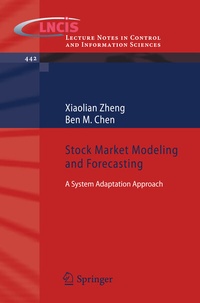
Stock Market Modeling and Forecasting
A System Adaptation Approach
Published on 5. April 2013
XII, 161 pages
978-1-4471-5155-5 (ISBN)
Description

Stock Market Modeling and Forecasting translates experience in system adaptation gained in an engineering context to the modeling of financial markets with a view to improving the capture and understanding of market dynamics. The modeling process is considered as identifying a dynamic system in which a real stock market is treated as an unknown plant and the identification model proposed is tuned by feedback of the matching error. Like a physical system, a financial market exhibits fast and slow dynamics corresponding to external (such as company value and profitability) and internal forces (such as investor sentiment and commodity prices) respectively. The framework presented here, consisting of an internal model and an adaptive filter, is successful at considering both fast and slow market dynamics. A double selection method is efficacious in identifying input factors influential in market movements, revealing them to be both frequency- and market-dependent.
The authors present work on both developed and developing markets in the shape of the US, Hong Kong, Chinese and Singaporean stock markets. Results from all these sources demonstrate the efficiency of the model framework in identifying significant influences and the quality of its predictive ability; promising results are also obtained by applying the model framework to the forecasting of major market-turning periods. Having shown that system-theoretic ideas can form the core of a novel and effective basis for stock market analysis, the book is completed by an indication of possible and likely future expansions of the research in this area.
The authors present work on both developed and developing markets in the shape of the US, Hong Kong, Chinese and Singaporean stock markets. Results from all these sources demonstrate the efficiency of the model framework in identifying significant influences and the quality of its predictive ability; promising results are also obtained by applying the model framework to the forecasting of major market-turning periods. Having shown that system-theoretic ideas can form the core of a novel and effective basis for stock market analysis, the book is completed by an indication of possible and likely future expansions of the research in this area.
More details
Other editions
Additional editions
Book
04/2013
1st Edition
Springer
€106.99
Shipment within 15-20 days
Persons
Xiaolian Zheng is a PhD candidate finishing her PhD program in the Department of Electrical and Computer Engineering, National University of Singapore. Her research interest is in financial market modeling.
Professor Ben M. Chen received his B.S. degree in mathematics and computer science from Xiamen University, Xiamen, China, in 1983, M.S. degree in electrical engineering from Gonzaga University, Spokane, Washington, USA, in 1988, and Ph.D. degree in electrical and computer engineering from Washington State University, Pullman, Washington, USA, in 1991. He was a software engineer in South-China Computer Corporation, Guangzhou, China, from 1983 to 1986, and was an assistant professor from 1992 to 1993 in the Department of Electrical Engineering, State University of New York at Stony Brook, USA. Since August 1993, he has been with the Department of Electrical and Computer Engineering, National University of Singapore, where he is currently a professor. His current research interests are in robust control, systems theory, unmanned aerial systems, and financial market modeling.
He is the author/co-author of 8 research monographs including Loop Transfer Recovery: Analysis and Design (Springer, 1993); H2 Optimal Control (Prentice Hall, 1995); Robust and H8 Control (Springer, 2000, Chinese edition is to be published by Science Press, Beijing, 2010); Linear Systems Theory: A Structural Decomposition Approach (Birkhauser, 2004; Chinese translation published by Tsinghua University Press, 2008); Hard Disk Drive Servo Systems (Springer, 1st Edn., 2002; 2nd Edn., 2006); and Unmanned Rotorcraft Systems (Springer, 2010). He served/serves on the editorial boards for a number of international journals including IEEE Transactions on Automatic Control, Automatica, Systems and Control Letters, and Journal of Control Theory and Applications.
Dr Chen is a Fellow of IEEE. He was the recipient of Best Poster Paper Award, 2nd Asian Control Conference, Seoul, Korea(1997); University Researcher Award, National University of Singapore (2000); Prestigious Engineering Achievement Award, Institution of Engineers, Singapore (2001); Temasek Young Investigator Award, Defence Science & Technology Agency, Singapore (2003); Best Industrial Control Application Prize, 5th Asian Control Conference, Melbourne, Australia (2004); and Best Application Paper Award, 7th Asian Control Conference, Hong Kong (2009).
Professor Ben M. Chen received his B.S. degree in mathematics and computer science from Xiamen University, Xiamen, China, in 1983, M.S. degree in electrical engineering from Gonzaga University, Spokane, Washington, USA, in 1988, and Ph.D. degree in electrical and computer engineering from Washington State University, Pullman, Washington, USA, in 1991. He was a software engineer in South-China Computer Corporation, Guangzhou, China, from 1983 to 1986, and was an assistant professor from 1992 to 1993 in the Department of Electrical Engineering, State University of New York at Stony Brook, USA. Since August 1993, he has been with the Department of Electrical and Computer Engineering, National University of Singapore, where he is currently a professor. His current research interests are in robust control, systems theory, unmanned aerial systems, and financial market modeling.
He is the author/co-author of 8 research monographs including Loop Transfer Recovery: Analysis and Design (Springer, 1993); H2 Optimal Control (Prentice Hall, 1995); Robust and H8 Control (Springer, 2000, Chinese edition is to be published by Science Press, Beijing, 2010); Linear Systems Theory: A Structural Decomposition Approach (Birkhauser, 2004; Chinese translation published by Tsinghua University Press, 2008); Hard Disk Drive Servo Systems (Springer, 1st Edn., 2002; 2nd Edn., 2006); and Unmanned Rotorcraft Systems (Springer, 2010). He served/serves on the editorial boards for a number of international journals including IEEE Transactions on Automatic Control, Automatica, Systems and Control Letters, and Journal of Control Theory and Applications.
Dr Chen is a Fellow of IEEE. He was the recipient of Best Poster Paper Award, 2nd Asian Control Conference, Seoul, Korea(1997); University Researcher Award, National University of Singapore (2000); Prestigious Engineering Achievement Award, Institution of Engineers, Singapore (2001); Temasek Young Investigator Award, Defence Science & Technology Agency, Singapore (2003); Best Industrial Control Application Prize, 5th Asian Control Conference, Melbourne, Australia (2004); and Best Application Paper Award, 7th Asian Control Conference, Hong Kong (2009).
Content
A System Adaptation Framework.- Market Input Analysis.- Analysis of Dow Jones Industrial Average.- Selected Asian Markets.- Forecasting of Market Major Turning Periods.- Technical Analysis Toolkit.- Further Research.
