

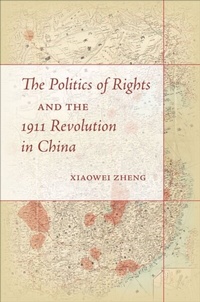
The Politics of Rights and the 1911 Revolution in China
Published on 23. January 2018
376 pages
978-1-5036-0109-3 (ISBN)
Description

China's 1911 Revolution was a momentous political transformation. Its leaders, however, were not rebellious troublemakers on the periphery of imperial order. On the contrary, they were a powerful political and economic elite deeply entrenched in local society and well-respected both for their imperially sanctioned cultural credentials and for their mastery of new ideas. The revolution they spearheaded produced a new, democratic political culture that enshrined national sovereignty, constitutionalism, and the rights of the people as indisputable principles.
Based upon previously untapped Qing and Republican sources, The Politics of Rights and the 1911 Revolution in China is a nuanced and colorful chronicle of the revolution as it occurred in local and regional areas. Xiaowei Zheng explores the ideas that motivated the revolution, the popularization of those ideas, and their animating impact on the Chinese people at large. The focus of the book is not on the success or failure of the revolution, but rather on the transformative effect that revolution has on people and what they learn from it.
Based upon previously untapped Qing and Republican sources, The Politics of Rights and the 1911 Revolution in China is a nuanced and colorful chronicle of the revolution as it occurred in local and regional areas. Xiaowei Zheng explores the ideas that motivated the revolution, the popularization of those ideas, and their animating impact on the Chinese people at large. The focus of the book is not on the success or failure of the revolution, but rather on the transformative effect that revolution has on people and what they learn from it.
Reviews / Votes
"While encompassing institutional and social history of the Republican Revolution in China, Zheng successfully breaks new ground by conceptualizing the era's political activism-its struggles and passions-around rights, law, and most of all, constitutionalism. This is the story of the birth of modern politics in China, whose historical messages remain valuable to the present day."-Prasenjit Duara, Duke University "In this powerful, original analysis, Xiaowei Zheng traces the genealogy of 'constitutionalism' and the transformation of elite consciousness in the last decades of the Qing dynasty. She analyzes both political culture and electoral politics and skillfully tacks between local and national levels. This is the best book on the 1911 Revolution to appear in many years, and it will be the point of departure for all future research on the subject."-Matthew Sommer, Stanford University "A major contribution to the historiography of the 1911 Revolution, this book illuminates the events leading to the birth of the Chinese republic in a context wherein the propagation of new ideas prepared both elites and commoners to turn against the Qing government. Zheng depicts, in vivid and compelling detail, the constitutional movement and the 1911 Revolution in Sichuan, without losing sight of nationwide developments."-Li Huaiyin, University of Texas at Austin "The Chinese Revolution of 1911 toppled the Qing dynasty and established a republic. In this thoughtful, well-written work, Zheng argues that the revolution ushered in a new political culture of respect for the equality and rights of citizens, formed in response to the imperialist threat to the nation."-K.E. Stapleton, Choice "The Politics of Rights and the 1911 Revolution in China should be mandatory reading for all scholars of twentieth- and twenty-first-century China."-Peter J. Carroll, Twentieth-Century China "This study offers an important new framework for understanding China's 1911 Revolution by bringing intellectual change to the fore as the most decisive factor in creating the conditions for revolution."-Edward McCord, China Review International "[A] considerable accomplishment in this impressive book....The repeated failures to establish the requisite political and institutional structures to successfully translate the emergence of this potent force into genuine, orderly, and meaningful political participation of the Chinese people in the management of their own country is, indeed, the tragedy of the Chinese revolution."-Michael Tsin, American Historical Review "The Politics of Rights and the 1911 Revolution in China is worth the attention of every student of modern China."-Peter Zarrow, Journal of Asian StudiesAll prices
More details
Edition
New edition
Language
English
Place of publication
Palo Alto
United States
Target group
Professional and scholarly
Edition type
New edition
Illustrations
17 halftones, 1 table, 7 maps
File size
13,97 MB
ISBN-13
978-1-5036-0109-3 (9781503601093)
Copyright in bibliographic data and cover images is held by Nielsen Book Services Limited or by the publishers or by their respective licensors: all rights reserved.
Schweitzer Classification
Other editions
Additional editions
Xiaowei Zheng
The Politics of Rights and the 1911 Revolution in China
Book
02/2018
Stanford University Press
€132.50
Shipment within 15-20 days
Xiaowei Zheng
The Politics of Rights and the 1911 Revolution in China
Book
01/2018
Stanford University Press
€30.50
Shipment within 15-20 days
Person
Xiaowei Zheng is Associate Professor of History and East Asian Languages and Cultural Studies at the University of California, Santa Barbara.
Content
Introduction: The Political Transformation of 1911
1. Sichuan and the Old Regime
2. The Ideas of Revolution: Equality, the People's Rights , and Popular Sovereignty
3. The Project: The Chuan-Han Railway Company and the New Policies Reform
4. Can Two Sides Walk Together Without Agreeing to Meet? Constitutionalists and Officials in the Late Qing Constitutional Reform
5. The Rhetoric of Revolution: the Rights of the Nation, Constitutionalism, and the Rights of the People
6. The Practice of Revolution: Organization, Mobilization, and Radicalization
7. The Expansion and Division of Revolution: Democratic Political Culture in Action
8. The End of Revolution: the Rise of Republicanism the Failure of Constitutionalism
Conclusion: The Legacy of the 1911 Revolution
1. Sichuan and the Old Regime
2. The Ideas of Revolution: Equality, the People's Rights , and Popular Sovereignty
3. The Project: The Chuan-Han Railway Company and the New Policies Reform
4. Can Two Sides Walk Together Without Agreeing to Meet? Constitutionalists and Officials in the Late Qing Constitutional Reform
5. The Rhetoric of Revolution: the Rights of the Nation, Constitutionalism, and the Rights of the People
6. The Practice of Revolution: Organization, Mobilization, and Radicalization
7. The Expansion and Division of Revolution: Democratic Political Culture in Action
8. The End of Revolution: the Rise of Republicanism the Failure of Constitutionalism
Conclusion: The Legacy of the 1911 Revolution

