

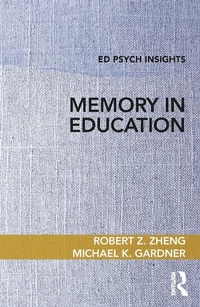
Memory in Education
1st Edition
Published on 23. October 2019
172 pages
978-0-429-67315-3 (ISBN)
Description

As our understanding of the human memory system broadens and develops, new opportunities arise for improving students' long-term knowledge retention in the classroom. Written by two experts on the subject, this book explores how scientific models of memory and cognition can inform instructional practices. Six chapters guide readers through the information processing model of memory, working and long-term memory, and Cognitive Load Theory (CLT) before addressing instructional strategies. This accessible, up-to-date volume is designed for any educational psychology or general education course that includes memory in the curriculum and will be indispensable for student researchers and both pre- and in-service teachers alike.
Reviews / Votes
"This book explains the fundamental components of human memory, such that both students and educators can understand and apply the material directly to learning. The text explains not only how memory works, but how we can utilize that information to optimize learning across a broad swath of domains. I look forward to using this book in my own courses in Educational Psychology." - Anne Cook, Ph.D., Professor and Chair of Educational Psychology Department, University of Utah, USA"Memory in Education makes a substantial contribution to the educational literature by articulating how theory and research explain and support multiple memory techniques. Among the many useful aspects of this text is the discussion of cognitive load theory. Knowing how to reduce extraneous cognitive load and increase positive, 'germane' cognitive load is especially important in addressing the complex information demands in education today. There is much in this text that can benefit both students and teachers." -Marc M. Sebrechts, Ph.D., Wylma and James Curtin Professor of Psychology, The Catholic University of America, USA
More details
Series
Edition
1. Auflage
Language
English
Place of publication
London
United Kingdom
Publishing group
Taylor & Francis Ltd
Target group
College/higher education
Professional and scholarly
Illustrations
2 Tables, black and white; 4 Line drawings, black and white; 9 Halftones, black and white; 13 Illustrations, black and white
ISBN-13
978-0-429-67315-3 (9780429673153)
Copyright in bibliographic data and cover images is held by Nielsen Book Services Limited or by the publishers or by their respective licensors: all rights reserved.
Schweitzer Classification
Other editions
Additional editions
Robert Z. Zheng | Michael K. Gardner
Memory in Education
Book
11/2019
1st Edition
Routledge
€179.51
Shipment within 15-20 days
Robert Z. Zheng | Michael K. Gardner
Memory in Education
Book
11/2019
1st Edition
Routledge
€53.40
Shipment within 15-20 days
Persons
Robert Z. Zheng is Professor of Educational Psychology at the University of Utah, USA.
Michael K. Gardner is Professor of Educational Psychology at the University of Utah, USA.
Michael K. Gardner is Professor of Educational Psychology at the University of Utah, USA.
Content
1. Introduction 2. Information Processing Model of Human Memory 3. Practical Educational Implications from Research on Memory 4. Working Memory, Cognitive Load and Learning 5. Designing Instructional Strategies for Effective Learning 6. Conclusions
