

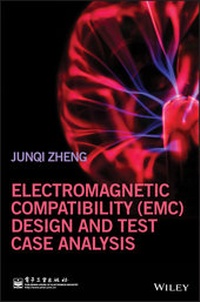
Electromagnetic Compatibility (EMC) Design and Test Case Analysis
Description

* Introduces techniques for the design of electronic products from the EMC aspects
* Covers normalized EMC requirements and design principles to assure product compatibility
* Describes the main topics for the control of electromagnetic interferences and recommends design improvements to meet international standards requirements (FCC, EU EMC directive, Radio acts, etc.)
* Well organized in a logical sequence which starts from basic knowledge and continues through the various aspects required for compliance with EMC requirements
* Includes practical examples and case studies to illustrate design features and troubleshooting
* Author is the founder of the EMC design risk evaluation approach and this book presents many years' experience in teaching and researching the topic
More details
Other editions
Additional editions
Person
JUNQI ZHENG, National Radio Interference and Standardization Technical Committee; Shanghai Testing and Inspection Institute for Electrical Equipment, China.
Content
Preface xi
Exordium xv
Introduction xix
1 The EMC Basic Knowledge and the Essence of the EMC Test 1
1.1 What Is EMC? 1
1.2 Conduction, Radiation, and Transient 2
1.3 Theoretical Basis 4
1.3.1 Time Domain and Frequency Domain 4
1.3.2 The Concept of the Unit for Electromagnetic Disturbance, dB 5
1.3.3 The True Meaning of Decibel 6
1.3.4 Electric Field, Magnetic Field, and Antennas 9
1.3.5 Resonance of the RLC Circuit 17
1.4 Common Mode and Differential Mode in the EMC Domain 21
1.5 Essence of the EMC Test 23
1.5.1 Essence of the Radiated Emission Test 23
1.5.2 Essence of the Conducted Emission Test 25
1.5.3 Essence of the ESD Immunity Test 29
1.5.4 Essence of the Radiated Immunity Test 30
1.5.5 Essence of the Common-Mode Conducted Immunity Test 32
1.5.6 Essence of the Differential-Mode Conducted Immunity Test 34
1.5.7 Differential-Mode and Common-Mode Hybrid Conducted Immunity Test 35
2 Architecture, Shielding, and Grounding Versus EMC of the Product 37
2.1 Introduction 37
2.1.1 Architecture Versus EMC of the Product 37
2.1.2 Shielding Versus EMC of the Product 38
2.1.3 Grounding Versus EMC of the Product 40
2.2 Analyses of Related Cases 41
2.2.1 Case 1: The Conducted Disturbance and the Grounding 41
2.2.2 Case 2: The Ground Loop During the Conducted Emission Test 46
2.2.3 Case 3: Where the Radiated Emission Outside the Shield Comes From 49
2.2.4 Case 4: The "Floating" Metal and the Radiation 52
2.2.5 Case 5: Radiated Emission Caused by the Bolt Extended Outside the Shield 55
2.2.6 Case 6: The Compression Amount of the Shield and Its Shielding Effectiveness 59
2.2.7 Case 7: The EMI Suppression Effectiveness of the Shielding Layer Between the Transformer's Primary Winding and Secondary Winding in the Switching-Mode Power Supply 62
2.2.8 Case 8: Bad Contact of the Metallic Casing and System Reset 68
2.2.9 Case 9: ESD Discharge and the Screw 70
2.2.10 Case 10: Heatsink Also Affects the ESD Immunity 71
2.2.11 Case 11: How Grounding Benefits EMC Performance 72
2.2.12 Case 12: The Heatsink Shape Affects Conducted Emissions from the Power Ports 76
2.2.13 Case 13: The Metallic Casing Oppositely Causes the EMI Test Failed 82
2.2.14 Case 14: Whether Directly Connecting the PCB Reference Ground to the Metallic Casing Will Lead to ESD 88
2.2.15 Case 15: How to Interconnect the Digital Ground and the Analog Ground in the Digital-Analog Mixed Devices 94
3 EMC Issues with Cables, Connectors, and Interface Circuits 101
3.1 Introduction 101
3.1.1 Cable Is the Weakest Link in the System 101
3.1.2 The Interface Circuit Provides Solutions to the Cable Radiation Problem 102
3.1.3 Connectors Are the Path Between the Interface Circuit and the Cable 103
3.1.4 The Interconnection between the PCBs Is the Weakest Link of the Product EMC 104
3.2 Analyses of Related Cases 107
3.2.1 Case 16: The Excessive Radiation Caused by the Cabling 107
3.2.2 Case 17: Impact from the Pigtail of the Shielded Cable 110
3.2.3 Case 18: The Radiated Emission from the Grounding Cable 113
3.2.4 Case 19: Is the Shielded Cable Clearly Better than the Unshielded Cable? 117
3.2.5 Case 20: Impacts on ESD Immunity of the Plastic Shell Connectors and the Metallic Shell Connector 124
3.2.6 Case 21: The Selection of the Plastic Shell Connector and the ESD Immunity 126
3.2.7 Case 22: When the Shield Layer of the Shielded Cable Is Not Grounded 128
3.2.8 Case 23: The Radiated Emission Problem Brings Out Two EMC Design Problems of a Digital Camera 131
3.2.9 Case 24: Why PCB Interconnecting Ribbon Is So Important for EMC 138
3.2.10 Case 25: Excessive Radiated Emission Caused by the Loop 144
3.2.11 Case 26: Pay Attention to the Interconnection and Wiring Inside the Product 149
3.2.12 Case 27: Consequences of the Mixed Wiring Between Signal Cable and Power Cable 151
3.2.13 Case 28: What Should Be Noticed When Installing the Power Filters 155
4 Filtering and Suppression for EMC Performance Improvement 161
4.1 Introduction 161
4.1.1 Filtering Components 161
4.1.2 Surge Protection Components 167
4.2 Analyses of Related Cases 173
4.2.1 Case 29: The Radiated Emission Caused by a Hub Exceeds the Standard Limit 173
4.2.2 Case 30: Installation of the Power Supply Filter and the Conducted Emission 178
4.2.3 Case 31: Filtering the Output Port May Impact the Conducted Disturbance of the Input Port 182
4.2.4 Case 32: Properly Using the Common-Mode Inductor to Solve the Problem in the Radiated and Conducted Immunity Test 187
4.2.5 Case 33: The Design of Differential-Mode Filter for Switching-Mode Power Supply 190
4.2.6 Case 34: Design of the Common-Mode Filter for Switching-Mode Power Supply 196
4.2.7 Case 35: Whether More Filtering Components Mean Better Filtering Effectiveness 203
4.2.8 Case 36: The Events Should Be Noticed When Positioning the Filters 208
4.2.9 Case 37: How to Solve Excessive Harmonic Currents of Switching-Mode Power Supply 211
4.2.10 Case 38: Protections from Resistors and TVSs on the Interface Circuit 213
4.2.11 Case 39: Can the Surge Protection Components Be in Parallel Arbitrarily? 218
4.2.12 Case 40: Components in Surge Protection Design Must Be Coordinated 224
4.2.13 Case 41: The Lightning Protection Circuit Design and the Component Selections Must Be Careful 226
4.2.14 Case 42: Strict Rule for Installing the Lightening Protections 227
4.2.15 Case 43: How to Choose the Clamping Voltage and the Peak Power of TVS 230
4.2.16 Case 44: Choose the Diode for Clamping or the TVS for Protection 232
4.2.17 Case 45: Ferrite Ring Core and EFT/B Immunity 235
4.2.18 Case 46: How Ferrite Bead Reduces the Radiated Emission of Switching-Mode Power Supply 238
5 Bypassing and Decoupling 243
5.1 Introduction 243
5.1.1 The Concept of Decoupling, Bypassing, and Energy Storage 243
5.1.2 Resonance 244
5.1.3 Impedance 248
5.1.4 The Selection of Decoupling Capacitor and Bypass Capacitor 249
5.1.5 Capacitor Paralleling 251
5.2 Analyses of Related Cases 253
5.2.1 Case 47: The Decoupling Effectiveness for the Power Supply and the Capacitance of Capacitor 253
5.2.2 Case 48: Locations of the Ferrite Bead and Decoupling Capacitor Connected to the Chip's Power Supply Pin 258
5.2.3 Case 49: Producing Interference of the ESD Discharge 263
5.2.4 Case 50: Using Small Capacitance Can Help Solve a Longstanding Problem 266
5.2.5 Case 51: How to Deal with the ESD Air Discharge Point for the Product with Metallic Casing 268
5.2.6 Case 52: ESD and Bypass Capacitor for Sensitive Signals 270
5.2.7 Case 53: Problems Caused by the Inappropriate Positioning of the Magnetic Bead During Surge Test 273
5.2.8 Case 54: The Role of the Bypass Capacitor 275
5.2.9 Case 55: How to Connect the Digital Ground and the Analog Ground at Both Sides of the Opto-Coupler 278
5.2.10 Case 56: Diode and Energy Storage, the Immunity of Voltage Dip, and Voltage Interruption 282
6 PCB Design and EMC 289
6.1 Introduction 289
6.1.1 PCB Is a Microcosm of a Complete Product 289
6.1.2 Loops Are Everywhere in PCB 289
6.1.3 Crosstalk Must Be Prevented 290
6.1.4 There Are Many Antennas in the PCB 291
6.1.5 The Impedance of the Ground Plane in PCB Directly Influences the Transient Immunity 291
6.2 Analyses of Related Cases 293
6.2.1 Case 57: The Role of "Quiet" Ground 293
6.2.2 Case 58: The Loop Formed by PCB Routing Causes Product Reset During ESD Test 298
6.2.3 Case 59: Unreasonable PCB Wiring Causes the Interface Damaged by Lightning Surge 303
6.2.4 Case 60: How to Dispose the Grounds at Both Sides of Common-Mode Inductor 305
6.2.5 Case 61: Avoid Coupling When the Ground Plane and the Power Plane Are Poured on PCB 309
6.2.6 Case 62: The Relationship Between the Width of PCB Trace and the Magnitude of the Surge Current 314
6.2.7 Case 63: How to Avoid the Noise of the Oscillator Being Transmitted to the Cable Port 317
6.2.8 Case 64: The Radiated Emission Caused by the Noise from the Address Lines 319
6.2.9 Case 65: The Disturbance Produced by the Loop 324
6.2.10 Case 66: The Spacing Between PCB Layers and EMI 329
6.2.11 Case 67: Why the Sensitive Trace Routed at the Edge of the PCB Is Susceptible to the ESD Disturbance 334
6.2.12 Case 68: EMC Test Can Be Passed by Reducing the Series Resistance on the Signal Line 338
6.2.13 Case 69: Detailed Analysis Case for the PCB Design of Analog-Digital Mixed Circuit 339
6.2.14 Case 70: Why the Oscillator Cannot Be Placed on the Edge of the PCB 357
6.2.15 Case 71: Why the Local Ground Plane Needs to Be Placed Under the Strong Radiator 360
6.2.16 Case 72: The Routing of the Interface Circuit and the ESD Immunity 363
7 Components, Software, and Frequency Jitter Technique 367
7.1 Components, Software, and EMC 367
7.2 Frequency Jitter Technique and EMC 368
7.3 Analyses of Related Cases 368
7.3.1 Case 73: Effect on the System EMC Performance from the EMC Characteristics of the Component and Software Versus Cannot Be Ignored 368
7.3.2 Case 74: Software and ESD Immunity 371
7.3.3 Case 75: The Conducted Emission Problem Caused by Frequency Jitter Technique 373
7.3.4 Case 76: The Problems of Circuit and Software Detected by Voltage Dip and Voltage Interruption Tests 379
Appendix A EMC Terms 381
Appendix B EMC Tests in Relevant Standard for Residential Product, Industrial, Scientific, and Medical Product, Railway Product, and Others 385
Appendix C EMC Test for Automotive Electronic and Electrical Components 405
Appendix D Military Standard Commonly Used for EMC Test 429
Appendix E EMC Standards and Certification 455
Further Reading 467
Index 469
Preface
The majority of domestic electromagnetic capacity books have a common defect, which is the lack of connections between design and testing. The discussion of the approach and techniques of EMC design should be based on EMC testing, not only because the first challenge of EMC design is the EMC test but also because those key factors like interference source, receiving antenna, and equivalent radiated antenna, which are critical to EMC analysis, will only exist during the EMC test. Taking the conducted emission test as an example, its essence is the voltage across a resistor in the line impedance stabilization network (LISN), when the resistance is fixed, the level of conducted disturbance depends on the current passing through the LISN resistor. EMC design is to reduce the current flow through the resistor. Possible tests include the typical immunity test, electrical fast transient/burst (EFT/B) test, big current injection (BCI) test, and electrostatic discharge (ESD) test, which is a typical common mode immunity test. The source of disturbance is a common-mode disturbance, referred to the reference ground plane, i.e. the reference point of these disturbance sources is the reference ground plane used in the test, which means that the current generated by the disturbance will eventually return to the reference ground plate. This is the basic starting point to analyze such disturbance problems.
Imagine, for the above-mentioned conducted disturbance test, that during the product testing, that the disturbance current does not flow through the LISN resistor, and at the same time, for the immunity test, that this disturbance current never passes through the product circuit, it is certainly very favorable for this product to pass the EMC tests, and this is what product design needs to consider. Therefore, the EMC design must be started from the EMC test. Electromagnetic Compatibility (EMC) Design and Test Case Analysis, as a project reference book, makes a close connection with the EMC test substance, EMC design principles, and specific product design to narrate EMC design methodology. Highly integrating the practical and theoretical contents is the biggest characteristic of this book.
The book is divided into seven chapters, in which the basic EMC knowledge is described in Chapter 1, mainly served for the 2-7 chapters. When readers read those later sections, if some basic concept is vague and not clearly explained, it can be easily consulted and checked from Chapter 1. Chapters 2-7 includes cases, which are typical and representative. Case descriptions use the same format: [Symptoms], [Analyses], [Solutions], and [Inspirations]. By analyzing each case, we introduce the practical information about EMC design and diagnostic technology to the designers to reduce the mistakes made by the designer in the product design and the diagnostic of EMC problems, and achieve good product EMC performance. At the same time, illustrating the design principles through EMC cases enables readers to achieve better understanding on the origin of the design. [Inspirations] section actually sums up the problem and highlights related issues. It can be used as a checklist of product EMC design. The cases are divided into the following six categories:
- Products' structural framing, shielding, and grounding versus EMC. For most devices, shielding is necessary. Especially with the increasing frequency in the circuit, relying solely on the circuit board design often fails to meet EMC standards. Proper shielding can greatly strengthen EMC performance, but an unreasonable shielding design can not only fail to play its desired effect but also oppositely cause additional EMC problems. In addition, grounding will not only help solve the safety problem but is also very important for EMC. Many EMC problems are caused by an unreasonable grounding design, as the ground potential is a reference potential of the entire circuit. If the ground is not properly designed, the ground potential may be unstable, which leads to failed circuits. It may also generate additional EMI problems. The purpose of the grounding design is to ensure that the ground potential is as stable as possible, to reduce the voltage drop on the ground, thereby eliminating the interference.
- Cables of products, connectors, and interface circuit versus EMC. Cable is always the path, which gives rise to radiation or bringing in the major disturbance. Because of their length, the cable is not only the transmitting antenna but also a good receiving antenna. And the cable has the most direct relationship, with the connector and interface circuit. Good interface circuit design not only can make the internal circuit noise well suppressed, so that there is no driving source for the transmitting antenna, but can also filter out the cable disturbance signal received from outside. Proper connector design of cable and interface circuit provides a good matching path.
- Filtering and suppressing. For any devices, filtering and suppressing are key techniques to resolve electromagnetic interference (EMI). This is because the conductor of the device is acting as a highly efficient receiving and radiating antenna, and therefore, most of the radiation generated by the device is achieved through a variety of wires, while the external disturbance is often received by the conductor first, then brought into the device. The goal of filtering and suppressing is to eliminate these interfering signals on the wire, to prevent circuit interference signals being transferred onto the wire and then radiated through the wire, and also to prevent the conductors receiving the disturbance and taking them into the circuit.
- Bypass, decoupling, and energy storage. When the device is operating, the signal level of the clock and data signals pins changes periodically. In this case, decoupling will provide enough dynamic voltage and current for the components when the clock and data are changing in normal operation. Decoupling is accomplished by providing a low-impedance power supply between the signal and power planes. As the frequency increases, before reaching the resonant point, the impedance of the decoupling capacitors will decrease, so that the high-frequency noise is effectively discharged from the signal line. Then the remained low-frequency RF energy will not be affected. Best results can be achieved through storage capacitors, bypass capacitors, and decoupling capacitors. These capacitance values can be calculated and obtained by specific formula. In addition, the capacitor insulation material must be correctly selected, rather than randomly selected based on the past usage and experience.
- PCB design versus EMC. Whether the device emits electromagnetic interference or is affected by outside disturbance, or generates mutual interference between the elects, PCB is the core of the problem (the component layout or the circuit routing of the PCB), and will have an impact on the nature of the product overall EMC performance. For example, a simulated interface connector position will affect the direction of common mode current flows in, and the path of the routing will affect the size of the circuit loop, these are the key factors of EMC. Therefore, a properly designed PCB is important to ensure good EMC performance for the product. The purpose of PCB design is to reduce the electromagnetic radiation generated by the circuit on the PCB and susceptibility to outside interference, and to reduce the interaction between the PCB circuits.
- Components, software, and frequency jittering technique. Circuits are composed of components, but the EMC performance of the components is often overlooked. In fact, the packaging, the rising edge, the pinout of the component, and the ESD immunity of the device itself have a huge impact on the performance of a product's EMC performance. Although the software does not belong to EMC academic areas, in some cases software fault-tolerant technique can be used to avoid the impact on the products from the outside interference. Frequency Jittering is a popular technique to reduce the conducted and radiated emission from circuits in recent years, but the technology is not foolproof. This chapter will give details to the substance of the case and precautions for frequency jitter technique.
In fact, EMC design rules are just like traffic regulations. Noncompliance will certainly not result in a traffic accident, but the risk is bound to increase. EMC design is in accordance, noncompliance of some rules may also be able to pass the test, but the risk is bound to be increased. So there is an urgent need to introduce the product design risk awareness to the industry. The purpose of EMC design is to minimize the risk of EMC test, as only for those products complying with all the EMC, and traffic rules have the lowest EMC risk. Most of the listed problems in this book are originated from EMC problems encountered in practical work, each case is originated from the experience of these cases, which come from the accumulation of a large number of typical EMC cases the author encountered. For those classic cases, there are more detailed theoretical analysis. Each of the results of those cases is formed with one or more of EMC design rules, and it is worth learning and referring. As the engagement of the author is limited, this book may not contain all kinds of EMC issues in electronics and electrical products.
If readers discover any mistakes due to the author's incomprehensive knowledge, leading to unreasonable or inaccurate descriptions or even critical mistakes, please feel free to contact...
