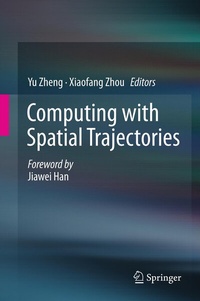
Computing with Spatial Trajectories
Description

Spatial trajectories have been bringing the unprecedented wealth to a variety of research communities. A spatial trajectory records the paths of a variety of moving objects, such as people who log their travel routes with GPS trajectories. The field of moving objects related research has become extremely active within the last few years, especially with all major database and data mining conferences and journals.
Computing with Spatial Trajectories introduces the algorithms, technologies, and systems used to process, manage and understand existing spatial trajectories for different applications. This book also presents an overview on both fundamentals and the state-of-the-art research inspired by spatial trajectory data, as well as a special focus on trajectory pattern mining, spatio-temporal data mining and location-based social networks. Each chapter provides readers with a tutorial-style introduction to one important aspect of location trajectory computing, case studies and many valuable references to other relevant research work.
Computing with Spatial Trajectories is designed as a reference or secondary text book for advanced-level students and researchers mainly focused on computer science and geography. Professionals working on spatial trajectory computing will also find this book very useful.
Reviews / Votes
From the reviews:
"This book is a focused collection addressing various data storage, access, and processing problems that are special to and significant in this domain. . The chapters . are intended to address a class of problems in this domain. The level of exposition is suitable for this purpose, and is generally equivalent to that of a graduate or upper-level college text. . Overall, this is a very timely and informative work, which should be particularly useful to readers who are relatively new to the subject." (R. M. Malyankar, ACM Computing Reviews, August, 2012)
More details
Other editions
Additional editions