

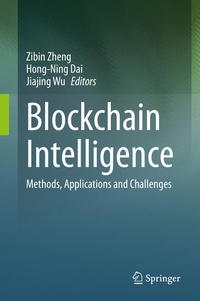
Blockchain Intelligence
Methods, Applications and Challenges
1st Edition
Published on 31. May 2021
IX, 166 pages
978-981-16-0127-9 (ISBN)
Description

This book focuses on using artificial intelligence (AI) to improve blockchain ecosystems. Gathering the latest advances resulting from AI in blockchain data analytics, it also presents big data research on blockchain systems.
Despite blockchain's merits of decentralisation, immutability, non-repudiation and traceability, the development of blockchain technology has faced a number of challenges, such as the difficulty of data analytics on encrypted blockchain data, poor scalability, software vulnerabilities, and the scarcity of appropriate incentive mechanisms. Combining AI with blockchain has the potential to overcome the limitations, and machine learning-based approaches may help to analyse blockchain data and to identify misbehaviours in blockchain. In addition, deep reinforcement learning methods can be used to improve the reliability of blockchain systems.
This book focuses in the use of AI to improve blockchain systems and promote blockchain intelligence. It describes data extraction, exploration and analytics on representative blockchain systems such as Bitcoin and Ethereum. It also includes data analytics on smart contracts, misbehaviour detection on blockchain data, and market analysis of blockchain-based cryptocurrencies. As such, this book provides researchers and practitioners alike with valuable insights into big data analysis of blockchain data, AI-enabled blockchain systems, and applications driven by blockchain intelligence.
Despite blockchain's merits of decentralisation, immutability, non-repudiation and traceability, the development of blockchain technology has faced a number of challenges, such as the difficulty of data analytics on encrypted blockchain data, poor scalability, software vulnerabilities, and the scarcity of appropriate incentive mechanisms. Combining AI with blockchain has the potential to overcome the limitations, and machine learning-based approaches may help to analyse blockchain data and to identify misbehaviours in blockchain. In addition, deep reinforcement learning methods can be used to improve the reliability of blockchain systems.
This book focuses in the use of AI to improve blockchain systems and promote blockchain intelligence. It describes data extraction, exploration and analytics on representative blockchain systems such as Bitcoin and Ethereum. It also includes data analytics on smart contracts, misbehaviour detection on blockchain data, and market analysis of blockchain-based cryptocurrencies. As such, this book provides researchers and practitioners alike with valuable insights into big data analysis of blockchain data, AI-enabled blockchain systems, and applications driven by blockchain intelligence.
More details
Other editions
Additional editions
Zibin Zheng | Hong-Ning Dai | Jiajing Wu
Blockchain Intelligence
Methods, Applications and Challenges
Book
06/2021
Springer
€160.49
Shipment within 3-4 weeks
Persons
Zibin Zheng received the Ph.D. degree from The Chinese University of Hong Kong in 2011. He is currently a Full Professor with Sun Yat-sen University, Guangzhou, China. His research interests include service computing, software engineering, and blockchain. He was a recipient of the IBM Ph.D. Fellowship Award. He received the ACM SIGSOFT Distinguished Paper Award at the ICSE 2010 and the Best Student Paper Award at the ICWS 2010. He is an IET Fellow and a senior member of IEEE.
Hong-Ning Dai received the Ph.D. degree in computer science and engineering from the Department of Computer Science and Engineering, Chinese University of Hong Kong. He is currently an Associate Professor with the Faculty of Information Technology, Macau University of Science and Technology. His research interests include blockchain, big data analytics, and Internet of Things. He also serves as associate editors/editors of IEEE Systems Journal, IEEE Access, Connection Science (Taylor& Francis), Ad hoc Networks (Elsevier), and guest editors of IEEE Transactions of Industrial Informatics and IEEE Transactions on Emerging Topics in Computing. He is a senior member of IEEE and a senior member of ACM. He was awarded with BOC Excellent Research Award of Macau University of Science and Technology in 2015.
Jiajing Wu received the Ph.D. degree from Hong Kong Polytechnic University, Hong Kong, in 2014. She was a recipient of the Hong Kong PhD Fellowship Scheme during her Ph.D. study in Hong Kong (2010--2014). In 2015, she joined the Sun Yat-sen University, Guangzhou, China, where she is currently an Associate Professor. Her research focus includes blockchain, graph mining, network science. She serves as an Associate Editor for IEEE Transactions on Circuits and Systems II: Express Briefs, and Guest Editor for Chaos and Sensors. She is IEEE senior member.
Hong-Ning Dai received the Ph.D. degree in computer science and engineering from the Department of Computer Science and Engineering, Chinese University of Hong Kong. He is currently an Associate Professor with the Faculty of Information Technology, Macau University of Science and Technology. His research interests include blockchain, big data analytics, and Internet of Things. He also serves as associate editors/editors of IEEE Systems Journal, IEEE Access, Connection Science (Taylor& Francis), Ad hoc Networks (Elsevier), and guest editors of IEEE Transactions of Industrial Informatics and IEEE Transactions on Emerging Topics in Computing. He is a senior member of IEEE and a senior member of ACM. He was awarded with BOC Excellent Research Award of Macau University of Science and Technology in 2015.
Jiajing Wu received the Ph.D. degree from Hong Kong Polytechnic University, Hong Kong, in 2014. She was a recipient of the Hong Kong PhD Fellowship Scheme during her Ph.D. study in Hong Kong (2010--2014). In 2015, she joined the Sun Yat-sen University, Guangzhou, China, where she is currently an Associate Professor. Her research focus includes blockchain, graph mining, network science. She serves as an Associate Editor for IEEE Transactions on Circuits and Systems II: Express Briefs, and Guest Editor for Chaos and Sensors. She is IEEE senior member.
Content
Chapter 1 Overview of blockchain and smart contract.- Chapter 2 On-chain and Off-Chain Blockchain Data Collection.- Chapter 3 Analysis and Mining of Blockchain Transaction Network.- Chapter 4 Intelligence Driven Optimization of Smart Contracts.- Chapter 5 Misbehavior Detection on Blockchain Data.- Chapter 6 Market Analysis of Blockchain-based Cryptocurrencies.- Chapter 7 Open research problems.
