

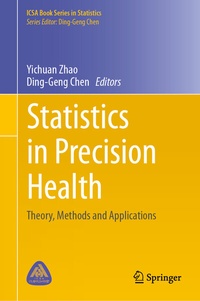
Statistics in Precision Health
Description

More details
Other editions
Additional editions
Persons
Dr. Ding-Geng Chen is a fellow of the American Statistical Association and is currently the executive director and professor in biostatistics at the College of Health Solutions, Arizona State University. He is also an extraordinary professor and the SARChI in biostatistics at the University of Pretoria, an honorary professor at the University of KwaZulu-Natal, South Africa. Dr. Chen was a professor in Biostatistics at the University of North Carolina at Chapel Hill, a professor in biostatistics at the University of Rochester Medical School, and the Karl E. Peace Endowed Eminent Scholar Chair in Biostatistics at Georgia Southern University. He is a senior biostatistics consultant for biopharmaceuticals and government agencies with extensive expertise in biostatistics, clinical trials, and public health statistics. Dr. Chen has more than 200 referred professional publications, co-authored 11 books and co-edited 24 books on clinical trial methodology, meta-analysis, data science, causal inference, and public health research. This work is partially supported by the National Research Foundation of South Africa (Grant Number 127727) and the South African National Research Foundation (NRF) and South African Medical Research Council (SAMRC) (South African DST-NRF-SAMRC SARChI Research Chair in Biostatistics, Grant Number 114613).
Content
Part I An Overview of Precision Health in the Big Data Era.- Overview of Precision Health: Past, Current, and Future.- A Selective Review of Individualized Decision Making.- Utilizing Wearable Devices to Improve Precision in Physical Activity Epidemiology: Sensors, Data and Analytic Methods.- Policy Learning for Individualized Treatment Regimes on Infinite Time Horizon.- Q-Learning Based Methods for Dynamic Treatment Regimes.- Personalized Medicine with Multiple Treatments.- Statistical Reinforcement Learning and Dynamic Treatment Regimes.- Part II New Advances in Statistical Methods of Precision Medicine and the Applications.- Integrative Learning to Combine Individualized Treatment Rules from Multiple Randomized Trials.- Adaptive Semi-supervised Learning for Optimal Treatment Regime Estimation with Application to EMR Data.- Estimation and Inference for Individualized Treatment Rules Using Efficient Augmentation and Relaxation Learning.- Subgroup Analysis Using Doubly Robust Semiparametric Procedures.- A Selective Overview of Fusion Penalized Learning in Latent Subgroup Analysis for Precision Medicine.- Part III Precision Medicine in Clinic Trials and the applications to EHR Data.- Mining for Health: A Comparison of Word Embedding Methods for Analysis of EHRs Data.- Adaptive Designs for Precision Medicine in Clinical Trials: A Review and Some Innovative Designs.- Maximum Likelihood Estimation and Design and Inference Considerations for Sequential Multiple Assignment Randomized Trials.- Precision Medicine Designs for Cancer Clinical Trials.- Part IV Precision Medicine in Survival Analysis and Genomic Studies.- Variant Selection and Aggregation of Genetic Association Studies in Precision Medicine.- Leveraging Functional Annotations Improves Cross-population Genetic Risk Prediction.- A Soft-Thresholding Operator for Sparse Time-Varying Effects in Survival Models.- Discovery of Gene-specific Time Effects on Survival.- Modeling and Optimizing Dynamic Treatment Regimens in Continuous Time.
