

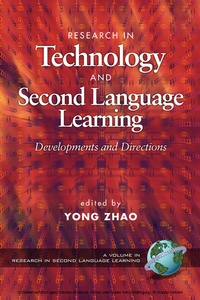
Research in Technology and Second Language Learning
Developments and Directions
1st Edition
Published on 1. April 2005
473 pages
978-1-60752-500-4 (ISBN)
Description

This book is divided into five parts. Part I includes three previously published articles and one specifically written for this book. Two of the three previously published articles are reviews of the literature from different perspectives and employ different review methodology. And the other one is a theoretical article discussing research paradigms and methods for CALL. The one written for this book discusses scientific research in general. The goal of Part I is to give an overview of research and development issues in the field of using technology to improve language education. Part II through Part V are organized according to the ways technology can be used to enhance language learning, each with an introductory chapter that elaborates the theoretical foundations and relevant second language acquisition (SLA) literature that support the technology uses included in the respective part. Specifically, Part II includes five studies that examined the effectiveness of using...
All prices
More details
Other editions
Additional editions
Book
04/2005
Information Age Publishing
€126.40
Article not available at the moment
Content
- Intro
- Cover
- Contents
- Part 1 Overview
- Chapter 1. Guiding Principles for Scientific Inquiry and Implications for Research on Technology and Language Education Yong Zhao
- Chapter 2. Recent Developments in Technology and Language Learning: A Literature Review and Meta-analysis CALICO Journal
- Chapter 3. CALL in the Year 2000: Still in Search of Research Paradigms? Carol Chapelle
- Chapter 4. The Use of Technology for Second Language Learning and Teaching: A Retrospective M. Rafael Salaberry
- Part 2 Enhancing Input Through Technology
- Chapter Introduction: The Importance of Input and the Potential of Technology for Enhancing Input
- Chapter 5. Research on Text Comprehension in Multimedia Environments Dorothy M. Chun and Jan L. Plass
- Chapter 6. The Effect of Multimedia Annotation Modes on L2 Vocabulary Acquisition: A Comparative Study Khalid Al-Seghayer
- Chapter 7. The Effects of Listeners' Control of Speech Rate on Second Language Comprehension Yong Zhao
- Chapter 8. Using Instructional Video to Teach Culture to Beginning Foreign Language Students Carol Herron, Steven P. Cole, Cathleen Corrie, and Sebastien Dubreil
- Chapter 9. Leveling the Playing Field: A Study of Captioned Interactive Video for Second Language Learning Peter Shea
- Part 3 Engaging Learners in Communicative Practices through Technology
- Chapter 10. Virtual Dialogues with Native Speakers: The Evaluation of an Interactive Multimedia Method William G. Harless, Marcia A. Zier, and Robert C. Duncan
- Chapter 11. The Non-neutrality of Technology: A Theoretical Analysis and Empirical Study of Computer Mediated Communication Technologies Yong Zhao, María José Alvarez-Torres, Bryan Smith, and Hueyshan Sophia Tan
- Chapter 12. Preliminary Tests of Language Learning in a Speech-Interactive Graphics Micro-world V. Melissa Holland, Jonathan D. Kaplan, and Mark A. Sabol
- Part 4 Providing Feedback through Technology
- Chapter 13. The Use of Speech Recognition Software as an English Language Oral Assessment Instrument: An Exploratory Study David Coniam
- Chapter 14. Exploiting the Potential of a Computer-based Grammar Checker in Conjunction with Self-Monitoring Strategies with Advanced Level Students of French Jack Burston
- Chapter 15. Explicit Pronunciation Training Using Automatic Speech Recognition Technology Jonathan Dalby and Diane Kewley-Port
- Part 5 Creating a Language Education Environment with Technology
- Chapter 16. Using the Web in Elementary French and German Courses: Quantitative and Qualitative Study Results Anne Green and Bonnie Earnest Youngs
- Chapter 17. The Future of Research in Technology and Second Language Education: Challenges and Possibilities Yong Zhao

