

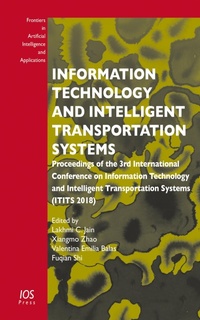
Information Technology and Intelligent Transportation Systems
Proceedings of the 3rd International Conference on Information Technology and Intelligent Transportation Systems (ITITS 2018) Xi'an, China, September 15-16, 2018
1st Edition
Published on 15. January 2019
396 pages
978-1-61499-939-3 (ISBN)
Description

Intelligent Transportation Systems (ITS) are the model for integrating advanced information technology, data communication transmission technology, electronic sensing technology, control technology and computer technology into a comprehensive ground traffic management system. They are the direction of development for future transportation systems.
This book presents the proceedings of the 3rd International Conference on Information Technology and Intelligent Transportation Systems (ITITS 2018), held in Xi'an, China, on 15-16 September 2018. The conference provides a platform for professionals and researchers from industry and academia to present and discuss recent advances in the field of information technology and intelligent transportation systems. Intelligent transport systems vary in the technologies they apply, from basic management systems to more application-based systems. Information technology - including wireless communication, computational technologies, floating car data/floating cellular data, sensor technologies, and video vehicle detection - is also intrinsic to intelligent transportation systems. All papers were reviewed by 3-4 referees, and the program chairs of the conference committee made their selections based on the score of each paper. This year, ITITS 2018 received more than 168 papers from 4 countries, of which 41 papers were accepted.
Offering a state-of-the-art overview of the theoretical and applied topics related to ITS, this book will be of interest to all those working in the field.
This book presents the proceedings of the 3rd International Conference on Information Technology and Intelligent Transportation Systems (ITITS 2018), held in Xi'an, China, on 15-16 September 2018. The conference provides a platform for professionals and researchers from industry and academia to present and discuss recent advances in the field of information technology and intelligent transportation systems. Intelligent transport systems vary in the technologies they apply, from basic management systems to more application-based systems. Information technology - including wireless communication, computational technologies, floating car data/floating cellular data, sensor technologies, and video vehicle detection - is also intrinsic to intelligent transportation systems. All papers were reviewed by 3-4 referees, and the program chairs of the conference committee made their selections based on the score of each paper. This year, ITITS 2018 received more than 168 papers from 4 countries, of which 41 papers were accepted.
Offering a state-of-the-art overview of the theoretical and applied topics related to ITS, this book will be of interest to all those working in the field.
More details
Series
Language
English
Place of publication
London
Netherlands
Publishing group
IOS Press
Target group
Professional and scholarly
File size
16,22 MB
ISBN-13
978-1-61499-939-3 (9781614999393)
Copyright in bibliographic data and cover images is held by Nielsen Book Services Limited or by the publishers or by their respective licensors: all rights reserved.
Schweitzer Classification
Other editions
Additional editions

Xiangmo Zhao | Valentina Emilia Balas
Information Technology and Intelligent Transportation Systems
Proceedings of the 3rd International Conference on Information Technology and Intelligent Transportation Systems (ITITS 2018) Xi'an, China, September 15-16, 2018
Book
01/2019
1st Edition
IOS Press,US
€155.99
Article exhausted; check different version
Content
- Intro
- Title Page
- Preface
- Editors Bios
- Contents
- A Hybrid Correction Method of English Grammar Error for Chinese Learners' Essays
- Parking Surveillance Based on Magnetic Feature and Collaborative Mechanism
- Optimization of AMT Gear Shift Strategy for Pure Electric Bus Based on a Fixed City-Bus Route
- Direct Yaw Moment Control for Four-in-Wheel-Motor-Driven Electric Vehicle
- Evaluation of the Correlation Between Ports and Rear Area Logistics Parks Based on Decision Tree Learning
- Information on SCIE Article Output on Transportation Engineering from China
- Structural Failure Prediction in Multi Storied Reinforced Concrete Buildings Using Cuckoo Search Optimization Combined with Neural Network
- Vehicle Estimation Using Floating Car Trajectory Data at Signalized Intersection
- Research on Fast and Slow Trains Operation Plan with a Target of Minimizing Total Passenger Travel Time
- Vehicle Parameters Estimation Under Braking and Steering Condition Based on EKF Observer
- Modeling and Optimizing of Traffic Signal Control Based on Timed Colored Petri Nets
- Passenger Traffic Volume Prediction with LSTM Neural Network
- Hybrid DWT-FFT Features for Detecting Freezing of Gait in Parkinson's Disease
- Combination of Total Variation and Robust Bilateral Filter in Image Denoising
- Image Denoising Using Wavelet Transform
- Linear Stability Analysis of a Cooperative Adaptive Cruise Control System Based on Intelligent Driver Model
- The Research on Charge and Discharge Characteristics with Single Li-NiCoMn Lithium-Ion Battery
- Self-Check Design for Embryonic Electronic Cell
- Study on the Dependency of SHM Sensors' Online Calibration on Excitation Sources
- Effect of Green Purchasing, Green Logistics, and Ecological Design on Organizational Performance: A Path Analysis Using Structural Equation Modeling
- Dust Particle Recognition Using ROF Model and Feature Information
- Design of Application System Based on Commercial Enterprise WeChat Public Platform
- A Sentence Level Corrected LDA Topic Model for Chinese English Learners
- Speech Emotion Recognition Based on Back Propagation Neural Network
- Level Set Segmentation Methods for fMRI Dataset of Brain
- Non-Nested Generalisation (NNGE) Algorithm for Efficient and Early Detection of Diabetes
- Study on Traffic Survey in Urban Traffic Planning
- Expressway Traffic Volume Prediction Using Floating Car Trajectory Data
- Leukocyte Nuclei Segmentation Using Entropy Function and Chan-Vese Approach
- Rough-KNN Noise-Filtered Convolutional Neural Network for Image Classification
- Bat Algorithm Optimized Controller for Automatic Generation Control of Interconnected Thermal Power System
- Research on Speed Guidance Srategy of Traffic Platoon Based on "Time Block
- Prediction of Passenger Traffic Volume Sharing Rate Based on Logit Model
- Chinese Railways Development Level Research Based on Entropy TOPSIS
- Key Zone Auto Location of Plantar Pressure Image Using De-Dimensionality and Wavelet Transformation
- Research on the Management Evaluation of the Enterprises Directly Affiliated to a State-Owned Enterprise Group Based on DEA
- Traffic Accident Data Mining Based on Association Rules Theory
- A Dynamic Non-Interference Trust Chain Model Based on Security Process Algebra
- Game Analysis of New Rural Financial Institutions and Traditional Rural Financial Institutions Based on the Perspective of Fairness Mechanism
- Region Based Extraction of Plantar Pressure Images with R-CNN and Fast R-CNN
- Study on the Traffic Impact Assessment of Large-Scale Stadiums and Gymnasiums - From the Perspective of Meta-Analysis Theory
- Subject Index
- Author Index
